
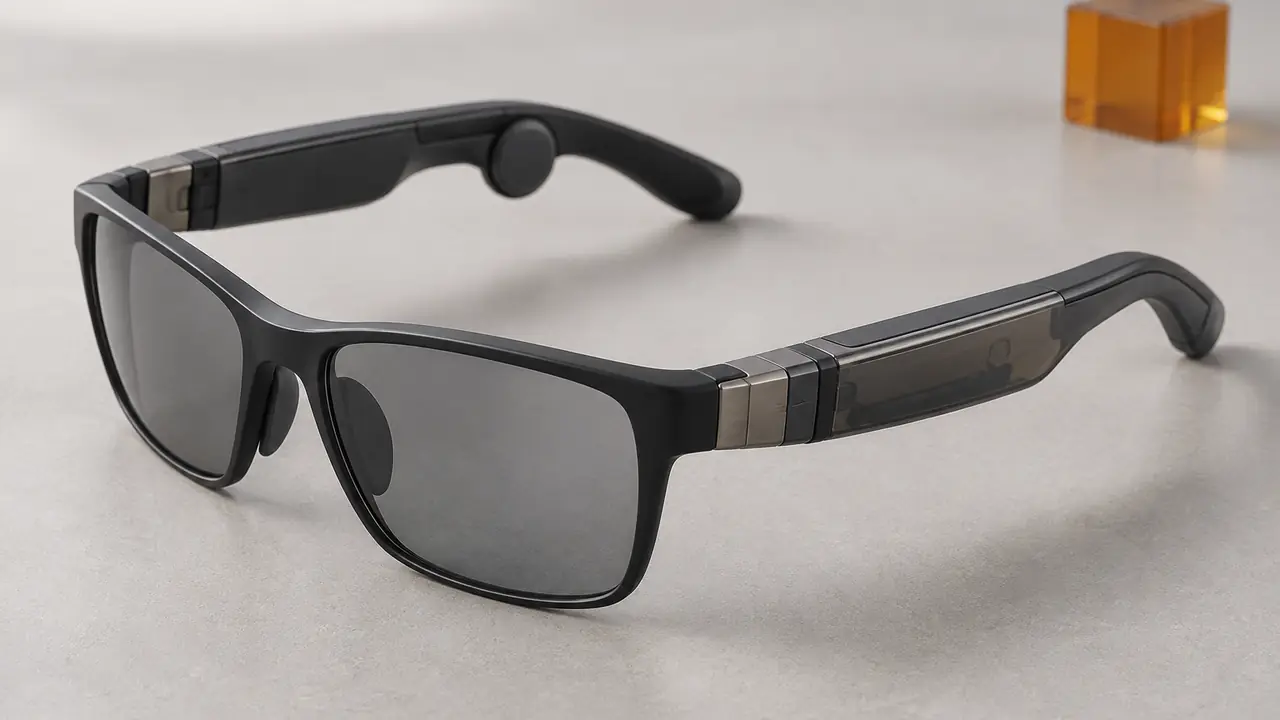
How bone conduction glasses work
Bone conduction glasses replace the temple speaker with a transducer: a small electromagnetic driver that vibrates against the head instead of pushing sound through the air. The vibration travels through the skull to the inner ear, so the ear canal and the outer ear stay completely free. That is the reason sports and outdoor buyers ask for the format - a cyclist or runner keeps full awareness of traffic, and nothing sits in or over the ear during long sessions in heat and sweat.
The physics brings a different set of trade-offs from a speaker. A transducer only works when it touches the head, so the frame becomes part of the acoustic system. Where the transducer sits, how firmly the temple holds it there and how the pad is shaped decide how loud the glasses are and how much low end the wearer perceives. A speaker-based open-ear model can be tuned on a test head in isolation; a bone conduction model has to be tuned together with its frame.
Transducer position and contact pressure
Across the category, the transducer is placed in one of two areas: on the temple, just in front of the ear, or lower towards the cheekbone, near the zygomatic arch. The temple position is easier to package in a straight arm and keeps the frame closer to a normal eyewear look. The cheekbone position usually gives a more stable contact point on a wider range of head shapes but needs a temple with a downward curve or a wrap design.
Contact pressure is the second variable. Too little pressure and the bass disappears and volume drops; too much and the frame becomes uncomfortable within an hour. Pressure comes from the hinge spring, the temple material and the frame width relative to the head. That is why frame sizing matters more on this line than on any other audio model, and why the desk asks for fit samples in more than one size when the target market spans different head widths. The general sizing logic is in the lens and frame fit guide.
Bone conduction or open-ear: the trade-off
Most brands considering this line are really choosing between bone conduction and open-ear. The table sets out the differences buyers usually weigh. It describes typical behaviour across the category, not a measured comparison of specific models.
| Factor | Bone conduction | Open-ear |
|---|---|---|
| Sound path | Vibration through the head | Air from a directional port |
| Ear area | Completely free | Free, speaker near the ear |
| Bass and volume | Depend on contact pressure and fit | Depend on chamber and port design |
| Sound leakage | Housing vibration can be audible nearby; verify per acoustic test | Controlled by chamber and reverse-phase vent |
| Weight and frame | Usually heavier, often wrap fronts | Closer to everyday eyewear |
| Water resistance | IPX4-IP55 per test | IPX4-IP54 per test |
| Strongest use | Cycling, running, outdoor sport | Commuting, office, music-first |
Many sports ranges carry both: a bone conduction model for riders who want the ear entirely free and an open-ear model for buyers who prioritise sound and a lighter frame. The longer comparison is in bone conduction vs open-ear glasses, and the open-ear line is on open-ear audio glasses.
Frames, lenses and the sports brief
Because the line sells mostly to active users, the brief usually looks like a sports eyewear brief with audio added: a TR90 or PC wrap front, polarized or photochromic lenses, non-slip nose pads and temple sleeves. Lens options follow ISO 12312-1 in Europe and ANSI Z80.3 in North America, with the FDA drop-ball impact test under 21 CFR 801.410 for the US market. Water resistance is stated as an IPX4 to IP55 rating tested per IEC 60529, covering sweat and rain rather than immersion. For a full sports specification, see sports smart glasses and audio glasses for cycling and running.
Tests and program path
The radio, battery and optical documents are the same as for the rest of the family: FCC Part 15.247 and Part 15 Subpart B, CE RED 2014/53/EU with EN 18031, Bluetooth SIG listing, a UN 38.3 summary and IEC 62133-2 for the cells. The order test plan adds items specific to this line: transducer output at set contact pressures, a wear trial on more than one head size, hinge spring cycling, sweat soak on the transducer pad and charging contacts, and spray to the stated IP rating.
Catalog and logo programs take 5-10 or 10-15 working days for samples and 20-35 days for batch production. A new transducer layout or frame is full OEM work, typically from 3,000 pairs per model, with a 30-60 day engineering sample and 45-75 days in batch. All figures are typical reference ranges, confirmed in writing for each program on MOQ and lead time; to start, use the quote form.