
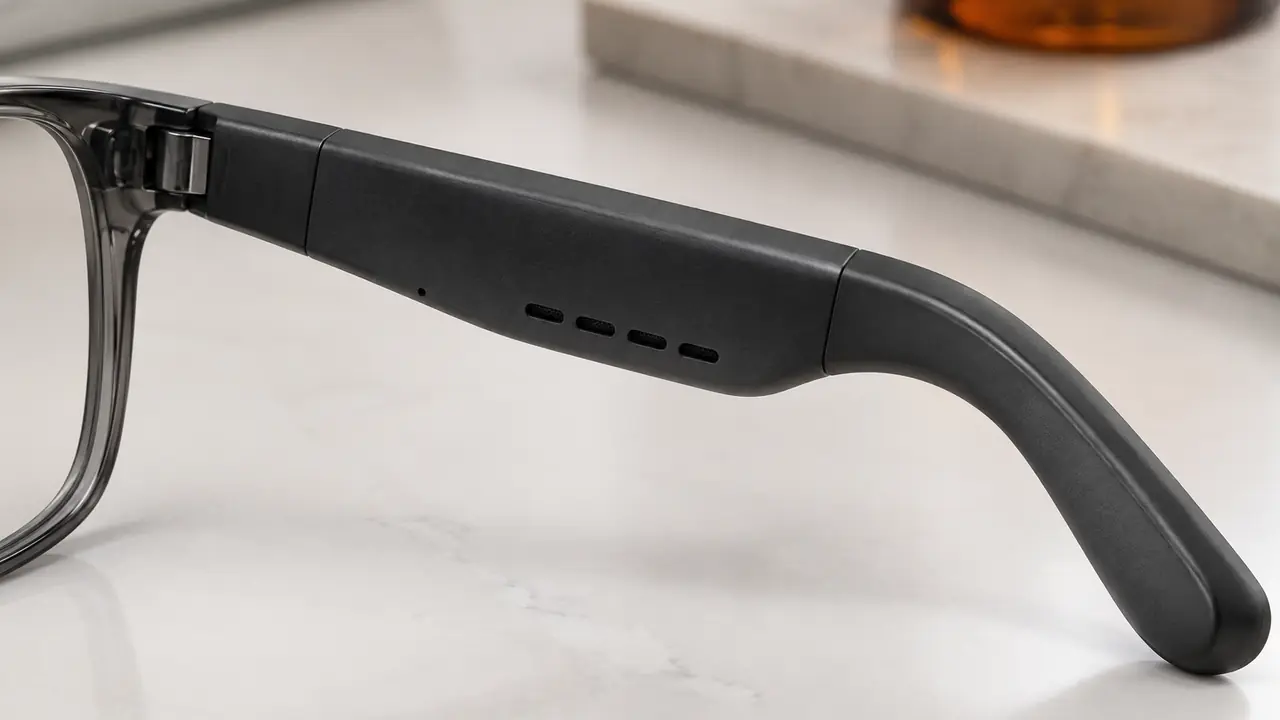
Two ways to keep the ear open
Customers often group every pair of audio glasses with no earbud into one bucket. Engineers do not. An open-ear pair uses a small air-conduction speaker in the temple that fires sound through the air towards the ear canal. A bone conduction pair uses a vibrating transducer pressed against the head - usually near the temple bone or the cheekbone just in front of the ear - so that vibration travels through the skull to the inner ear while the ear canal stays completely free. Both leave the wearer aware of their surroundings, which is why both are popular for commuting and outdoor sport, but the way they produce sound changes almost every other line on the spec sheet.
For a buyer, the choice is less about which technology is better and more about which set of compromises your customers will accept. A range planned for office calls lands in a different place from one planned for trail running, and a frame designed for fashion retail lands somewhere else again.
How each transducer behaves
An open-ear speaker behaves like a tiny loudspeaker. Its output and low-frequency response depend on the driver, the chamber behind it and the port layout, and its main weakness is leak: whatever reaches the wearer also radiates into the room, partly controlled by rear-port cancellation per acoustic test. The full design picture is in open-ear speaker design.
A bone conduction transducer behaves more like a small shaker. It needs firm, steady contact with the head to transfer energy. Low-frequency output and perceived volume depend strongly on contact pressure, so the frame has to clamp a little more than an ordinary pair and the transducer pad has to sit in the right place. When the contact loosens - during a run, or on a smaller head - the sound gets thinner. At high levels the vibration can also be felt as a tickle on the skin, and the housing radiates some airborne sound of its own, so bone conduction is not free of leak either.
Side-by-side comparison
| Factor | Open-ear (air conduction) | Bone conduction |
|---|---|---|
| Sound path | Speaker in temple fires through air to the ear | Transducer vibrates against temple or cheekbone area |
| Ear canal | Open, nothing touches the ear | Open, pad touches the skin in front of the ear |
| Low frequencies | Limited by chamber volume and port layout | Varies with contact pressure and pad position |
| Sound leak | Main trade-off; controlled by port design per test | Usually lower at moderate volume; housing still radiates some sound |
| Weight | Typical pairs about 27 to 50 g across the category | Usually heavier than open-ear for a similar frame |
| Comfort | Light clamp, similar to ordinary eyewear | Firmer clamp needed; some wearers notice vibration |
| Water resistance | Typically IPX4 to IP54 per test report | Typically IPX4 to IP55 per test report |
| Typical use | Commuting, office calls, daily wear | Running, cycling, outdoor sport |
Water resistance figures in the table are ratings seen across the category, tested per IEC 60529 on the unit as built. Neither format should be marketed as anything stronger than water-resistant per its IPX rating.
Comfort and fit decide returns
In practice, fit drives more returns than sound quality. Open-ear pairs are sensitive to temple length and frame width, because those move the port relative to the ear; a pair that sounds full on one head can sound distant on another. Bone conduction pairs are sensitive to clamp force and pad position; too little and the sound fades, too much and the pair becomes uncomfortable within an hour. Both formats need the frame size to match the target customers. Across the category, common frame sizes are 48 to 56 mm lens width, 16 to 20 mm bridge and 140 to 150 mm temple length, and a range that offers two front sizes usually sees fewer fit complaints than a one-size range. The sizing logic is covered in the lens and frame fit guide.
Points to check on samples
- Sound at the same volume step on small, medium and large heads or fixtures.
- For bone conduction, sound stability while walking and jogging, and skin feel after an hour.
- For open-ear, leak at an agreed distance in a quiet room.
- Hinge feel and temple flex, because both formats run a flex circuit through the hinge.
- Call quality in wind, which depends on the microphone design rather than the speaker type.
What stays the same across both formats
Much of the temple is shared. Both formats use the same class of Bluetooth audio SoC, typically Bluetooth 5.2 to 5.4 with 5.3 the most common, the same small lithium-ion cells - about 85 to 235 mAh in total across the category - and the same magnetic charging contacts. Music playback typically runs 4 to 13 hours and calls 3 to 9 hours, per spec sheet and depending on volume. Microphones, touch controls, multipoint pairing and the companion app are chosen independently of the transducer, so a buyer can often keep the same firmware feature set and app white-label across an open-ear model and a bone conduction model. That makes a two-format range easier to support: one app, one set of listing content for controls and pairing, and one after-sales script, with only the fit and sound sections differing between the two models.
Which one to stock
For a general retail or marketplace range, open-ear is usually the default: it looks closer to ordinary eyewear, weighs less, accepts Rx-ready fronts and tinted lenses easily and covers commuting and calls well. Bone conduction suits a sports-led range where the customer already accepts a wrap frame and a firmer fit, and where steady sound during movement matters more than slim styling. Many brands start with one open-ear catalog model and add a bone conduction sports model once return data shows what their customers value. The audio glasses buying guide maps both formats against buyer types.
Both formats source from the same temple-electronics base in Shenzhen, with frames from the Henggang and Ouhai eyewear clusters and lenses from Danyang or Xiamen. Typical starting quantities are 50 to 500 pairs per catalog model, 500 to 1,000 pairs for a logo program and from 3,000 pairs for full custom tooling, confirmed in writing per program on MOQ and lead time. Send the use case and frame style through the quote form and the desk will shortlist toolings in each format for side-by-side sampling.