
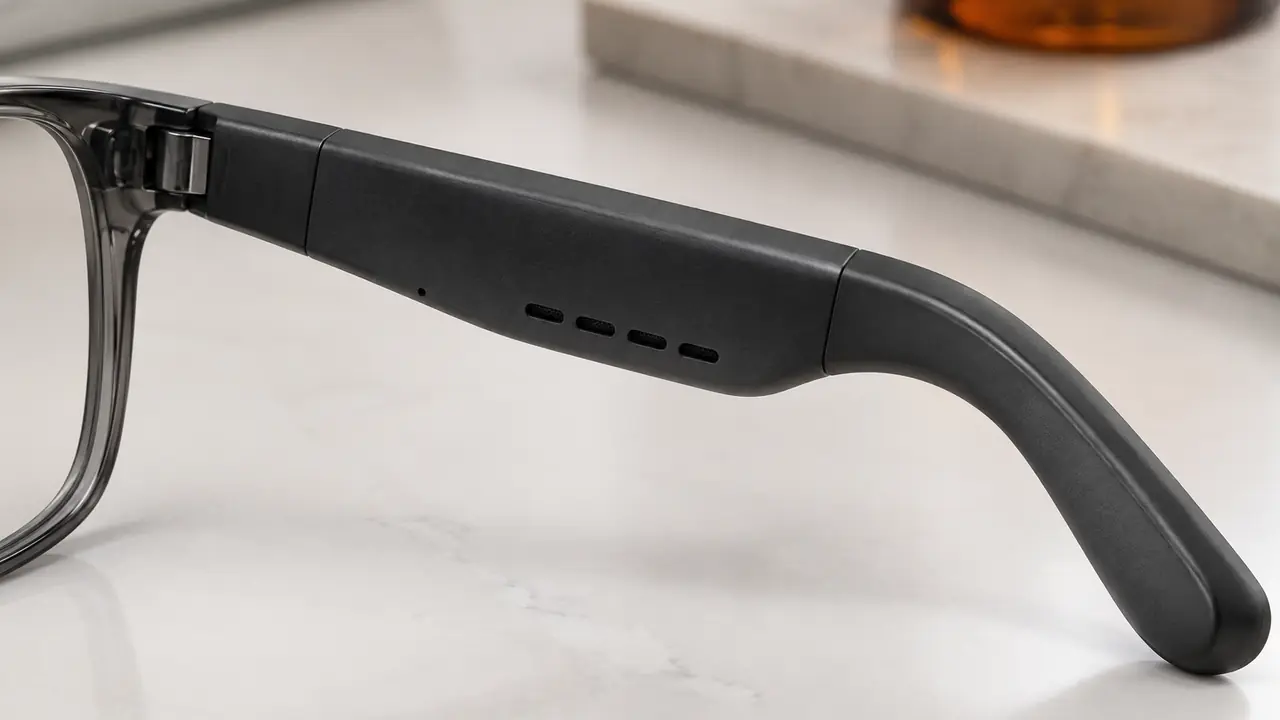
Why calls are harder on glasses
A wired headset puts a microphone a few centimetres from the mouth. Glasses cannot. The nearest point on a temple is several centimetres behind and above the corner of the mouth, and the temple faces sideways rather than towards the voice. The microphone therefore hears the wearer only slightly louder than it hears the room, the traffic or the wind, and the open-ear speaker a few centimetres away adds the far-end voice back into the same space. Good call glasses solve this with several microphones and signal processing; poor ones solve it by turning up gain, which makes everything louder including the noise.
Across the category, audio glasses use dual or quad microphone ENC for calls, with noise reduction running on the Bluetooth audio SoC per firmware. Business call models add multi-mic arrays with ENC or AI-based noise reduction, also per firmware. The difference between a good and a poor result is mostly in placement, acoustic sealing and tuning rather than in microphone count alone.
Placement and count
Each microphone needs a small acoustic port in the temple shell, a sealed path from the port to the microphone, and a mesh to keep out sweat and dust. Typical arrangements are one or two microphones per temple near the hinge end, aimed forward and down towards the mouth. When two microphones on the same temple sit along a line pointing at the mouth, the processing can compare their timing and level to separate the voice from sound arriving from other directions. Microphones on both temples add a wider baseline and some redundancy.
| Arrangement | What it allows | Typical fit |
|---|---|---|
| Single mic per pair | Basic pickup, simple noise suppression | Entry audio models, light call use |
| Dual mic, one temple | Two-mic beamforming along the temple | Mainstream audio glasses |
| Dual mic, both temples | Wider pickup, some redundancy | Daily wear with moderate calls |
| Quad mic, two per temple | Beamforming on each side plus cross-temple processing | Business call and translation models |
More microphones are not automatically better. Each one adds a port that must be sealed and kept clear, a part that can fail, and data the SoC must process, which draws battery. A well-placed, well-sealed dual-mic design can outperform a poorly tuned quad-mic design.
ENC and beamforming in plain terms
Beamforming combines signals from two or more microphones so that sound from the direction of the mouth adds up and sound from other directions partly cancels. It works best when the microphone spacing and the angle to the mouth are known and stable, which is why frame fit matters for calls. ENC, environmental noise cancellation, is a broader term for the processing that suppresses steady and changing background noise in the outgoing call signal after the beam is formed. Some plants describe newer algorithms as AI noise reduction; on a spec sheet that should simply mean a trained noise suppression model running per firmware, and its effect should be judged on samples rather than on the label.
Two further blocks matter. Echo cancellation removes the far-end voice that leaks from the open-ear speaker back into the microphones; without it, the other party hears themselves. Wind handling detects the low-frequency rumble of wind across the ports and reduces it, often by switching microphones or filtering. These are distinct from ANC, active noise cancellation for listening, which open-ear glasses do not offer in the earbud sense because the ear is not sealed.
Testing call quality on samples
Call quality claims are easy to write and hard to compare. The desk asks partner plants to run the same script on every candidate sample so the results can be compared side by side.
- Quiet room. Record a short scripted call from the wearer's side at normal speaking level.
- Office noise. Repeat with recorded background chatter played at a fixed level.
- Street noise. Repeat with traffic noise, then outdoors on a real street.
- Wind. Repeat walking outdoors or with a fan at a set distance and angle.
- Echo. Check the far-end recording for the far party's own voice at high speaker volume.
- Platforms. Repeat on the phone network and on the meeting software your customers use, verified per program.
Microphone noise reduction is also one of the items in a standard test plan, listed on testing and inspection. For batch production, a simple microphone sensitivity and seal check on each lot catches blocked or poorly sealed ports, which are the most common cause of a sudden drop in call quality. Troubleshooting is covered in call quality problems on glasses.
Production risks that degrade calls
Most call complaints that appear after launch are not algorithm problems. They come from the physical path between the port and the microphone, and they show up as a lot that sounds worse than the golden sample. The usual culprits are worth naming on the inspection checklist.
- Glue or coating in the port. Adhesive or paint that partly covers a microphone port reduces sensitivity on one channel and confuses the beamformer.
- Gasket leaks. If the seal between port and microphone leaks, the microphone hears sound from inside the temple, including speaker vibration, which weakens echo cancellation.
- Mesh changes. A substitute mesh with different resistance shifts the frequency response of one microphone relative to the other.
- Sweat and residue. In daily use, sweat and skin oil clog ports over time; port position and mesh choice decide how quickly.
- Firmware mismatch. A lot flashed with an older tuning file can lose wind handling or noise reduction settings agreed on the sample.
Each of these can be checked quickly with a per-lot microphone sensitivity test and a firmware version check, which is why both belong on the pre-shipment checklist rather than only in engineering validation.
Specifying the array
A microphone section on the spec sheet should state microphone count and position per temple, port mesh, the noise reduction and echo cancellation features per firmware, wind handling, and the call test script and conditions. For business ranges, add multipoint pairing and the meeting software to be verified. Typical starting quantities are 50 to 500 pairs per catalog model and 500 to 1,000 pairs for a logo program; a new microphone layout means new temple tooling and is a full custom program from about 3,000 pairs. These are reference ranges confirmed in writing per program on MOQ and lead time. Use the quote form to describe the call environments your customers work in, and the desk will shortlist toolings to test against that script.