
What retailers find hard about smart glasses
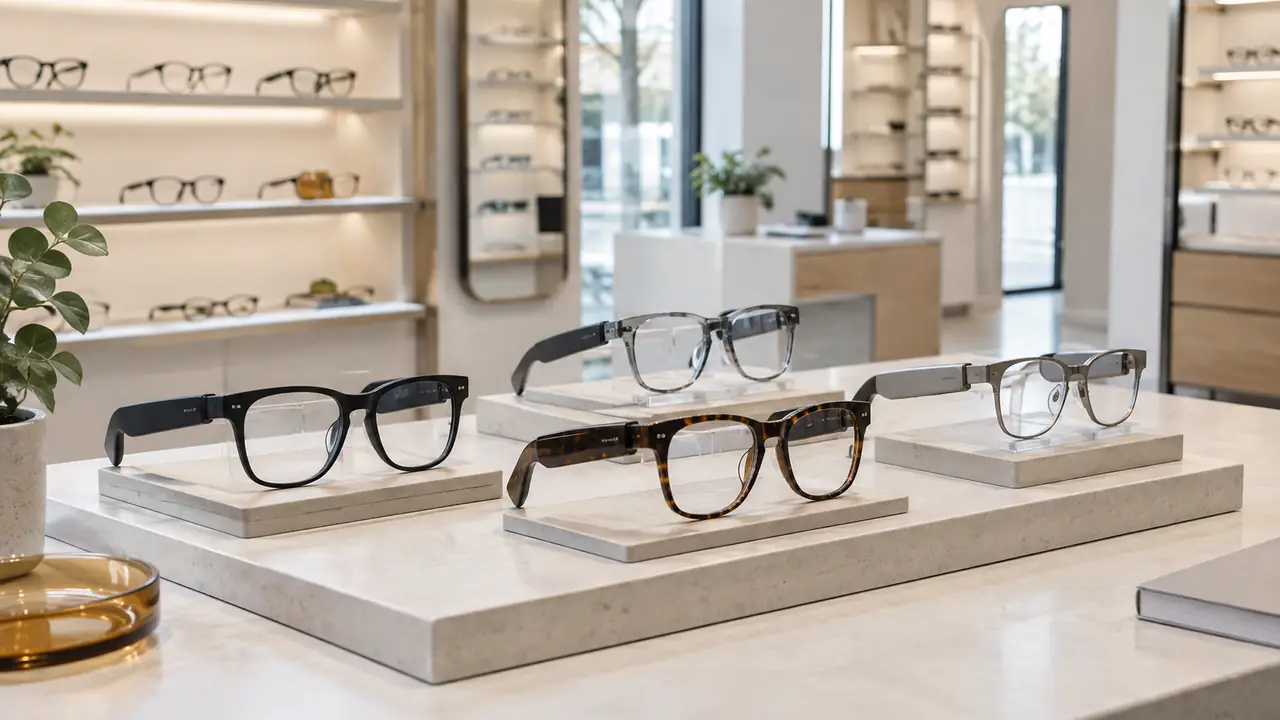
Retailers meet the product where online sellers never do: on a customer's face, in a shop, with a staff member who has a few minutes. Four problems come up. Try-on: customers want to feel weight and fit and hear the sound, but a powered sample on an open shelf gets drained, lost or damaged. Display: smart glasses look like ordinary frames, so without a stand and clear signage the technology is invisible. Packaging and codes: store systems need barcodes, consistent SKUs and boxes that fit the shelf and hang on pegs where required. Staff knowledge: if staff cannot explain pairing, charging and water resistance in plain words, returns rise and the counter loses confidence.
Recommended lines and why
- Prescription-ready frames: they fit the optical store workflow, where lenses are cut and fitted in-store or by a partner lab. Typical fronts are 48-56 mm lens width, 16-20 mm bridge and 140-150 mm temples, so stores can stock two or three sizes.
- Photochromic glasses: an easy story at the counter, one pair for indoors and outdoors, with lens behaviour stated per lens spec and labelling to ISO 12312-1.
- Kids smart glasses: light TR90 or silicone frames, usually under 30 g per model, UV400 lenses, optional blue-light filtering lenses with no health claim, a volume limit and screen-time reminders in the app per firmware. In the US they are children's products under CPSIA and need a CPC.
Display kit and packaging
The desk specifies the display kit with the product, because the two are designed around each other. Typical elements are shown below; quantities and finishes are confirmed per program with the packaging and display partners.
| Element | Typical options | Why it matters |
|---|---|---|
| Try-on stand | Counter stand with 3-6 positions, security tethers, mirror | Customers feel fit and weight without opening boxes |
| Powered sample | One charged sample per model on a charging dock | Sound can be heard without draining stock units |
| Signage | Feature card per model: playback per spec sheet, water resistance per IPX rating | Staff and customers see the same facts |
| Retail box | Shelf or peg box, barcode, model and size on the end panel | Fits store systems and shelf layouts |
| Inner kit | Pouch, magnetic cable, quick start card, size card | Fewer support questions after purchase |
Box and display options are on packaging and retail boxes; display ideas are in smart glasses retail display.
Staff training material
A short staff guide is part of every retail program. It is written in plain language and covers what customers actually ask:
- How the glasses work: speakers in the temples, a battery in each arm, a phone connection over Bluetooth.
- Pairing, reconnection and resetting, in three steps with pictures of the touch area.
- Charging: how the magnetic contacts seat and how long a full charge takes, typically 1-2 h.
- Water: water-resistant per IPX4 or IP54 rating tested per IEC 60529, for sweat and splashes, not for swimming.
- Lenses: what UV400 means, what Cat. 4 lenses mean for driving, and how prescription lenses are fitted.
- Kids models: what the app controls do, and what the product does not claim.
Documents, inspection and delivery
Retail buyers usually ask for the full compliance file before listing a product: FCC Part 15 and CE under RED with EN 18031, Bluetooth SIG, UN 38.3 and IEC 62133-2, lens reports to ISO 12312-1 or ANSI Z80.3 and the 21 CFR 801.410 drop-ball test, RoHS and REACH declarations, and for kids models the CPSIA file with the CPC and lead and phthalate results. Certificates are held by partner plants or test labs and verified per project. Pre-shipment inspection adds retail checks: barcode scan, box print and colour, insert fit, peg hole position and carton labels matching the store's receiving rules. The broader file is listed on compliance and certifications.
Illustrative case: an optical chain adds audio frames
This is an illustrative, anonymous example. A regional optical chain wanted to test smart frames in a handful of stores. The desk proposed an Rx-ready audio front in two sizes and a photochromic sun version, run as a logo program with peg-free shelf boxes and barcodes in the chain's format. Each store received a three-position try-on stand with a powered sample on a dock and a two-page staff guide. Lens fitting stayed with the chain's own labs. After the first quarter the chain added a third size, based on the fit notes staff logged at the counter. To plan a retail program, send the brief through the quote form.