
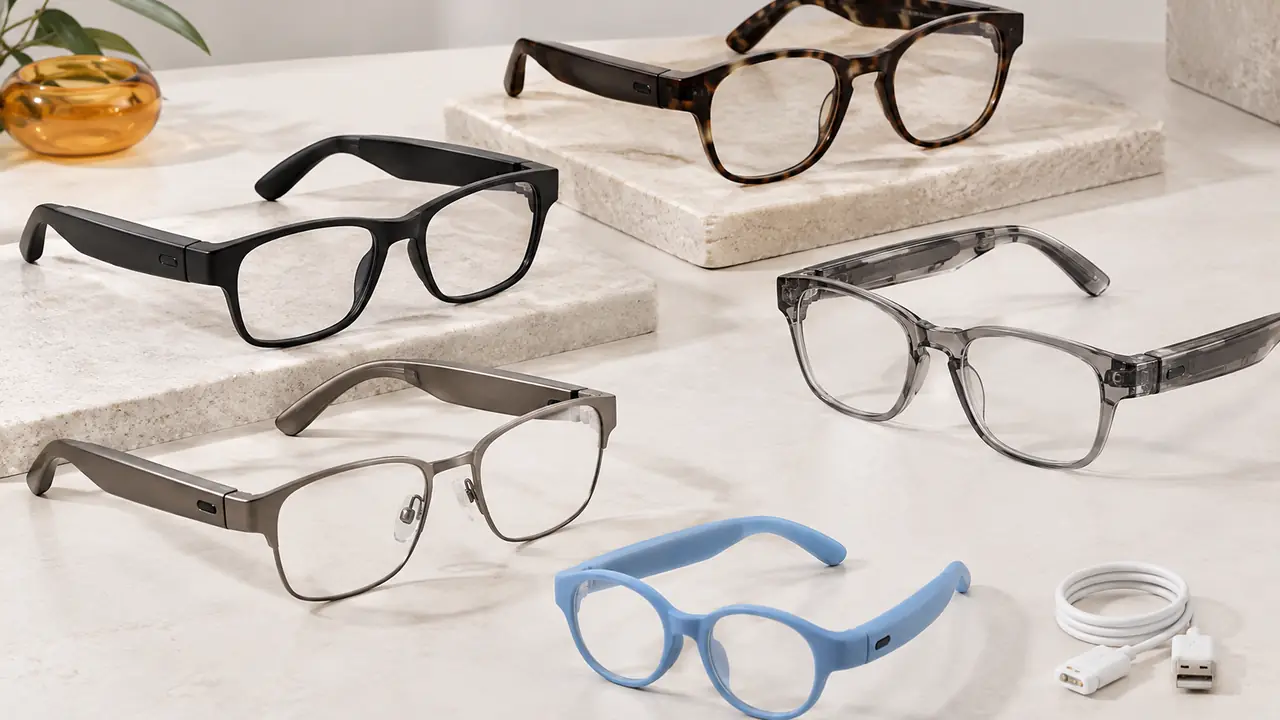
What changes when the wearer is a child
A kids smart glasses model starts from the same idea as an adult audio frame - a Bluetooth audio SoC, small cells, an open-ear speaker and a simple control in each temple - but almost every part is resized and re-specified. Fronts are smaller and the temples shorter, so frame sizes are set per model rather than taken from the adult range. Materials move to soft TR90 nylon or silicone that bends without snapping, and hinges are flexible or spring-loaded so the frame survives being pulled off with one hand. Across the category, kids models usually weigh under 30 grams per pair, per model, which leaves less room for cells and makes runtime targets more modest than on adult frames.
The bigger shift is in how the product is described and documented. Parents ask what a pair does for their child's eyes, and the honest answer is a list of structural facts rather than a promise. Kids products also carry their own legal route in most markets, and the app may touch children's data. The line therefore needs a tighter brief, more test lab time and more careful copy than any other in the range. A side-by-side view is in kids smart glasses vs adult models.
Lens and comfort features, stated as facts
The table lists what a kids model can carry and how each item should be worded on the box, the listing and the spec sheet.
| Feature | What it is | How to describe it |
|---|---|---|
| UV400 lenses | Lenses that block ultraviolet light up to 400 nm, tested per lens spec | UV400 lenses, per lens test report |
| Blue-light filtering lens | Optional lens with a coating or tint that filters part of the blue band | Optional blue-light filtering lens, no health claim |
| Wear-time reminder | Parent app setting that sends a reminder after a chosen wearing time | App feature, available per firmware and app version |
| Volume cap | Maximum output level fixed in firmware or set by a parent | Volume cap per firmware; level stated per acoustic test |
| Light frame | TR90 or silicone front and temples | Under 30 g per model, per spec sheet |
Background on wording for filter lenses is in blue light filtering lenses facts.
CPSIA, CPC and the app
In the United States, a product designed or intended primarily for children aged 12 or under is a children's product under the Consumer Product Safety Improvement Act. That brings third-party testing at an accepted lab, a Children's Product Certificate (CPC) issued by the importer or brand, limits on lead in accessible parts and on certain phthalates, and tracking labels on the product and packaging. The radio and battery route still applies on top: FCC Part 15.247 and Part 15 Subpart B, a UN 38.3 summary and usually IEC 62133-2 for the cells. In the European Union, CE under the Radio Equipment Directive with EN 18031 cybersecurity covers the radio part, alongside general product safety under the GPSR and any further rules that depend on how the product is positioned - confirm the route with your test lab.
The app needs its own review. If the companion app collects personal information from children under 13, COPPA may apply - confirm with counsel. That affects account design, parental consent flows and what the firmware logs. The desk asks the app partner for a data map early so these decisions are made before the golden sample, not after. More detail is in CPSIA for kids smart glasses and compliance and certifications.
Tests the order usually adds
On top of the standard Bluetooth glasses tests, a kids program typically adds small-parts and accessible-component checks, pull tests on nose pads and temple tips, repeated twist and bend of the frame, a stricter drop test, and verification that the volume cap holds after a firmware update. Battery compartments are checked for access without tools. Lens UV400 performance and impact under 21 CFR 801.410 are confirmed per lens test report. Exact counts and pass criteria are stated working defaults, confirmed per order, and are listed on testing and inspection.
Quantities and timing
The kids line usually starts at 1,000 pairs per model, a typical reference range that reflects the extra testing and the smaller frame tooling. Samples follow the usual pattern of 5-10 working days for catalog models and 10-15 working days with a logo, and batch production for catalog and logo programs runs 20-35 days, plus test lab time for CPSIA and radio reports. All figures are confirmed in writing for each program on MOQ and lead time. To brief the desk on a kids model, use the quote form.