
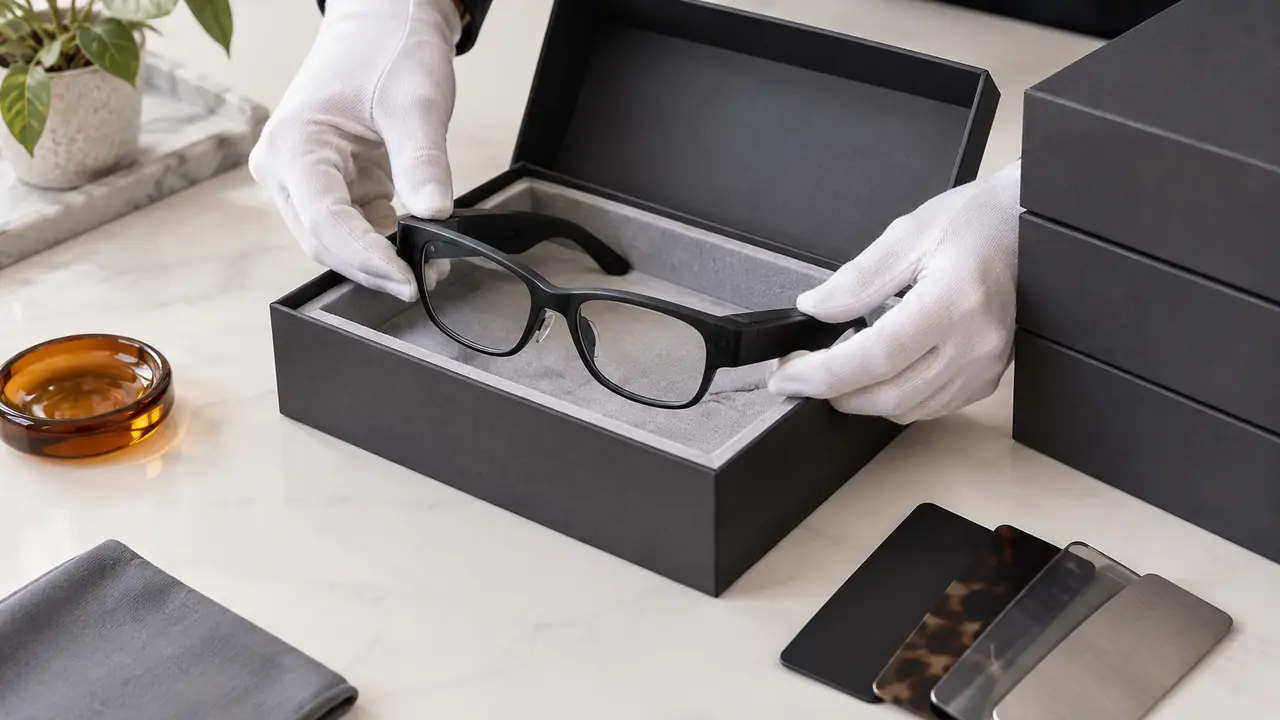
What can be customised on a pair of smart glasses
A smart glasses unit is a frame, a pair of lenses and two temples full of electronics, and each of those layers can be customised to a different depth. Some changes are cosmetic and ride on an existing catalog model; others touch the acoustic chamber, the board or the firmware and turn the order into an engineering program. Knowing which is which is the fastest way to set a realistic quantity and timeline before samples are requested.
The desk groups customisation into seven areas, in the order buyers usually raise them:
- Appearance: front shape, temple profile, surface finish (matte, gloss, soft-touch) and logo position. A new front or temple shape needs a new mould; a new finish usually does not.
- Colour: frame colour, temple colour and accent parts such as hinge covers or nose pads. Colour matching is done against a physical chip and recorded on the spec sheet.
- Lenses: clear, filter, polarized, photochromic or Rx-ready fronts, sourced from the Danyang and Xiamen lens clusters. Sunglass lenses carry a category under ISO 12312-1 or ANSI Z80.3. See lens options.
- Acoustic tuning: equaliser curve, volume ceiling and the port layout that controls sound leakage. EQ changes are firmware work; port changes are tooling work. See acoustic design.
- App white-label: app name, icon, colours and onboarding screens on the solution provider's app framework, with store listings in your account per project.
- Firmware: device name in the Bluetooth list, prompt tones and voice prompts, touch gestures, volume limits and OTA behaviour, per firmware and per solution provider. See firmware and app.
- Packaging: gift box, retail box, charging case print, manuals and labels, covered on packaging and retail boxes.
Three routes: catalog, logo and full custom
Most briefs fall into one of three routes. The table compares them using the typical reference ranges the desk works with; every figure is confirmed in writing for each program.
| Route | What changes | Typical MOQ per model | Samples | Batch lead |
|---|---|---|---|---|
| Catalog model | Nothing structural; choice of stocked colours and lenses | 50-500 pairs | 5-10 working days | 20-35 days |
| Logo program | Logo print or laser mark, colour from the existing range, retail box, app skin where available | 500-1,000 pairs | 10-15 working days | 20-35 days |
| Full custom OEM or ODM | New frame mould, acoustic and PCBA tuning, app white-label, custom firmware | From 3,000 pairs | 30-60 days engineering sample, including 25-45 days tooling | 45-75 days, excluding certification queues |
The route also decides which certificates can be reused. A logo program on an unchanged board can often build on the partner plant's existing radio test reports, subject to your test lab's review; a new board or antenna layout normally needs fresh FCC and CE RED testing. The trade-off is set out in catalog model vs custom smart glasses and ODM vs OEM smart glasses.
Who does the work in a custom program
A custom program spans three supply chains. Temple electronics - acoustics, PCBA, cells and firmware - come from partner plants and solution providers in Shenzhen's Bao'an and Nanshan districts and nearby Dongguan. Frames and moulds come from the Henggang cluster in Shenzhen or from Ouhai in Wenzhou. Lenses come from Danyang or Xiamen. The desk coordinates the brief, the shortlist, the spec sheet and the inspection plan so that a front moulded in one city fits a temple board assembled in another, and so that every change is recorded against the golden sample.
Tooling and mould ownership
New fronts, temples, charging contacts and sometimes the retail box insert need tooling. Mould ownership is set in the contract, not assumed: the agreement states who pays for the mould, who owns it, where it is stored, how long it is kept after the last order and whether it can be transferred to another plant. The desk asks for the mould number, photos of the tool and the number of cavities to be recorded in the program file. Exclusivity of a shape or a tuning profile is likewise a contract term, agreed per program and per market. The longer discussion is on smart glasses tooling and molds.
Documents a private label program produces
Whatever the route, the program should end with a document set you can reuse for listings, retailers and customs: a signed spec sheet covering the six temple modules, the golden sample record with photos, colour and lens references, the test plan and test reports (verified per project), the battery UN 38.3 test summary, label and marking artwork, and the packing specification. Certificates are issued by test labs to the partner plant or to your brand, depending on what the contract says.
To scope a program, send the target market, route, quantity per model and the parts you want changed through the quote form; current ranges are on MOQ and lead time.