
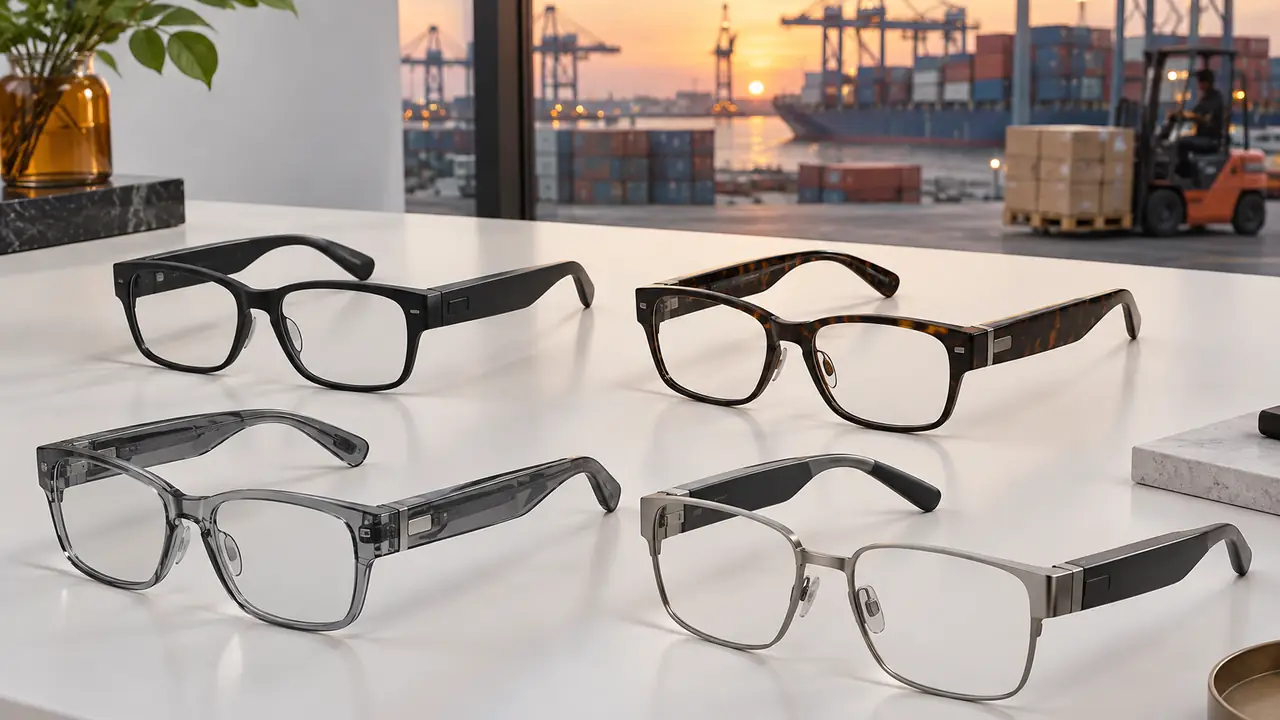
What private label means for smart glasses
In a private label program, the product itself - frame shape, board, battery, speakers, microphones - stays as the partner plant built and tested it. What changes is everything the customer sees as the brand: the logo on the temple, the frame and lens color within the plant's options, the name and voice prompts the glasses announce when they pair, the app the customer downloads, the box, the manual and the labels. Because the electronics and tooling do not change, private label is faster and needs a lower quantity than custom work, and the plant's existing test reports may remain usable, subject to the lab and the market.
The trade-off is differentiation. Other brands may sell the same base model, so a private label range wins on fit and color choice, packaging, content, after-sales service and price position rather than on unique hardware. Many brands start here and move to custom work once a line sells through.
Choosing the base model is the most important private label decision, and it is worth more time than the logo. Check the model's fit range against your customers (lens width, bridge and temple length), its weight, its runtime under realistic volume, its call quality outdoors and its return history if the plant will share it. A well-chosen base model with a modest logo will outsell a weak model with an elaborate box. Line-by-line options are on audio glasses.
Logo methods on frames and temples
A smart temple is not a flat surface: it curves, it has a touch strip on one side and it often has a speaker grille near the ear. The logo method has to suit the material and avoid the touch area.
| Method | Suits | Watch for |
|---|---|---|
| Pad printing | TR90, PC and other injected temples | Abrasion resistance; check with a rub test and an artificial sweat soak |
| Laser marking | Metal parts, some coated plastics | Contrast on dark colors; heat near the battery cavity |
| Hot stamping or foil | Smooth plastic surfaces | Edge lift on curved temples |
| Metal badge or inlay | Acetate and premium fronts | Needs a recess, which may mean tooling changes |
| Inside temple print | All materials | Space shared with model, size and compliance markings |
Keep the logo away from the touch strip and the speaker port, and confirm its position on the logo sample before batch. Compliance markings such as the FCC ID and CE mark are usually printed on the inside of a temple or on the label and packaging, depending on space and the market's rules; leave room for them in the artwork.
App, device name and voice prompts
Customers notice the electronic identity as much as the logo. Three layers can usually be changed on a catalog model, per firmware and per partner plant:
- Bluetooth device name. The name shown in the phone's pairing list. Usually a simple firmware setting, but it needs a firmware build and a version record.
- Voice prompts. Power on, pairing, low battery. These are audio files in the firmware; custom prompts need a recording, a build and a check on every language you sell in.
- App white-label. A companion app with your name, icon and colors, built on the plant's or solution house's app framework. This is the largest change: it involves app store accounts, a privacy policy, data handling and an update plan.
App white-label deserves a careful look. Ask who publishes the app, who hosts any cloud services such as translation or an AI assistant, which data leaves the device and how firmware updates are delivered over the air. For the EU, the cybersecurity requirements of RED Article 3(3)(d)(e)(f), with the EN 18031 standards, apply to wearable radio equipment including glasses from 1 August 2025, so the app and update process are part of the compliance picture, not only the brand picture. Firmware and app topics are covered on firmware and app.
Packaging and inserts
Packaging is where most private label programs differentiate, and where most schedule slips happen, because print runs, die lines and proofs take longer than buyers expect.
- Box format. A printed sleeve over a stock box is quick; a rigid custom box with a molded insert is slower and has its own print minimums.
- Protective case. Many smart glasses ship in a hard case that doubles as a charging case. A case with its own cell is a battery product in its own right for shipping and labelling, classed per its watt-hour rating.
- Manual and labels. Quick start guide, safety and battery information, compliance statements, barcodes and retail labels for each market.
- Drop and transit protection. Confirm the packed pair passes the agreed drop and transit checks before the box is approved.
More on formats and testing is on packaging and retail boxes.
Documents a private label buyer should receive
Ask for the document pack at the start, not at shipment. A typical pack for an audio model includes radio test reports for the target markets (FCC Part 15.247 and Subpart B, CE RED with EN 300 328, EN 301 489 and EN 62368-1), RF exposure assessment, a UN 38.3 test summary and IEC 62133-2 report for the cells, optical reports for the lenses (ISO 12312-1 or ANSI Z80.3, and 21 CFR 801.410 drop ball for the US), RoHS and REACH declarations, and the Bluetooth SIG listing. These documents are held by the partner plant or lab per project; the desk verifies them per project. Whether they cover your brand name, or whether a listing in your name is needed, is a question for your test lab and counsel.
Quantities, samples and timing
Private label sits in the middle of the three routes. Typical reference ranges, confirmed in writing per program, are 500-1,000 pairs per model, logo samples in 10-15 working days and batch production in 20-35 days. Each additional color, lens tint or packaging variant can carry its own minimum. A realistic sequence is: choose the catalog model, approve the logo position and color on a logo sample, approve firmware name and prompts on a second sample if needed, sign the golden sample, then release packaging print and batch production together. The full comparison of routes is in OEM and MOQ explained, and current ranges are on MOQ and lead time. To start a logo program, send the model, colors and packaging level through the quote form.