
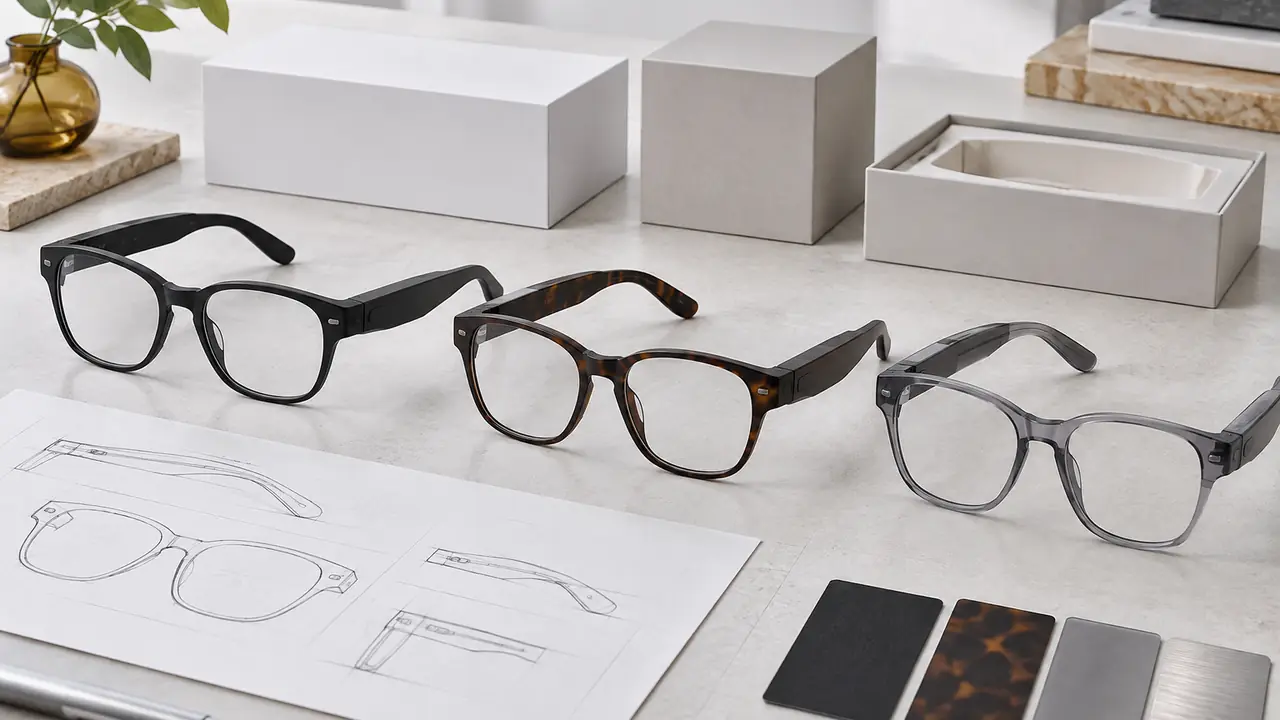
What brand owners usually struggle with
A brand owner is not buying a product so much as buying a design that nobody else will sell. That creates four recurring problems. The first is the frame: a catalog front shared by dozens of sellers cannot carry a brand, so the program needs its own mould, and the mould has to leave room for the temple electronics, the hinge flex cable and the charging contacts. The second is sound: open-ear speakers tuned for a generic frame can sound thin or leak in a new shape, so the acoustic chamber has to be tuned again. The third is the app: a white-label app needs your name, your privacy text and a firmware update path you can actually control. The fourth is paperwork ownership: if the FCC grant, the CE test reports and the Bluetooth SIG listing sit in a supplier's name, moving production later becomes slow and expensive.
The desk plans for all four from the first brief, because each one is cheap to settle early and costly to fix after tooling is cut.
Recommended lines and why
Brand programs work best where the design and the experience can be differentiated, not only the colour. Three lines carry that well:
- Open-ear audio glasses: the acoustic chamber and speaker port are tuned per frame, so a brand can own a sound signature and a leakage target, verified per acoustic test.
- AI translation glasses: the app and translation engine choice define the product; language count and latency are always stated per app and translation engine, with typical cloud latency of 0.5-3 s.
- Camera glasses: the camera module, recording indicator LED and app permissions are where a brand earns trust; the indicator design follows the EDPB statement of October 2026, which is guidance rather than law.
A brand range often adds a Bluetooth audio model on the same board as an entry tier.
Order routes, quantities and timing
Most brand owners do not start with full custom. The usual path is a logo program on a catalog frame to test demand, then a custom front once the return data is in. Ranges below are typical across the category and confirmed in writing per program.
| Stage | What changes | Typical MOQ | Samples | Batch lead |
|---|---|---|---|---|
| Logo program | Temple print or laser mark, box, app skin | 500-1,000 pairs per model | 10-15 working days | 20-35 days |
| Full custom OEM/ODM | New front mould, acoustic or PCBA tuning, white-label app | From 3,000 pairs per model | 30-60 days incl. 25-45 days tooling | 45-75 days |
| Accessories with brand | Replacement lenses, charging case, pouch | 500-1,000 pieces | Per item | Per item |
FCC and CE lab work typically adds 3-6 weeks per lab and scope, and it can run in parallel with tooling if the design is frozen early. Tooling ownership and mould storage are written into the program agreement; see smart glasses tooling and moulds.
Files and certifications to hold in your name
For brand owners the desk recommends that key reports are issued to the brand, not only to the assembling plant. The usual list:
- FCC Part 15.247 grant and FCC ID for the transmitter, plus Part 15 Subpart B for the digital circuit, for the United States.
- CE under RED 2014/53/EU: EN 300 328, EN 301 489-1/-17, EN 62368-1, EN 50566 or EN 62479 for RF exposure, and EN 18031 cybersecurity, applicable since 1 August 2025.
- Bluetooth SIG qualification with a Declaration ID listed for the brand's product.
- Battery: UN 38.3 test summary and IEC 62133-2, plus labelling under the EU Battery Regulation 2023/1542.
- Lenses: ISO 12312-1 or ANSI Z80.3, and 21 CFR 801.410 drop-ball impact testing for the US.
- Tooling agreement, golden sample record, firmware release notes and app data-handling text.
Scope, costs and timing for each item are confirmed with your test lab; the desk verifies model numbers and validity per project. The full list is in the certification guide.
Inspection and delivery checkpoints
- Design freeze: front drawing checked against temple module size, hinge flex path and charging contact position.
- EVT sample: fit, weight and first acoustic measurement; changes logged against the spec sheet.
- DVT sample: hinge cycling, sweat soak, splash to the stated IP rating per IEC 60529, drop and runtime.
- Golden sample signed with colour, finish, sound and app version.
- In-line checks during assembly, then pre-shipment inspection against the golden sample and an agreed AQL.
Illustrative case: a lifestyle brand moves to its own front
This is an illustrative, anonymous example. A lifestyle brand sold a logo version of a catalog open-ear frame for one season. Return notes pointed to two issues: the front felt wide on smaller faces and people nearby could hear calls in quiet offices. For the second season the desk briefed a Henggang frame plant on a narrower custom front and asked the Shenzhen acoustic partner to retune the chamber for the new temple. Engineering samples went through two rounds, the FCC and CE reports were issued in the brand's name, and the app was re-skinned with the brand's privacy text. To plan a similar step, send your brief through the quote form.