
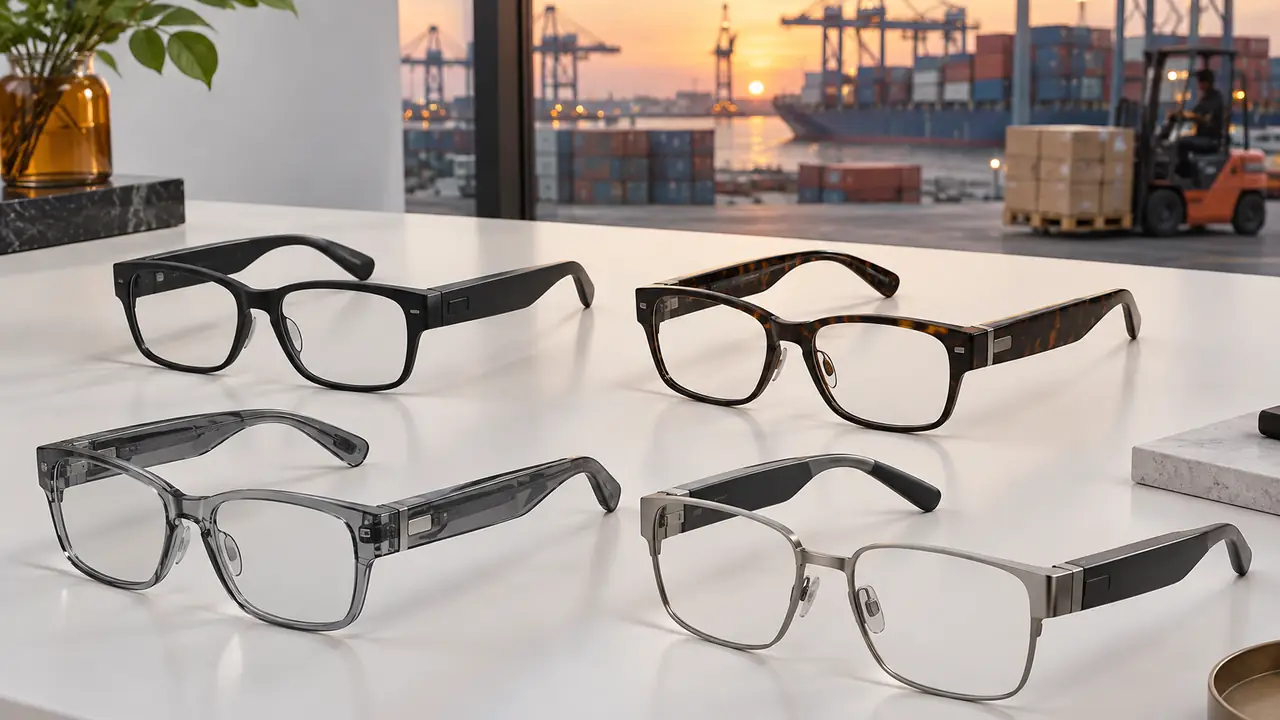
Why MOQ follows the route
An MOQ is not an arbitrary number a plant chooses to filter buyers. It reflects the fixed work that has to be done before the first pair comes off the line: setting up a production run, buying parts in the quantities suppliers sell them, printing packaging, opening tooling and tuning firmware. The more of that fixed work your program needs, the higher the quantity over which it has to be spread. That is why the same plant will quote very different minimums for a catalog model in its own color and for a new frame with custom acoustics.
For smart glasses, the useful way to think about MOQ is by route. There are three: buy a catalog model as it is, put your logo and packaging on a catalog model, or build a full custom product. Each has a typical range across the category. The figures below are typical reference ranges, confirmed in writing per program.
The three routes compared
| Route | What changes | Typical MOQ per model | Samples | Batch lead time |
|---|---|---|---|---|
| Catalog model | Nothing, or a stock color choice | 50-500 pairs | 5-10 working days | 20-35 days |
| Logo and packaging | Logo on temple, voice prompt or app name per firmware, custom box and inserts | 500-1,000 pairs | 10-15 working days | 20-35 days |
| Full custom OEM/ODM | New frame tooling, acoustic and PCBA tuning, app white-label | From 3,000 pairs | 30-60 days, including 25-45 days of tooling | 45-75 days, excluding certification queues |
| Accessories | Replacement lenses, charging cases | 500-1,000 pieces | Per item | Per item |
| Kids line | Kids sizes and materials, volume limits per firmware | From 1,000 pairs | Per route | Per route |
The ranges are wide because plants differ and because the details of each program move the figure. A catalog model at the low end of its range often means taking a stock color and a plain box; a logo program at the low end usually means a single color and a simple print.
What pushes an MOQ up
- Colors per model. Each frame color is a separate injection or plating run. Four colors at 250 pairs each is not the same job as one color at 1,000 pairs.
- Custom lenses. Polarized, photochromic or tinted lenses from a lens partner have their own minimums per tint and base curve.
- Printed packaging. Rigid boxes, inserts and printed manuals are bought in print runs that often exceed the glasses quantity of a small program.
- Firmware changes. A custom voice prompt or app name per firmware needs a build, a test cycle and version control, which plants prefer to spread over a larger batch.
- New tooling. Any new frame or temple mold moves the program into the custom route. See tooling and molds.
How buyers bring it down
There are honest ways to get a lower starting quantity without asking a plant to work at a loss. Start with fewer colors and add others in the second order. Use a stock lens tint for the first batch. Choose a printed sleeve over a stock box before committing to a rigid custom box. Keep the electronics on a catalog board and differentiate on frame color, logo and packaging first. For a new brand, a catalog or logo program that sells through is usually a better first step than a full custom build that ties up capital in tooling. The comparison is laid out in catalog model vs custom smart glasses.
MOQ and certification
Certification interacts with MOQ in a way buyers often miss. A catalog model may already have FCC Part 15 and CE RED test reports held by the partner plant, and a logo program on the same board and antenna may be able to rely on them, subject to the lab's and the market's rules. A full custom build with a new board or antenna needs its own testing, and under RED the cybersecurity requirements in EN 18031 now apply to wearable radio equipment including glasses. Radio lab testing commonly takes 3-6 weeks per lab and scope. Certification costs are fixed per model, which is another reason custom MOQs start higher. Confirm the scope with your test lab; the overview is on compliance and certifications.
Reorders, samples and split shipments
The first order and the reorder are often treated differently. Once tooling is paid for, the golden sample is signed and the packaging artwork is approved, a plant can usually accept a smaller reorder than the first batch, because most of the fixed work has already been done. Some programs agree a lower reorder quantity in writing at the start, which makes it easier to plan a second color or a seasonal restock. Ask about it before the first order rather than after.
Sample quantities are separate from MOQ. A catalog program might take two or three samples per color for fit and listing photos; a custom program will go through engineering samples and EVT/DVT rounds before a golden sample is signed, each round in small quantities. Samples are built by hand or on a short run, so their timing follows the ranges above rather than the batch line. The sequence is explained in the sample process.
Finally, a single order can often be shipped in parts: an early air shipment for launch stock and the balance by sea. That does not change the MOQ, but it changes cash flow and the battery shipping paperwork. Every air shipment of glasses with built-in cells is declared under UN3481, PI 967 Section II, and needs a UN 38.3 test summary; the forwarder confirms what each lot needs.
One more practical point: count MOQ per model and per variant the same way the plant does. A model in two frame colors and two lens tints can be four variants, and each may carry its own minimum. A short variant table attached to the brief removes most of the back-and-forth.
Putting a number on your program
To get a confirmed MOQ, share the line, the route, the number of colors, the lens type, the packaging level and the target market. The desk then checks with two or three partner plants and returns a written figure, together with sample timing and batch lead time. Typical ranges are kept current on MOQ and lead time, and the route options are described on OEM and private label. When you are ready, send the brief through the quote form.