
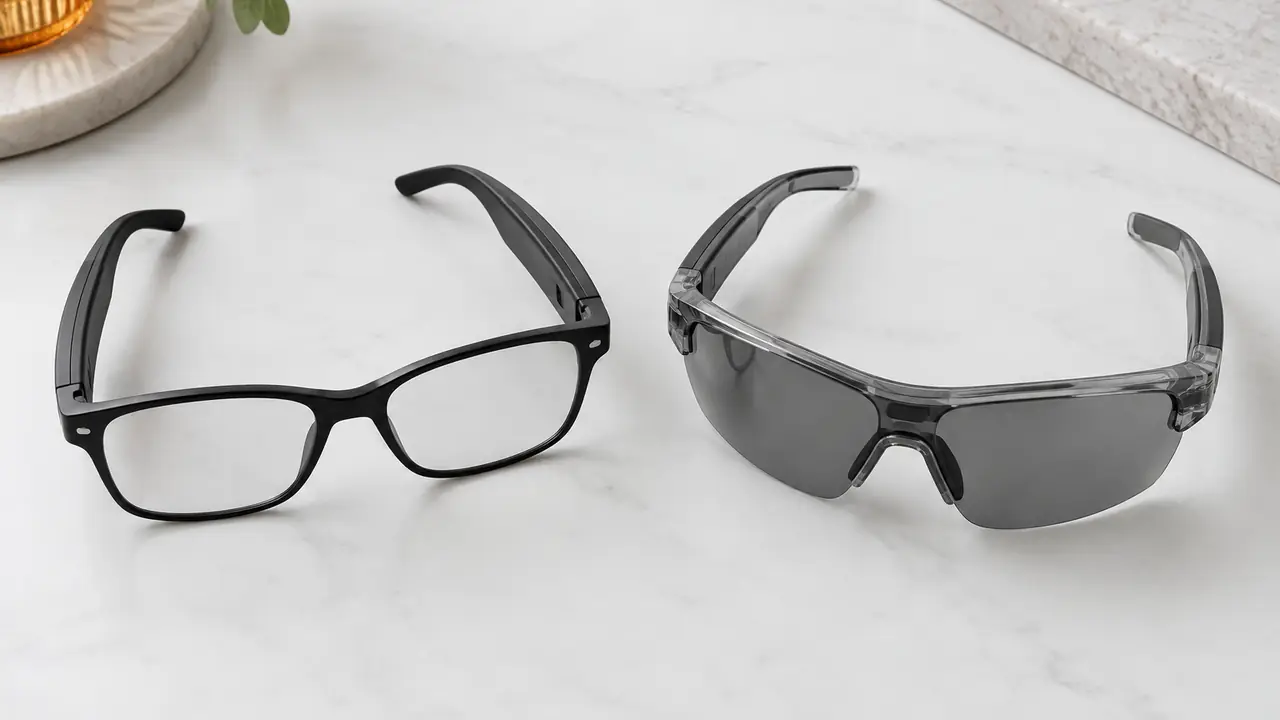
Three routes, not two
Buyers often frame this as catalog versus custom, but in practice there are three routes, and most programs move from one to the next over time.
- Catalog model. An existing model from a partner plant, already engineered, tested and in production. The buyer chooses colour, lens and quantity. Branding is minimal or none.
- Logo program. The same catalog model with the buyer's logo on the temple, branded packaging, inserts and sometimes a choice of lens and frame colours outside the standard range. The electronics, app and frame shape stay as they are.
- Full custom OEM or ODM. A new frame shape with its own moulds, acoustic or PCBA tuning, sometimes a white-label app, and a specification written for the brand. This is a development project, not an order.
The difference between the routes is not only quantity. It is how much engineering the program takes on, who carries the risk if something does not work, and how long it takes before goods can be sold.
The decision table
All quantities and times below are typical reference ranges, confirmed in writing for each program.
| Factor | Catalog or logo model | Full custom OEM or ODM |
|---|---|---|
| Typical MOQ | Catalog 50-500 pairs per model; logo 500-1,000 pairs per model | From 3,000 pairs per model |
| Samples | Catalog 5-10 working days; logo 10-15 working days | Engineering samples in 30-60 days, including 25-45 days for moulds |
| Batch lead time | 20-35 days | 45-75 days, excluding certification queues |
| Tooling | None; existing moulds | New moulds for front and temples; ownership agreed in writing |
| Frame and fit | Existing sizes and shapes | Shape and sizes designed for the brand's customers |
| Acoustics and electronics | As engineered by the plant | Tuning, mic layout and chipset choice per spec |
| App | Provider's app | App white-label possible, with maintenance agreed |
| Test reports and certificates | Existing reports from the partner plant, verified per project | New testing for the new design, typically 3-6 weeks at the lab |
| Differentiation | Low; similar models may appear elsewhere | High; the design is the brand's |
| Main risk | Competing on the same model as other sellers | Delays, engineering issues, unsold volume |
Read the table row by row against the business plan. A brand that needs stock for a season in two months has, in practice, already chosen the catalog or logo route. A brand that needs a distinct product to defend a price band has to accept the timeline of a custom build.
What a catalog model really gives you
The strongest argument for a catalog model is that its problems are already known. The plant has shipped it, the hinge and battery have been through production, and the test reports exist. The desk checks that those reports match the actual model and the markets the buyer sells into - FCC Part 15 for the US, CE RED with EN 300 328, EN 301 489, EN 62368-1 and EN 18031 for the EU, UN 38.3 for the battery, and optical standards such as ISO 12312-1 for the lenses. Certificates and reports are held by the partner plant or test lab and verified per project; where the brand needs its own name on a filing, that is scoped with the lab.
The weakness is sameness. Other sellers may carry a near-identical model, so the listing competes on content, packaging, lens options and after-sales rather than on the product. A logo program reduces this with branded temples, packaging and a curated lens and colour range, which is often enough for a first season. See private label smart glasses for what a logo program can change.
What full custom really costs
A custom build is a project with phases: brief, design, moulds, engineering samples, testing, golden sample approval, then production. Engineering samples typically take 30-60 days including about 25-45 days for moulds, and batch production 45-75 days, not counting time in the certification queue. Radio and safety testing at the lab usually takes 3-6 weeks per lab and scope. Each change after mould release adds time.
The costs are fixed costs - moulds, engineering, testing - plus a larger commitment on volume, typically from 3,000 pairs per model. Mould ownership, the specification and who holds which test reports should be agreed in writing before work starts. App white-label adds an ongoing cost: someone has to maintain the app as phone operating systems change. The notes on ODM vs OEM smart glasses and tooling and molds go through these in detail.
A staged path most buyers follow
Many brands use the routes in sequence. They start with a catalog model to learn which sizes, lenses and colours sell and why customers return the product. They move to a logo program to build the brand and fix the most common return causes through lens choice, packaging and copy. Once they know their customer, they commission a custom frame or tuning that addresses what they learned, at a volume they can now forecast. This path keeps the early commitment small and puts the large commitment where the data is strongest. The sourcing process page shows the steps the desk runs on each route.
A second pattern suits distributors and project buyers: a catalog or logo model for the volume tier, and a custom model only for one flagship. That keeps most of the range on short lead times while still giving the brand one product of its own.
Which route to choose
Choose a catalog model when speed and low commitment matter most, when testing a channel, or when the order is below a few hundred pairs. Choose a logo program when the brand needs its own identity on the product and packaging but the existing model already fits the customer. Choose full custom when the brand has a clear reason the existing models fail its customers - fit, acoustics, a feature, a look - and can commit to the volume and the timeline. Check quantities and timelines against the reference ranges on MOQ and lead time, then describe the target channel, volume and launch date on the quote form; the desk will recommend a route and shortlist plants for it.