
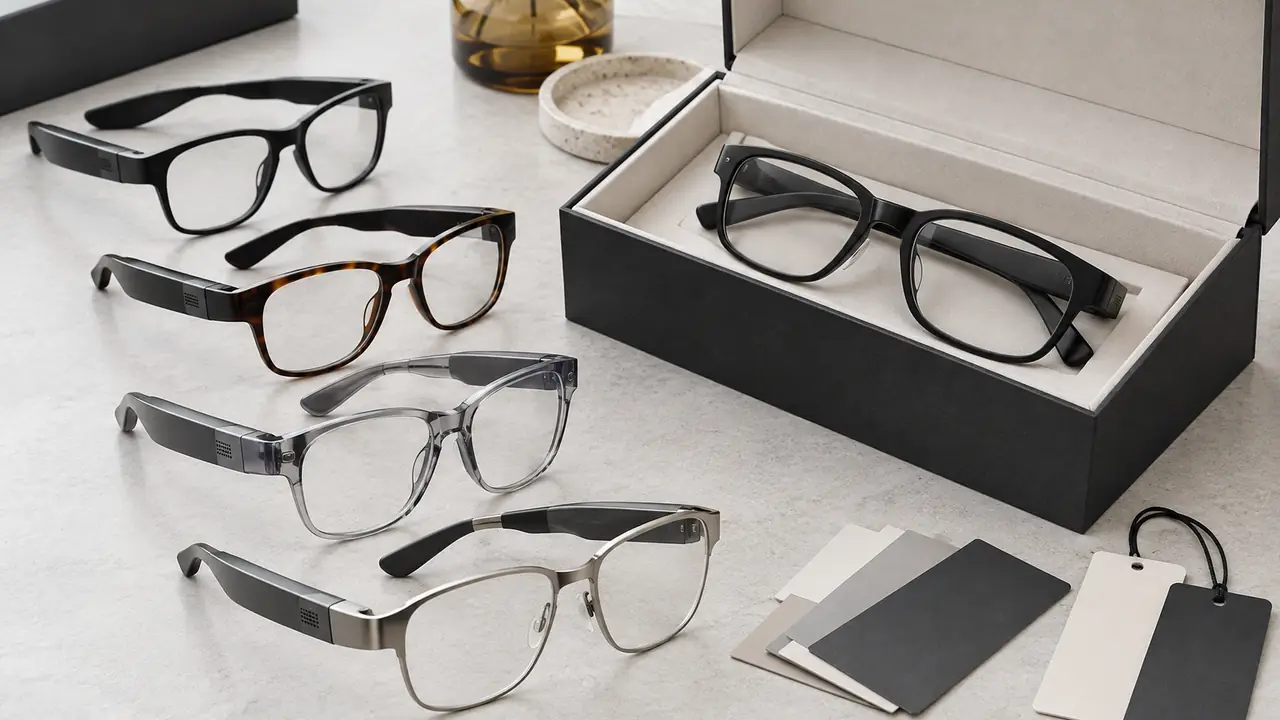
Three routes, one decision
Every smart glasses brand program sits somewhere on a line from buying what already exists to designing something new. At one end, a catalog model from a partner plant's existing range, unchanged except for the packaging you choose. In the middle, a logo program: the same model with your logo on the temple, your retail box and often your skin on the companion app. At the far end, a full custom OEM or ODM program with a new frame mould, acoustic and PCBA tuning and a white-label app. The route decides quantity, time, tooling and how much of the product you can call your own.
The right route is usually the shortest one that meets the brand promise. A marketplace seller testing demand rarely needs a new mould; a brand building a signature shape cannot avoid one. Many brands start on a logo program and move to full custom for the second generation once sell-through data exists.
The routes compared
| Item | Catalog model | Logo program | Full custom OEM/ODM |
|---|---|---|---|
| Typical MOQ per model | 50-500 pairs | 500-1,000 pairs | From 3,000 pairs |
| Samples | 5-10 working days | 10-15 working days | 30-60 days engineering samples, including 25-45 days for tooling |
| Batch lead time | 20-35 days | 20-35 days | 45-75 days, excluding certification queues |
| Tooling | None | None; print or laser plates only | New frame mould and, where needed, temple and acoustic parts |
| App | Partner plant's standard app | Logo or colour skin per provider | White-label app per provider and firmware |
| Certification | Existing reports, verified per project | Existing reports, checked for label and model changes | New testing in most cases |
All figures are typical reference ranges, confirmed in writing for each program; the current table is on MOQ and lead time. Accessories such as spare lenses and charging cases typically start at 500-1,000 pieces, and kids models from 1,000 pairs per model.
What a logo program covers
A logo program changes what the customer sees without changing the electronics. Typical items are a temple print or laser mark, a colour choice from the existing range, a custom retail box and inserts, a user manual with your brand details, and often a logo or colour skin inside the companion app. Because the board and firmware stay the same, the partner plant's radio and battery reports can usually be reused after checking that model numbers and labels match. Packaging options are on packaging and retail boxes, and a fuller walkthrough is in private label smart glasses.
What full custom adds
Full custom programs open the product itself. A new frame shape needs a mould, which usually takes 25-45 days inside a 30-60 day engineering sample stage. Acoustic and PCBA tuning changes the speaker chamber, microphone layout or chipset. An app white-label puts your brand, account system and settings in the companion app, per app provider and firmware. Engineering samples are usually built in EVT and DVT stages before a golden sample is signed. Tooling ownership, mould storage and the right to move the mould should be written into the agreement at the start; see smart glasses tooling and molds.
Cost factors without prices
Unit cost moves with the chipset and feature set, cell capacity, front material, lens type, the number of colours, packaging complexity and order quantity per model. Tooling and app white-label are one-off cost factors that are spread across the first orders. Certification is a separate cost factor whenever the radio or battery changes. The desk sets these out per brief rather than publishing price lists. Two practical ways to keep cost factors under control are to share one board and firmware across several fronts, and to keep colour counts low on the first order; both reduce the quantity tied up in slow-moving variants and make spare parts simpler for after-sales.
Choosing your route
- Test demand or fill a range gap: start with a catalog model.
- Build a brand on proven hardware: a logo program.
- Own a signature shape, sound or app experience: full custom OEM/ODM.
Send the route, quantities and target market through the quote form, and the desk will shortlist partner plants that fit it. The sourcing steps are on sourcing process.