
What distributors need that other buyers do not
A distributor carries a range into a territory and supports the retailers and resellers below it. That brings three concerns that single-product buyers rarely face. Territory: the distributor needs confidence that the same branded model will not appear in its region through another channel, which only works if the terms are written down and the model is under the distributor's own logo. Range structure: resellers want an entry model, a step-up and a feature model, with clear differences they can explain at the counter. After-sales: when a hinge breaks or a charging cable is lost, the distributor is the one asked for a part, so spares have to be ordered with the first batch rather than after the first complaint.
Building a model ladder
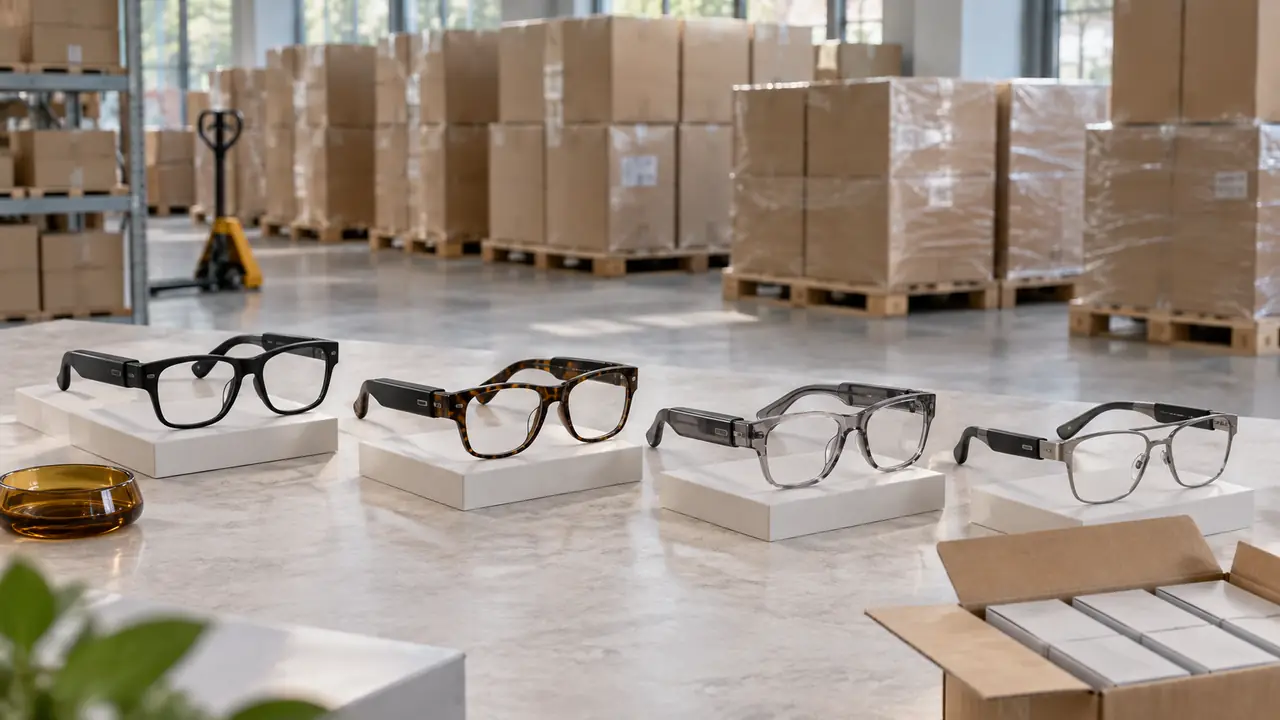
The desk usually proposes a ladder of three to six models drawn from the three product families, sharing boards and chargers where possible so that spares and documents overlap. A typical structure:
| Tier | Lines | Selling point at the counter | Shared parts |
|---|---|---|---|
| Entry | Bluetooth audio, clear and sun versions | Music and calls in a normal-looking frame | Board, charging cable |
| Step-up | Open-ear or business call | Less sound leakage, better calls with multi-mic noise reduction per firmware | Charging cable, case |
| Outdoor | Sports, photochromic | Wrap fit, water-resistant per IPX4-IP55 rating, lens options | Lenses, nose pads |
| Feature | AI translation or camera | App features stated per app and engine; recording indicator LED on camera models | App, case |
| Specialist | Prescription-ready, kids | Optician channel; UV400 and volume limit per firmware for kids | Fronts, temple tips |
The line pages behind the ladder start at audio glasses, AI and camera glasses and specialty smart glasses. Range logic is discussed further in smart glasses range planning.
Order routes, territory and quantities
Distributors typically run logo programs at 500-1,000 pairs per model so the range carries their brand, which is the practical basis for any territory arrangement. A top-tier model may move to full custom from 3,000 pairs per model once sell-through is known. Territory terms, the models they cover and the conditions for keeping them are written into the program agreement; the desk does not promise exclusivity beyond what the partner plant confirms in writing. Batch production typically takes 20-35 days for logo programs and 45-75 days for full custom, and sea freight about 15-25 days to the US west coast and 30-45 days to Europe. Ranges are confirmed in writing per program; see MOQ and lead time.
Document pack per model
Each model in the ladder ships with its own file so that resellers in the territory can answer compliance questions without going back to the distributor:
- Radio: FCC Part 15.247 grant and Part 15 Subpart B; CE under RED 2014/53/EU with EN 300 328, EN 301 489, EN 62368-1 and EN 18031; UKCA, MIC or KC where the territory needs them, confirmed per project.
- Bluetooth SIG Declaration ID.
- Battery: UN 38.3 summary, IEC 62133-2, safety data sheet and EU Battery Regulation 2023/1542 labelling.
- Optics: ISO 12312-1 or ANSI Z80.3 and the 21 CFR 801.410 drop-ball report.
- Materials: RoHS, REACH SVHC declaration and WEEE registration guidance for the importer.
- Product: spec sheet, golden sample photos, manual, warranty terms and spares list with part numbers.
Certificates are held by partner plants or test labs and verified per project; legal scope is confirmed with your test lab or counsel.
Spares, inspection and delivery
- Spares plan agreed with the first order: replacement lenses, nose pads, temple tips, charging cables and cases, typically 500-1,000 pieces per accessory.
- Golden sample per model, with part numbers matched to the spares list.
- Pre-shipment inspection per model, including hinge cycling and charging contact checks.
- Consolidated loading so the full ladder arrives together, with carton labels per model.
- Warranty returns logged by fault type and fed into the next order.
After-sales planning is covered in smart glasses warranty and spares.
Illustrative case: a four-model ladder for one region
This is an illustrative, anonymous example. A consumer electronics distributor wanted to add smart glasses to its range for one regional market. The desk proposed a four-model ladder: an entry audio frame in clear and sun versions, an open-ear step-up, a sports model and a translation model, with the first three sharing one charging cable. All four ran as logo programs under the distributor's brand, and a spares order of lenses, nose pads and cables shipped in the same container. Territory terms covering the four logo models were confirmed in writing by the partner plants. To plan your own ladder, send the brief through the quote form.