
Where DTC smart glasses programs go wrong
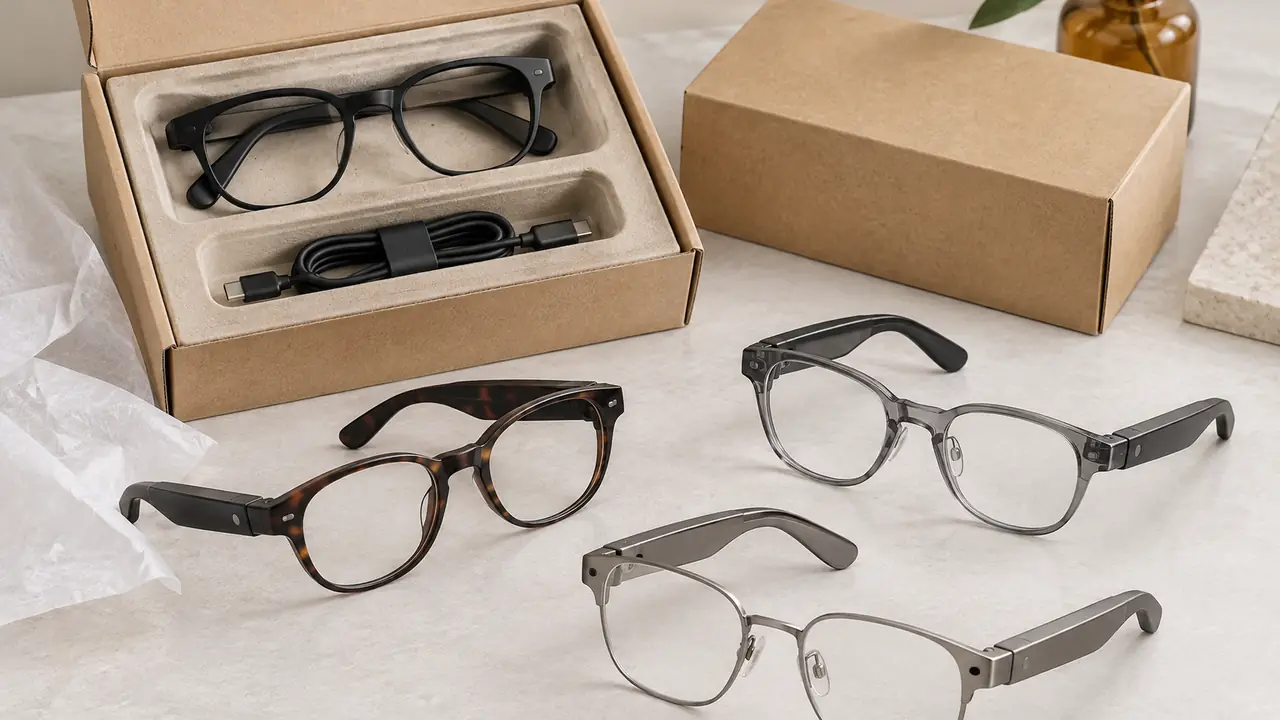
A DTC brand sells through its own store and social channels, so every unit is judged twice: once at unboxing and again after a week of wear. Three patterns show up again and again. Colour pressure: the audience wants three or four colourways, but each new colour on a custom mould multiplies the minimum. Unboxing: a plain brown box with a generic manual undercuts a brand that spent heavily on content. Returns: most returns in the category trace back to fit (the front is too wide or the temples press behind the ear) and to connection issues (the glasses drop the phone, or fail to reconnect after the case). None of these are solved by a better ad; they are solved in the spec sheet.
Recommended lines and why
- Bluetooth audio glasses: the volume line, easy to certify and ship, and the lowest-commitment way to offer several colourways on one board, because the electronics, test reports and battery paperwork stay the same across every colour. Typical playback is 4-13 h of music across the category, per spec sheet.
- Photochromic glasses: one product that works indoors and outdoors, which suits a small range. Lens behaviour is stated per lens spec, Cat. 0-3 dynamic, with ISO 12312-1 labelling.
- Prescription-ready frames: they open the large audience that already wears glasses; lenses are made by an optician or lens lab, with typical fronts of 48-56 mm lens width, 16-20 mm bridge and 140-150 mm temples.
Order routes and colour strategy
The DTC sweet spot is a logo program on catalog hardware. Colour is added through front finish and temple coating rather than new tooling, so variants stay inside one minimum where the plant allows split colours. Ranges are typical across the category and confirmed in writing per program.
| Decision | Lower-risk option | Higher-commitment option |
|---|---|---|
| Hardware | Catalog model, 50-500 pairs per model | Full custom front from 3,000 pairs per model |
| Branding | Logo program, 500-1,000 pairs per model | Custom mould and app white-label |
| Colours | Finish and coating on one front, split per plant rules | Separate mould colour per variant |
| Packaging | Branded sleeve over a standard box | Fully custom rigid box with insert |
| Lens | Clear filter or polarized from stock | Photochromic or Rx-ready program |
Logo samples typically take 10-15 working days and batch production 20-35 days. Packaging options and their lead times are on packaging and retail boxes.
Documents and certifications
A DTC brand selling into the US and EU needs the same core file as any other seller: FCC Part 15.247 with an FCC ID and Part 15 Subpart B; CE under RED 2014/53/EU with EN 300 328, EN 301 489, EN 62368-1 and EN 18031; Bluetooth SIG qualification; UN 38.3 and IEC 62133-2 for the cells; and ISO 12312-1 or ANSI Z80.3 for the lenses, with the 21 CFR 801.410 drop-ball test for the US. On top, DTC brands benefit from three documents that cut support tickets: a size chart with front width, bridge and temple length; a one-page pairing and reset card; and a charging card that shows how the magnetic contacts seat. Certificates are held by partner plants or test labs and verified per project; confirm scope with your test lab.
Inspection aimed at return reasons
The desk builds the pre-shipment check around what customers send back, not only around cosmetic defects:
- Fit check on head forms in two sizes, against the size chart printed in the box.
- Pairing, reconnection after the case and multipoint switching on two phone platforms, per firmware.
- Charging contact seating and sweat soak on the contacts.
- Runtime spot check against the stated playback figure, per spec sheet.
- Packaging drop and unboxing check: insert fit, print registration, manual and card set.
More detail on reducing returns is in reducing returns on smart glasses.
Illustrative case: four colours inside one minimum
This is an illustrative, anonymous example. A DTC eyewear brand wanted to add audio glasses in four colours without committing to a custom mould. The desk shortlisted two catalog audio frames whose plants allow split colours by coating, ran logo samples in all four finishes, and added a branded sleeve and a pairing card to the standard box. The first batch tested reconnection after the case on every carton sample, because support logs from a previous product showed it as the top complaint. When the brand later moved one colour to a photochromic lens, it reused the same board and certification file. To scope a similar program, use the quote form.