
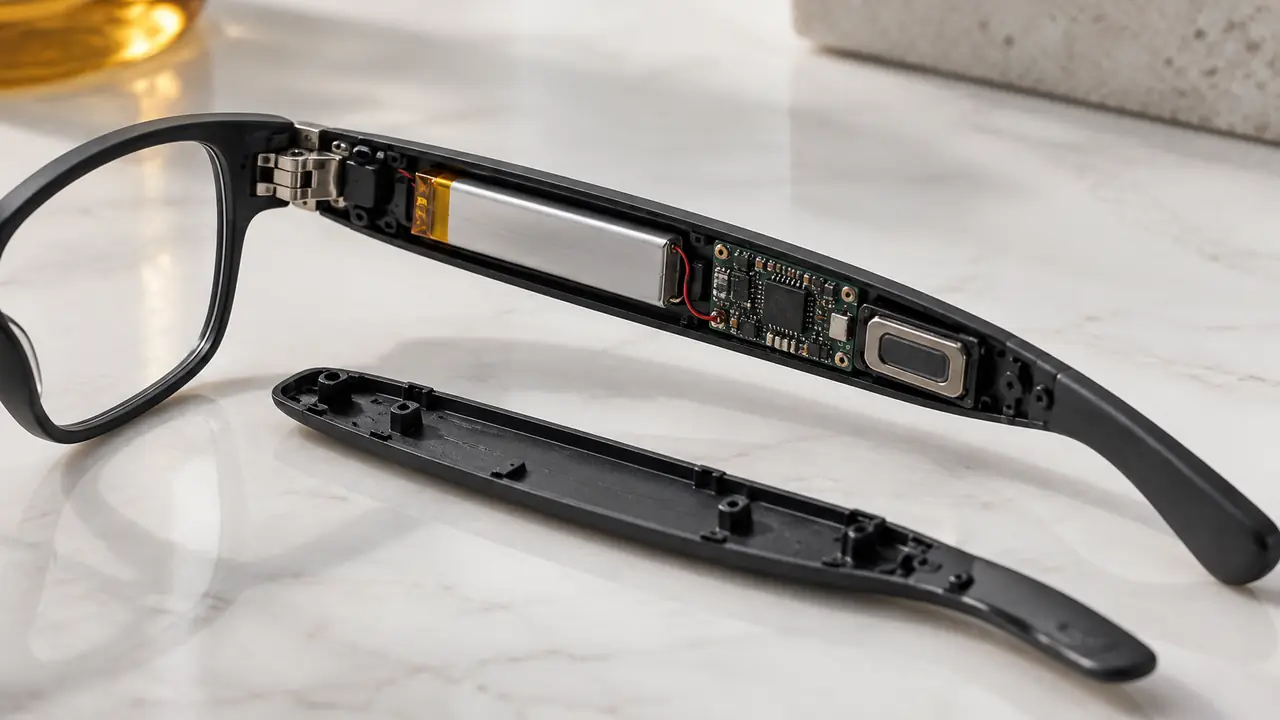
Why everything lives in the temple
A pair of glasses offers very little space for electronics. The front has to stay thin and hold lenses to an optical standard; the nose pads carry weight and touch skin. The temples are the only parts long enough to hold a circuit board, a battery and a speaker, and they sit right next to the ear, which is where audio needs to be. That is why almost every smart glasses design, from a simple audio pair to a camera model, puts its electronics into the two temples and links them across the hinge.
It also explains why the brand name Templora points at the temple. When a buyer compares two catalog models that look identical from the front, the real differences - runtime, sound, durability, repairability - are all hidden in about 12 to 15 centimetres of plastic or metal on each side. Typical temple lengths across the category run from 140 to 150 mm.
The six modules in assembly order
Every Templora spec sheet lists the same six modules in the order a partner plant assembles them. Using one order on every sheet makes catalog models comparable and makes missing information obvious.
| Module | What it contains | Typical range or option | Common failure point |
|---|---|---|---|
| 1 Front and lenses | Frame front, lenses, nose pads | Lens width 48-56 mm, bridge 16-20 mm; UV400, polarized or photochromic options | Lens fit, coating scratches, nose pad comfort |
| 2 Hinge and flex | Metal hinge, flexible circuit crossing it | Spring or fixed hinge; hinge cycle test per order | Flex fatigue causing one-side audio loss |
| 3 Board and chipset | PCBA with BT audio SoC, power management, antenna | Bluetooth 5.2-5.4, 5.3 most common | Antenna detuned by metal frames or the head |
| 4 Battery and charging | Lithium-ion cells, protection circuit, pogo contacts | About 85-235 mAh total; 1-2 h magnetic charge | Sweat corrosion on contacts, deep discharge in storage |
| 5 Audio or imaging module | Directional speaker, bone conduction transducer or camera | Open-ear peak SPL about 75-90 dB per maker figures; 5-12 MP camera sensors | Leakage, rattle, camera heat |
| 6 Mics, controls and app | Mic array, touch strip or buttons, companion app and firmware | Dual or quad mic ENC per firmware; OTA updates | Wind noise, touch misfires, failed updates |
Front, lenses and the hinge
The front looks like ordinary eyewear but carries constraints from the electronics. A camera model needs space at the hinge corner for the sensor and indicator LED; an audio model needs the front to stay light so that the heavier temples do not tip the pair forward. Lenses are specified separately: UV400 is the common baseline, polarized and photochromic lenses are options, and Rx-ready fronts allow an optician or lens lab to fit prescription lenses. Optical rules - ISO 12312-1 for sunglasses in Europe and ANSI Z80.3 in North America, plus the drop ball impact test of 21 CFR 801.410 in the US - apply to the lens and front regardless of the electronics. See lens options.
The hinge is the most underrated part. In most designs a thin flexible circuit runs through it so that both temples share one battery system and one Bluetooth link, or so that the second speaker gets its signal. Every fold bends that flex. A weak flex shows up months later as audio cutting out on one side when the wearer opens the arms fully. Hinge open-close cycles and temple bending are therefore standard items in the test plan, with counts and pass criteria as a stated working default confirmed per order.
Board, battery and the audio or imaging module
The board holds the Bluetooth audio system-on-chip, power management, the charging circuit and the antenna. Because the board is long and thin, layout matters: the antenna must sit away from metal hinge parts and the wearer's head, and the charging contacts must be sealed against sweat. Chipsets are described generically on Templora spec sheets, for example a BT 5.3 audio SoC with multipoint per firmware.
The battery is usually split into two small cells, one per temple, to balance weight. Across the category total capacity runs from about 85 to 235 mAh, giving roughly 4 to 13 hours of music and 3 to 9 hours of calls depending on volume, codec and features. The cells must pass UN 38.3 for transport, and partner plants commonly hold IEC 62133-2 reports. The battery and charging page lists the options.
The fifth module is the reason the customer bought the product. Open-ear speakers use ports and acoustic cavities to steer sound into the ear and cancel some of it outward; bone conduction transducers need steady contact pressure; camera modules need a clear window, a visible recording indicator LED and a heat path. This is the module where acoustic tuning or image tuning happens, and where an acoustic design review earns its cost.
Mics, controls and the app
The last module is partly hardware and partly software. Two to four microphones per pair feed environmental noise cancellation per firmware; their position and mesh decide wind performance. Touch strips or buttons handle play, pause, calls and volume; sensitivity is tuned in firmware so that adjusting the glasses does not trigger commands. The companion app carries equalizer settings, assistant or translation features, and over-the-air firmware updates. A buyer should treat the app as a part of the product, check who maintains it and confirm the update plan, as covered in smart glasses apps and firmware.
Using the map when sourcing
The six-module map turns a catalog comparison into a checklist. For each module, ask whether it is fixed in a catalog model or customizable in a program: logo and colour on the front are usually open; the board and chipset usually stay fixed unless the order reaches a full custom build. Typical starting quantities run from 50-500 pairs per catalog model to 500-1,000 pairs for logo programs and from 3,000 pairs for full custom OEM or ODM work, confirmed in writing per program on MOQ and lead time.
When the module list is filled in, send it with your target quantity through the quote form, and the desk will shortlist partner plants whose temple stacks fit it.