
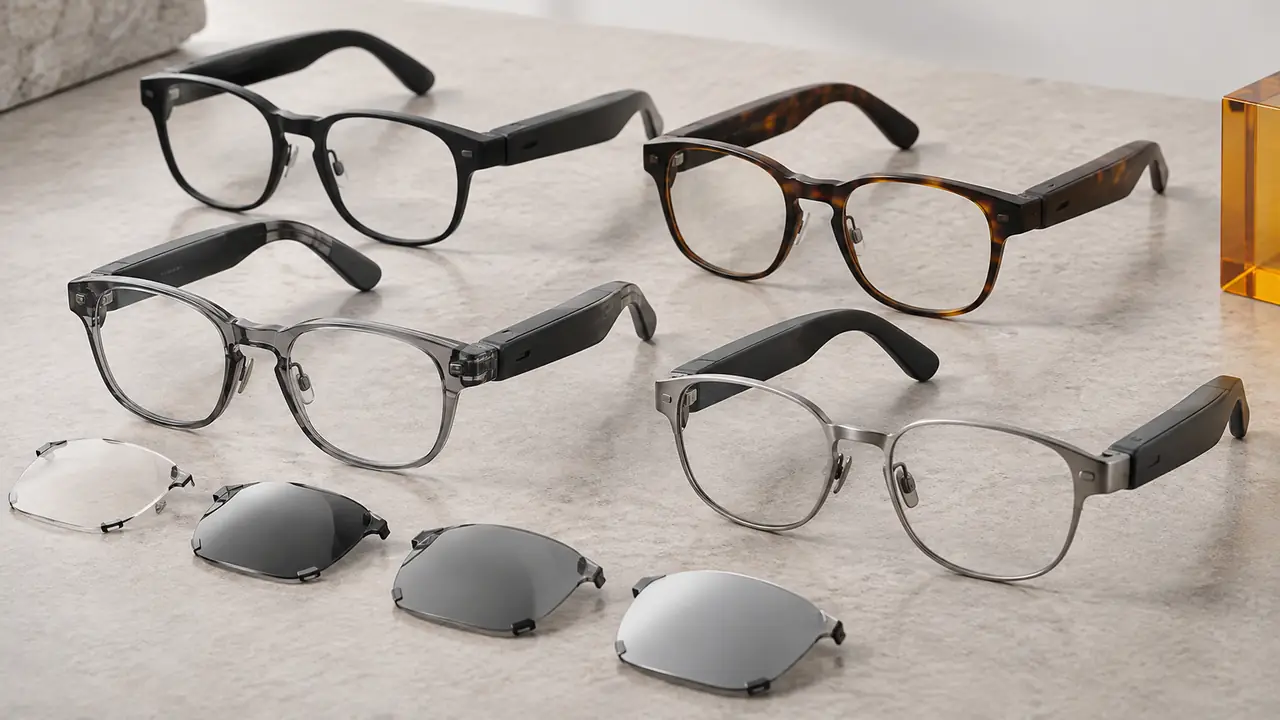
What UV400 refers to
Ultraviolet radiation sits just below the visible spectrum, at wavelengths shorter than about 400 nanometres. UV400 is a trade label meaning that a lens blocks ultraviolet radiation across that range, up to 400 nm, so that the transmittance measured through the lens in the UV range is close to zero. It is a statement about the lens material or coating, measured with a spectrophotometer, and nothing more.
Two points follow from that definition. First, UV400 is independent of darkness. A completely clear lens can be UV400 if its material or coating contains a suitable UV absorber, and a dark lens can fall short if it does not. Second, UV400 is not itself the name of a standard. Standards such as ISO 12312-1 in Europe and ANSI Z80.3 in North America set their own UV transmittance requirements, linked to the lens category; a UV400 label is an additional statement that the test report must support separately. The correct wording on a Templora spec sheet is short: blocks UV radiation up to 400 nm per test report.
How lenses achieve it
Lens plants reach a UV400 result in three common ways, sometimes combined:
- Inherent material absorption. Some lens materials, polycarbonate among them, absorb much of the UV range by nature. Whether the cut-off reaches 400 nm depends on grade and additives, so it is still measured.
- UV absorber in the material. An absorber added to the monomer or resin before casting or molding, common on TAC, nylon and acrylic lenses.
- UV coating. A coating layer that adds UV absorption, used where the base material does not reach the target alone. Coating adhesion then becomes part of the durability question.
The method matters for inspection. A material-based result is consistent through the lens, while a coating-based result depends on coating thickness and adhesion, so coated lenses benefit from UV checks after the sweat soak and abrasion items in the test plan.
Where the lenses come from also shapes how the result is managed. Smart glasses lenses are usually sourced from lens specialists rather than from the electronics plant: Danyang for a wide range of plano, photochromic and prescription lenses, where local reporting describes output of more than 400 million pairs a year, and Xiamen for sun and polarized lenses. The desk keeps the lens plant's UV data, the test lab report and the frame plant's assembly records connected, so that the lens in the finished pair can be traced back to the measurement that supports its label.
UV400 versus category and other labels
Buyers and customers often confuse UV400 with other lens properties. The table separates them.
| Property | What it describes | Evidence | Independent of UV400? |
|---|---|---|---|
| UV400 | UV transmittance up to 400 nm | Spectral transmittance curve in the UV range | - |
| Filter category 0-4 | Visible light transmittance, how dark the lens is | Luminous transmittance per ISO 12312-1 | Yes |
| Polarized | Filtering of horizontally polarized reflected light | Polarizing test in the report | Yes |
| Photochromic | Darkening in UV, clearing indoors | Faded and darkened categories | Yes; UV still measured separately |
| Blue light filtering | Partial filtering of the blue band of visible light | Transmittance curve in the visible range | Yes |
The category system is explained in lens categories under ISO 12312-1, and the boundary between UV and blue light wording in blue light filtering lenses. A useful rule: each property in the table is its own line on the spec sheet and its own line on the report.
Wording that the report supports
UV400 attracts exaggeration more than any other lens label. The safest copy says what the measurement says, with the source attached, and leaves out anything about effects on the wearer.
| Wording | Supported by | Use |
|---|---|---|
| UV400 lenses: block UV radiation up to 400 nm per test report | UV transmittance curve for the lens as supplied | Yes |
| Category 3 sun lens per ISO 12312-1, UV400 | Category and UV lines in the same report | Yes |
| Clear UV400 lens for all-day wear | UV line on a Category 0 lens | Yes |
| Claims about effects on the wearer or long-term outcomes | Would need evidence beyond a lens test | No |
| UV400 on a variant that was not tested | Nothing | No; test every lens variant |
Listings that follow this pattern read as more credible, not less. The note on smart glasses listing content shows how to present lens options in a comparison block.
Testing and lot control
The UV result comes from a spectral transmittance measurement on the lens as supplied, made by the lens plant or a test lab and verified by the desk against the golden sample. Because a lens can change if the plant changes resin lot, absorber supplier or coating line, the result has to be tied to the production lens, not a one-off sample. In practice:
- Report per variant. Every lens material, tint, coating and mirror combination in the range has a UV line in the report.
- Bill of materials match. The report names the lens material and coating, and the spec sheet uses the same names.
- Incoming spot checks. Lots of lenses are spot-checked with a UV transmittance meter at incoming inspection, and results are recorded with the lens batch.
- Change control. Any change of resin, absorber or coating triggers a new measurement before the change ships.
Lot checks are part of the inspection plan on quality control.
UV400 across smart glasses lines
UV400 is standard on most sun lenses, polarized lenses and photochromic lenses in smart glasses ranges, and increasingly common on clear lenses for all-day audio and AI glasses. On the kids line it is a baseline item: UV400 lenses, an optional blue light filtering lens with no health claim, and screen-time reminders and volume limits in the app per firmware, as described on kids smart glasses. For kids products sold in the US, CPSIA requirements apply to the whole product as well.
Adding UV400 to a catalog lens is usually a lens specification choice rather than a route change; replacement UV400 lens sets as accessories typically start at 500 to 1,000 pieces, a reference range confirmed in writing for each program. List the lenses you need and the markets on the quote form, and the desk will request UV curves with the lens samples.