
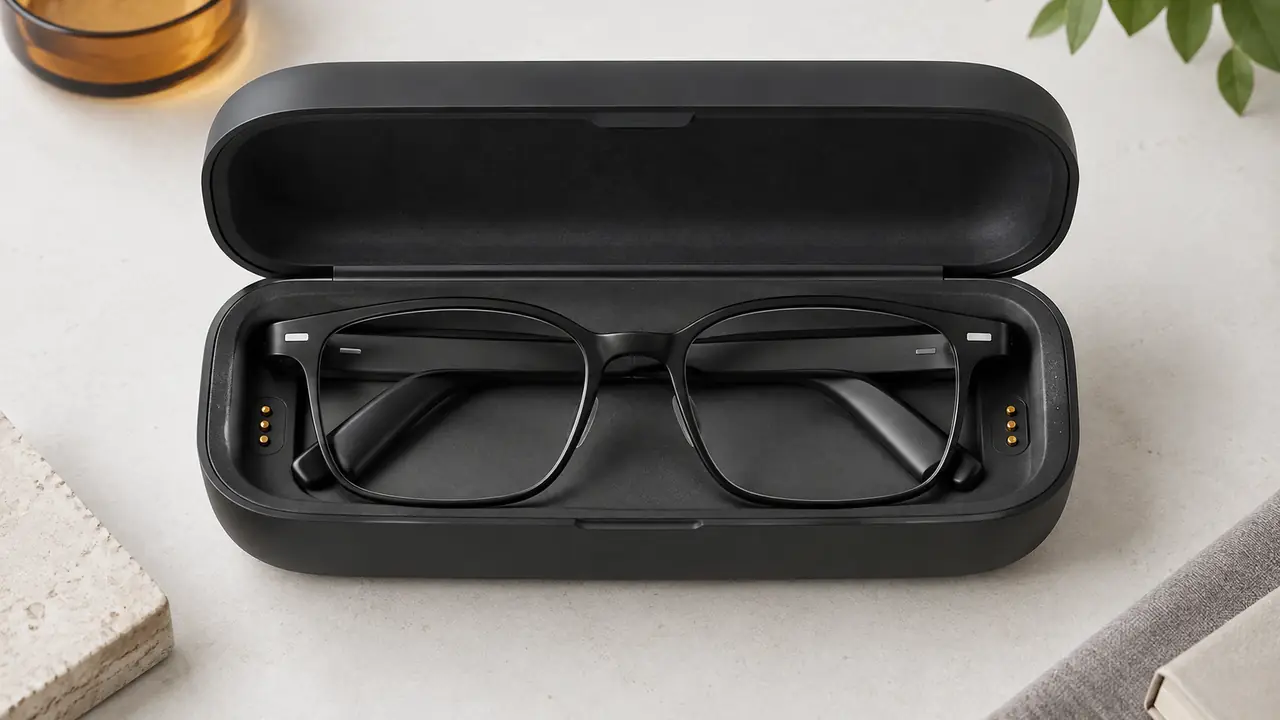
Same cells, more work
Across the category, the cells in the temples of smart glasses hold about 85 to 235 mAh in total, and finished pairs weigh about 27 to 50 grams. AI and camera models live inside the same space and weight limits as audio glasses, so they rarely get a much bigger battery. What changes is the work the electronics do. A plain audio pair spends most of its time streaming audio over Bluetooth. An AI pair adds microphones that listen more often, a processor that runs more often, a radio link that carries more data and, on some models, a camera, storage and Wi-Fi. Each of those draws current, and several of them tend to run together.
The result is predictable: AI, translation and camera models usually sit at the lower end of the category runtime range - typical figures are 4 to 13 hours of music and 3 to 9 hours of calls - when those features are in use. The useful question for a buyer is not whether runtime drops but by how much, under which use pattern, and whether the drop is stated honestly.
Where the power goes
| Feature | Systems that wake up | Effect on runtime |
|---|---|---|
| Voice assistant with wake word | Microphones and a low-power listening path, then processor and radio on wake | Raises standby drain; short bursts of high draw when used |
| Live translation | Microphone array, noise reduction, continuous audio uplink to the phone app and cloud engine | Behaves like a long call or more; one of the heaviest audio uses |
| Photo capture | Camera sensor, image processor, storage write | Short peaks; modest if used occasionally |
| Video recording | Sensor, encoder, storage, recording indicator LED | Sustained high draw and heat; the largest single drain on most models |
| Wi-Fi transfer | Wi-Fi radio alongside Bluetooth | High draw while transferring media to the phone |
| Display or HUD | Projector or display driver and optics | Continuous draw while the display is on |
Translation and assistants: the radio is the cost
Translation glasses pick up speech through the temple microphones, clean it up with noise reduction, send it to the phone app and, for most language pairs, on to a cloud translation engine. Language coverage and delay depend on the app and translation engine; typical cloud latency is about 0.5 to 3 seconds, per network and language pair. For the battery, the important point is that translation keeps the microphones, the processor and the Bluetooth uplink busy for as long as the conversation lasts. In power terms, an hour of translation is closer to an hour of calls than an hour of music.
Voice assistants cost power in two ways. Listening for a wake word adds a small but constant drain that shortens standby, and each request triggers a burst of microphone, processing and radio activity. Firmware choices decide how large both are - for example, whether the wake word runs on a dedicated low-power path or on the main processor, and whether a press-to-talk option is offered. The system view is in how AI translation glasses work and AI assistants on smart glasses.
Cameras, Wi-Fi and heat
Camera glasses typically use 5 to 12 MP sensors with 1080p video as the norm and storage of 16 to 128 GB. Video is the heaviest load on most models: the sensor, the encoder and the storage all run continuously, and the recording indicator LED must stay on. Transferring media to the phone usually uses Wi-Fi for speed, which adds a second radio at high power. Both raise temperature in a small enclosure near the skin.
Heat matters twice. Firmware often limits recording length or charge current when the temple warms up, so heat can cut a recording short before the battery is empty. And heat speeds cell aging, so heavy camera users see capacity fall sooner. The notes on camera glasses specs and battery aging in wearables cover both sides.
- Clip length limits: state the maximum clip length and what happens at the thermal limit.
- Transfer mode: state whether media moves over Wi-Fi or Bluetooth and whether transfer can wait until charging.
- Indicator: the recording indicator LED is part of the design, not an option to save power.
Firmware levers that recover runtime
Much of the difference between two AI models with similar cells sits in firmware. Common levers include aggressive sleep when the glasses are folded or taken off, wear detection that pauses features when the pair is not on the head, press-to-talk alternatives to always-on wake words, batching of notifications, deferring media transfer until the glasses are charging, and limiting noise reduction intensity when it is not needed. Each lever is a design decision with a user-experience cost, which is why it belongs in the specification rather than being left to the plant. The firmware side is covered on firmware and app.
Firmware levers also have a lifecycle. An over-the-air update that adds a feature, changes the wake word engine or retunes noise reduction can shift runtime noticeably on pairs already in customers' hands. Programs that treat runtime as a release criterion - re-running the per-feature runtime test on the golden sample before each firmware release is approved - avoid the pattern where reviews turn negative after an update. The release check is quick compared with the cost of a support wave, and it gives the brand a documented baseline when customers ask why runtime changed. The same discipline applies when the phone app changes how often it polls the glasses or how it batches translation audio, because app behaviour drives radio activity in the temple just as much as the firmware does.
Specifying runtime for AI and camera models
- Runtime per feature: music, calls, translation, video recording and standby with assistant on, each measured on the golden sample.
- Mixed-use profile: an agreed daily pattern that reflects how the target customer uses the features.
- Thermal behaviour: maximum clip length, behaviour at temperature limits and charge current when warm.
- Firmware settings: sleep, wear detection and wake word defaults, frozen with the firmware version.
- Listing wording: state plainly which features shorten runtime.
AI and camera programs often need app and firmware work, which pushes them toward logo or full custom routes: typically 500 to 1,000 pairs per model for logo programs and from 3,000 pairs for full custom, confirmed in writing on MOQ and lead time. Send feature and runtime targets through the quote form.