
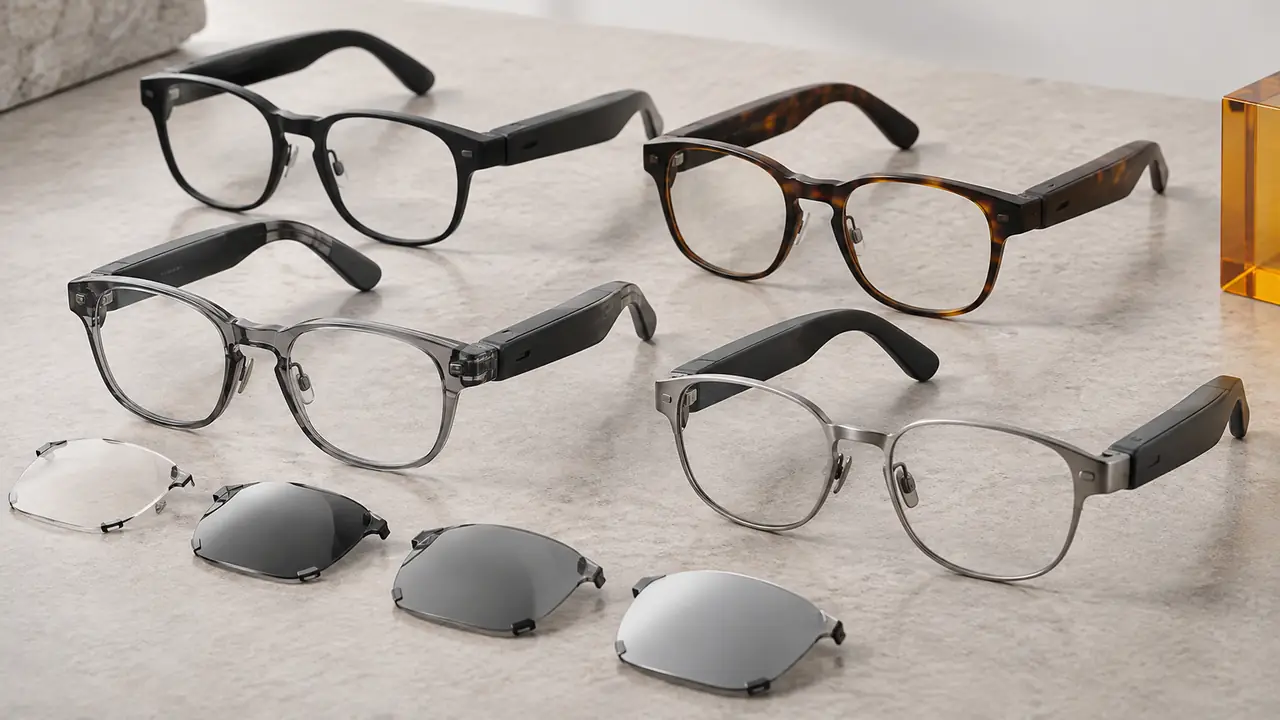
Why interchangeability matters for smart glasses
The electronics in a pair of smart glasses - the board, battery, speakers and microphones in the temples - are the expensive, certified and slow-to-change part of the product. The lenses and the front are the parts customers see and want to vary. Separating the two lets a brand build one temple platform, take it through radio, battery and safety testing once, and then offer it with different lenses or front shapes as the range grows. Customers gain too: one pair can move from office to outdoors by swapping lenses, and a photochromic or polarized set can be bought later as an upgrade.
The idea is simple; the engineering is not. Every interface that allows a part to be removed is also a place where it can loosen, misalign, scratch or get lost, and every new lens or front is a new variant that needs its own optical results. Planning interchangeability well is mostly about choosing the right system for the line and writing the variants into the test plan from the start.
Attachment systems in use
| System | How it attaches | Typical use | Engineering watch points |
|---|---|---|---|
| Snap-in lenses | Lenses flex into a rim or groove and click into place | Sports wraps, lifestyle audio frames | Lens edge wear after repeated changes; rim retention |
| Magnetic lens or clip-on | A lens panel or sun clip held by small magnets on the front | Clear lens by day, sun clip outdoors | Retention when knocked; magnet placement near sensors and charging contacts |
| Swappable passive front | The whole front, with lenses, detaches from the temples at the hinge | Fashion ranges, Rx fronts sold separately | Hinge or connector alignment; cable route if the hinge carries signal |
| Rx insert or carrier | A small carrier behind the main lens holds prescription lenses | Sports and wrap frames for glasses wearers | Fogging, field of view, fit of the carrier |
Magnetic systems are popular because changing a lens takes a second, but they need care in smart glasses. Magnets close to a compass or motion sensor can disturb readings, and magnets near the magnetic pogo charging contacts can make the cable snap to the wrong place. Swappable fronts depend on the hinge design: if power or signal crosses the hinge on a flex cable, the front can only be swapped if the cable stays with the temples. The hinge options are covered in hinges and flex cables in smart glasses.
Building a range on one temple platform
A well-planned interchangeable range usually looks like this: one temple platform with fixed electronics, two or three front shapes in standard sizes, and a set of lenses per front - clear, a sun tint, polarized and photochromic, plus a blue light filtering clear lens offered with no health claim. Sizes typically sit within lens widths of 48 to 56 mm, bridges of 16 to 20 mm and temples of 140 to 150 mm.
That structure gives several commercial advantages:
- Range depth without new electronics. New fronts and lenses add SKUs while the temple platform and its radio and battery documents stay the same, subject to the checks below.
- Accessory revenue. Lens sets and fronts become accessories that customers buy after the first purchase.
- Prescription access. An Rx front or insert lets glasses wearers use the same temples; see prescription lenses for smart frames.
- Simpler stocking. Retailers can stock fewer complete pairs and more lens sets. The good-better-best logic is in smart glasses range planning.
Testing every variant
Interchangeability does not remove testing; it moves it. Each lens in the range needs its own optical results - the category under ISO 12312-1, the UV line that supports any UV400 label, polarizing results for polarized lenses and both states for photochromic lenses - and the US drop ball test under 21 CFR 801.410 applies to each lens type. A front made of a different material, especially metal, can change radio performance, so ask your test lab whether the existing radio results cover it or whether a check is needed.
Mechanical items change too. A test plan for an interchangeable line normally adds lens or front change cycles, retention after drop, magnet retention where magnets are used, and lens edge inspection after repeated changes. Cycle counts and pass criteria are a stated working default, confirmed for each order. The choice between lens types for stocking is discussed in polarized vs photochromic smart glasses.
Packaging, spares and after-sales
Interchangeable parts create packaging and service questions that a fixed-lens line never meets. Spare lenses need a case or pouch that keeps them from scratching; magnetic clips need a slot that holds them in the main case; fronts need packaging that protects the hinge interface. Retail boxes for range lines often show the platform and the lens options together, and the box structure is covered on packaging and retail boxes.
After-sales planning should assume that small parts get lost. Keep spare lenses, clips and fronts available for the expected life of the platform, decide which parts are sold and which are supplied under warranty, and record the lens batch on each accessory so that a complaint can be traced to a report. The wider approach is in warranty and spare parts planning.
Quantities and program route
On a catalog platform that already supports interchangeable lenses, adding a lens set is an accessory order; replacement lenses and similar accessories typically start at 500 to 1,000 pieces. A logo program on the platform typically starts at 500 to 1,000 pairs per model. A new attachment system, front shape or lens mold is full custom work, typically from 3,000 pairs per model with 30 to 60 days for engineering samples including tooling. All are reference ranges confirmed in writing on MOQ and lead time.
The desk coordinates the three supply chains involved: temple electronics from Shenzhen, fronts from the Henggang and Ouhai clusters, and lenses from Danyang and Xiamen, aligning lens shape, base curve and groove to the front so that every lens in the set fits every front it is sold for. Describe the platform, fronts and lens set you have in mind on the quote form.