
Why Rx matters for a smart glasses range
A customer who wears prescription glasses all day has two choices with a standard pair of audio glasses: take off their own glasses, or skip the product. Neither works for long. If the range offers a practical way to fit prescription lenses, the same customer can replace their everyday glasses with a smart pair and wear it from morning to night, which is exactly the use smart glasses are designed for. For optical retailers and DTC brands with an eyewear background, Rx capability is often the reason to enter the category at all.
It is important to be precise about what the product does. A smart glasses frame holds lenses made to the wearer's prescription by an optician or lens lab; the electronics add audio, calls and other features. The frame itself makes no claim about eyesight, and lens power, centring and fitting remain the work of the eye care professional and the lab. Templora describes Rx options only as structural facts: which lenses fit, how they are mounted and which range the lab can process.
Four routes to prescription lenses
| Route | How it works | Strengths | Limits |
|---|---|---|---|
| Rx-ready front | The front is designed so an optician or lens lab can cut and fit prescription lenses directly | Looks like ordinary eyewear; full-field lenses | Needs a lab or optician; lens range per lab |
| Magnetic lens insert or front | A prescription insert or a second front attaches magnetically | Switch between Rx, sun and clear lenses | Extra parts; fit and weight checked on samples |
| Clip-in insert | A small frame with Rx lenses clips behind the main lenses | Works with wrap and sports frames | Bulkier; gap between lenses can fog |
| Swappable front | The temples with electronics detach from the front, so one set of temples serves several fronts | Rx, sun and fashion fronts on one set of electronics | Hinge connector design; usually a custom program |
The right route depends on the channel. An optical retailer can work with Rx-ready fronts because fitting is already its business. An online DTC brand needs a lens partner that can receive prescriptions and ship finished pairs, or an insert route that customers can manage themselves. Sports programs often use clip-in inserts because wrap fronts are hard to glaze with prescription lenses.
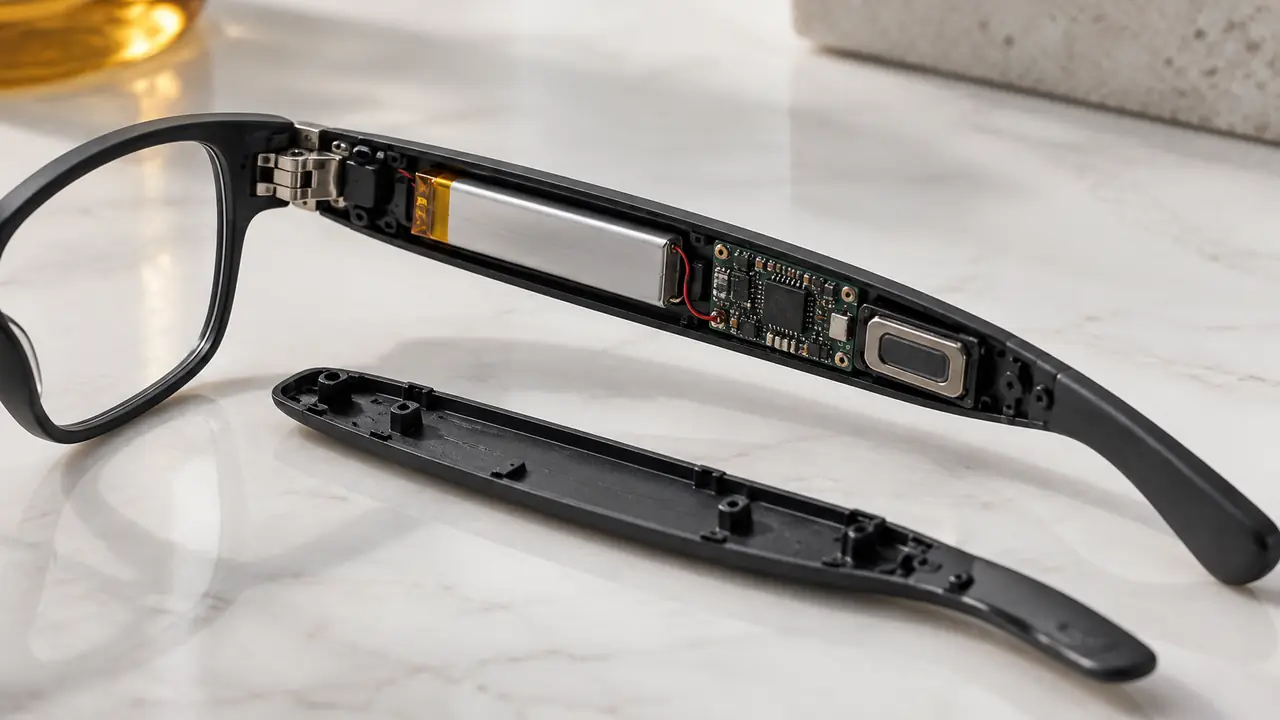
Cost and complexity rise in the same order as the table. An Rx-ready front adds little to the frame itself but moves work to the lens partner. Magnetic inserts add parts to every box and must be checked for retention when the wearer moves. A swappable front changes the hinge, the flex path and often the antenna environment, so it behaves like a new product in testing. Many brands start with Rx-ready fronts on a proven catalog model, then add inserts or swappable fronts once they know how many customers actually order prescription lenses.
Fit and frame measurements for Rx
Prescription lenses add constraints that plano lenses do not. Across the category, Rx-ready frames commonly use a lens width of 48-56 mm, a bridge of 16-20 mm and a temple length of 140-150 mm. Within that range, the lens height must leave room for the lab's centring needs, especially for progressive lenses, and the front must be stiff enough to hold the lens without stress. Higher powers mean thicker lenses, which add weight at the front and change the balance of a pair that already carries batteries in the temples; lighter lens materials help, per lens lab.
- Lens shape and groove: the lab needs the lens shape tracing or data and the groove or rim type.
- Power range: stated by the lens lab for the frame; not something the frame supplier can promise alone.
- Coatings: anti-reflective, scratch-resistant, UV400 and optional blue-light filtering lenses with no health claim.
- Tinted and photochromic Rx: available through many labs; sun lenses follow ISO 12312-1 categories, and Category 4 lenses are not suitable for driving.
Sizing in detail is covered in smart glasses sizing, and lens materials and treatments on lens options.
The lens lab workflow
A prescription program connects the electronics and frame supply chain with the lens supply chain. Frames come from the Shenzhen Henggang and Wenzhou Ouhai eyewear clusters, temple electronics from Shenzhen and lenses from labs in places such as Danyang, which local reporting describes as producing over 400 million pairs of lenses a year. For a brand, the practical workflow looks like this:
- Choose the Rx route and confirm the frame's lens shape, groove and size data on the engineering or catalog sample.
- Select the lens partner - a lab near your market, a domestic optician network or a lab that works with the frame supply chain - and confirm its power range for the frame.
- Test glazing on samples: the electronics in the temples must not be heated, bent or stressed during lens fitting, so the glazing method is agreed in writing.
- Write the handling rules for opticians into the fitting guide: which parts can be adjusted, which cannot, and how to handle the charging contacts.
- Plan returns: a prescription pair cannot be resold, so return rules and electronics repair paths need to be clear before launch.
Sourcing notes for brands and retailers
Rx-ready fronts on a catalog model are usually available within catalog MOQs of 50-500 pairs per model, with logo programs typically from 500-1,000 pairs. Magnetic or swappable fronts that need a new connector or hinge are a custom build from 3,000 pairs per model, with engineering samples typically in 30-60 days including tooling. Replacement fronts and lens inserts can be ordered as accessories, typically from 500-1,000 pieces. All of these are reference ranges confirmed in writing per program on MOQ and lead time.
Retail channels add their own needs: try-on frames fitted with plain display lenses are not part of the sales unit, so plan display stock separately, along with staff training and a short fitting guide. Optical retailers will find the channel view in smart glasses for optical retailers and on retailers. To scope an Rx-capable range, send your channel, target sizes and lens partner situation through the quote form.