
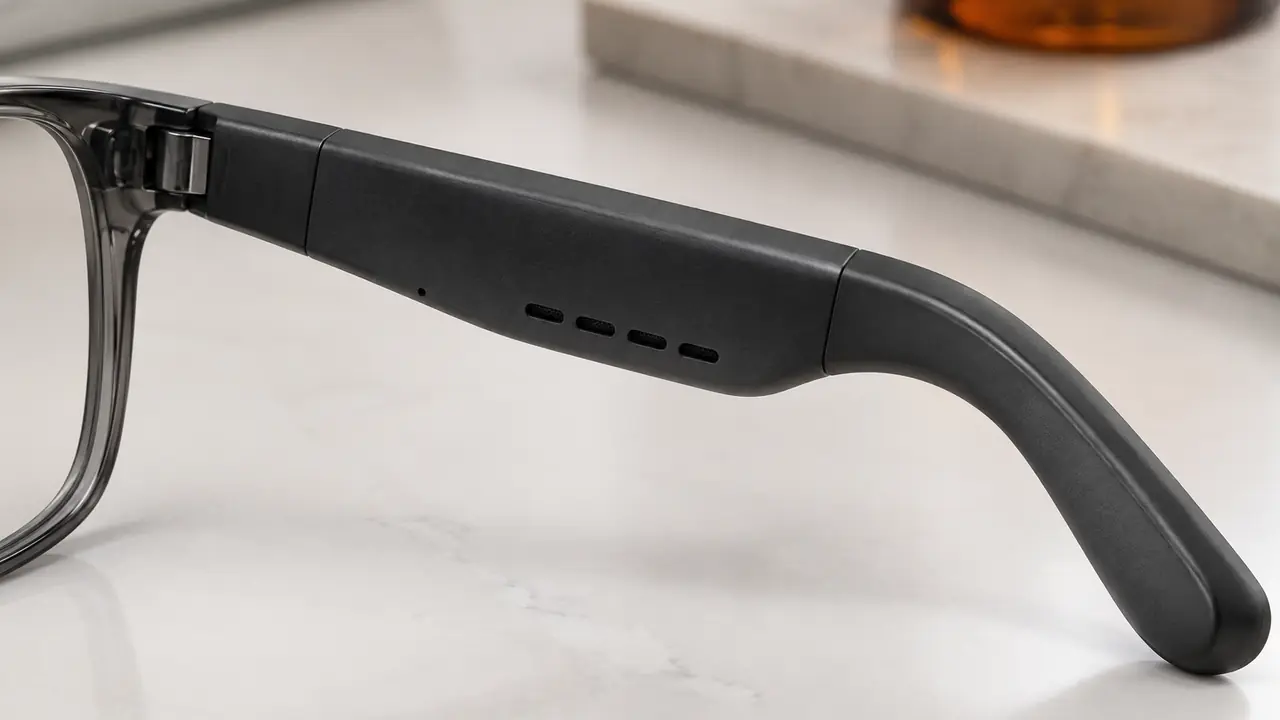
What an open-ear speaker in a temple is
An open-ear speaker in smart glasses is a small dynamic driver mounted inside the temple, just in front of or above the ear, firing sound towards the ear canal without sealing it. Nothing sits in or on the ear. The wearer hears music, calls and prompts while still hearing the room or the street, and the frame looks close to ordinary eyewear. That is the whole appeal of the format, and it is also the root of every acoustic compromise in it: an unsealed speaker has to push sound across a gap of air, and some of that sound inevitably travels in other directions.
Because the driver lives in the temple, the speaker is also a mechanical design problem. It shares a narrow plastic or metal shell with the battery cell, the Bluetooth board, the microphones and the flexible circuit that runs through the hinge. Every cubic millimetre given to the acoustic chamber is taken from the cell or the board. Programs that treat the speaker as a component to be dropped in late usually end up with thin bass, high leak or a temple that is thicker than the frame drawing promised.
The acoustic path: driver, chamber and ports
Three parts decide how an open-ear temple sounds. The driver is the moving diaphragm and magnet assembly, usually an elongated or racetrack shape so it fits the temple profile. The chamber is the sealed or partly vented volume behind and around the driver; its size and venting shape low-frequency output. The ports are the openings in the temple shell that let sound out - a main port aimed at the ear and, in most current designs, one or more secondary ports that release the sound radiated from the back of the diaphragm.
The back of a diaphragm radiates sound that is opposite in phase to the front. Designers use this. If a rear port is placed so that its out-of-phase output meets the front output away from the ear, the two partly cancel in that direction, which is the basic principle behind most anti-leak designs. Near the ear, where the main port is closer, the front output dominates and the wearer still hears the signal. This is usually described on spec sheets as reverse-phase or dipole leak control, and its effectiveness depends on port spacing, port size, mesh resistance and the exact position of the temple relative to the ear - which is why it is confirmed per acoustic test rather than assumed from a drawing.
Common port layouts compared
Partner plants in the Shenzhen electronics base tend to offer a small set of proven layouts per temple tooling. The table summarises how they behave in practice.
| Layout | How it works | Typical strength | Typical weakness |
|---|---|---|---|
| Single forward port | One opening aimed at the ear, rear volume sealed | Simple tooling, robust against sweat ingress | Higher leak, less low-frequency extension |
| Front plus rear port | Rear port releases out-of-phase sound away from the ear | Lower leak in the far field per acoustic test | Sensitive to port position and mesh tolerance |
| Downward-firing port | Main port on the underside of the temple near the tragus | Less visible openings, good for slim fronts | Output varies more with head shape and fit |
| Dual driver per temple | Two small drivers tuned for different bands | Fuller sound on premium models | More volume, more weight, more cost drivers |
None of these is right for every line. A sports wrap with a thick temple can afford a larger chamber; a slim business frame usually cannot, and its tuning has to accept a lighter low end. The acoustic choices for each temple tooling are summarised on acoustic design.
Tuning trade-offs: loudness, bass and leak
Open-ear tuning is a three-way negotiation. Raising output raises leak in roughly the same proportion, so a louder pair is usually a leakier pair unless the port layout changes. Extending bass needs either more chamber volume or more equalisation boost, and boosting the low end on a small driver costs battery and can push the driver into distortion at high volume. Reducing leak by cancelling rear and front output also cancels some useful sound near the ear, which the firmware then tries to recover with equalisation.
Firmware matters as much as hardware. The equaliser curve, the limiter that stops the driver from distorting, and the maximum volume step are all set in the Bluetooth audio SoC per firmware. Two pairs with identical drivers and temples can sound very different because one plant tuned for loud outdoor use and the other for quiet office calls. This is why buyers should audition engineering samples with the tuning they intend to ship, and lock that tuning file as part of the golden sample. The related topics are covered in sound leakage causes and fixes and audio glasses volume and SPL.
Mechanical details that change the sound
- Port mesh. Acoustic mesh keeps sweat and dust out but adds resistance; a mesh change between samples can shift the response noticeably.
- Temple wall stiffness. Thin walls resonate and colour the sound; ribs or a stiffer material reduce buzz at high volume.
- Driver sealing. A poor gasket between driver and chamber leaks air internally and kills bass.
- Distance to the ear. Temple length and frame size move the port relative to the ear, so fit and sound are linked.
What to write on the spec sheet
A useful speaker section on a smart glasses spec sheet is short but specific. It should name the driver type and size class as offered by the plant, the port layout, the mesh type, the tuning file version, the maximum volume step per firmware, the leak check method and the frequency response check method. It should also state the conditions: which test fixture or head simulator, which distance for leak checks, which test tone or programme signal. Without conditions, two plants can quote similar numbers that mean different things.
- Brief. Describe the use case - outdoor sport, office calls, commuting - and the frame style.
- Shortlist. The desk shortlists temple toolings with layouts that fit the use case.
- Audition. Engineering samples are compared with the intended tuning, on the same playlist and call script.
- Lock. The tuning file, mesh and port layout are frozen on the golden sample.
- Check. Leak and response checks are repeated on batch samples per the agreed method.
How the program runs
A catalog open-ear model from an existing temple tooling usually starts at 50 to 500 pairs per model, with samples in about 5 to 10 working days. A logo program on the same tooling typically starts at 500 to 1,000 pairs. Changing the port layout or the chamber means a new temple mould and acoustic retuning, which is a full custom ODM program from about 3,000 pairs, with engineering samples in about 30 to 60 days including tooling. These are typical reference ranges, confirmed in writing for each program on MOQ and lead time. If you already know the frame style and the use case, the quote form collects what a plant needs to propose a speaker layout.