
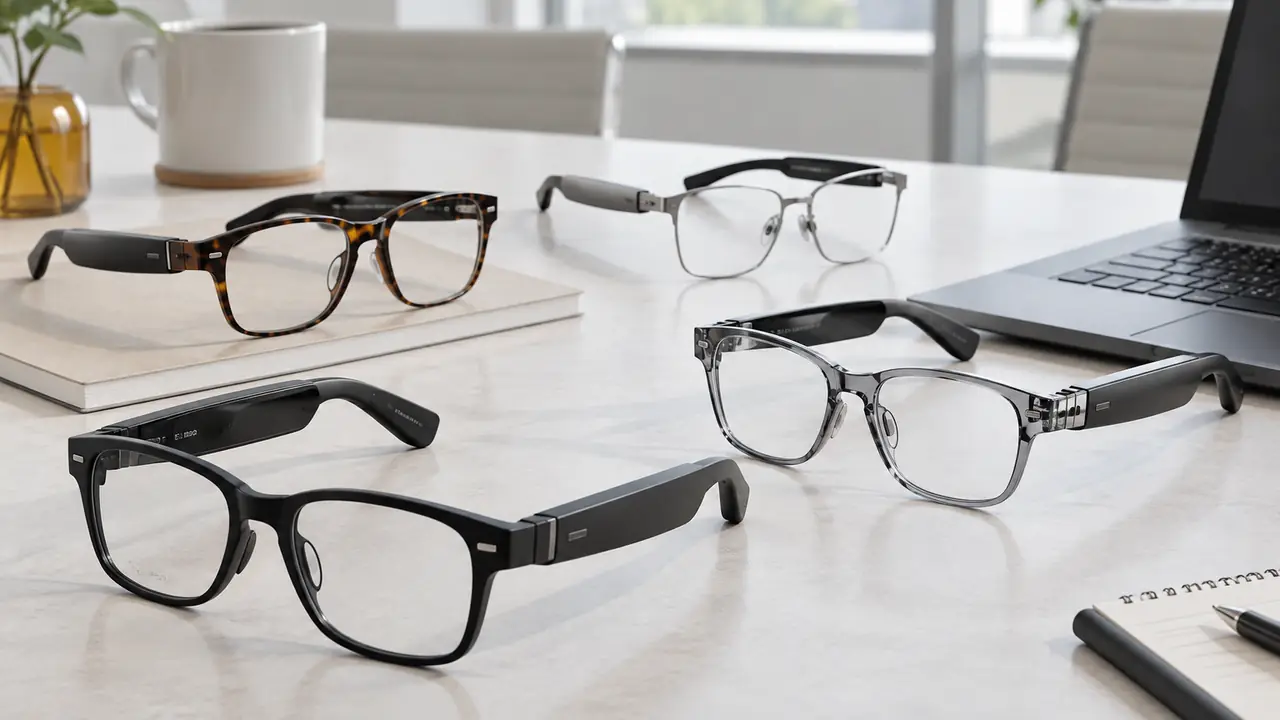
Why offices consider glasses instead of headsets
An office worker moves between a laptop, a phone and a meeting room several times a day. Headsets solve the audio but get left in drawers, press on the ears and announce that the wearer is on a call. Call glasses put the same functions - microphones, speakers, Bluetooth link and touch controls - into a frame that many people already wear, with open-ear speakers that leave the ears free for colleagues. For a brand or an enterprise buyer, the program succeeds if three things hold up in daily use: the pair switches cleanly between devices, the far end hears the wearer clearly in an open-plan office, and the frame is still comfortable at five in the afternoon.
The business call line carries the electronics for that; this page covers how to specify and test it for office use. Range context is on audio glasses.
Multipoint: two hosts, one pair
Multipoint lets the glasses hold connections to two devices, usually a laptop and a phone, and switch when a call arrives on either. Support depends on the chipset and the firmware, not on the Bluetooth version alone. In practice the details matter more than the feature flag: does music on the laptop pause when the phone rings, does the pair return to the laptop after the call, and what happens when a third device tries to connect. The desk asks partner plants to describe the switching rules in writing for the firmware version that ships, and the test plan checks them on the operating systems your users have. The behaviour is explained in multipoint Bluetooth in glasses.
Voice pickup and ENC
Call glasses typically use two or four microphones across the temples with environmental noise cancellation tuned in firmware. ENC reduces the background the far end hears; it does not change what the wearer hears. Results depend on mic placement, port design and the tuning for the target setting, so a quiet-room recording proves little. For office programs the desk requests recordings in a defined open-plan noise condition with nearby speech, keyboard noise and air conditioning, and compares candidate boards side by side.
| Office need | Spec to set | How it is checked |
|---|---|---|
| Clear voice in open plan | Dual or quad mic array, ENC per firmware | Recordings in defined office noise, side-by-side comparison |
| Laptop and phone | Multipoint per firmware, written switching rules | Pairing and switching tests on target operating systems |
| Meeting software | Standard Bluetooth headset profiles | Compatibility checks per project on the buyer's tools |
| Privacy at the desk | Open-ear speaker with leak control by design | Leak check per acoustic test at set volume |
| Full working day | Light front, balanced temples, adequate call time | Weight, runtime and wear trial on the golden sample |
Background on arrays and the common failures are in microphone arrays for call glasses and call quality problems on glasses.
Conferencing software compatibility
Call glasses connect as a standard Bluetooth headset, so most conferencing tools see them as an audio device. Compatibility is still not automatic: mute sync, call answer from the temple, the audio profile used during a call and the switch between headset and media modes vary by tool, operating system and firmware. The desk does not state compatibility in general terms. It is verified per project on the tools and platforms the buyer names, and the result is written into the spec sheet. Enterprise buyers should include their standard laptop image and meeting tools in the brief.
Weight and comfort over a working day
Across the audio lines, finished pairs weigh about 27 to 50 grams, typical across the category. For all-day wear, balance matters as much as total grams: cells and boards sit in the temples, so a pair can feel lighter on the nose than its weight suggests, or press behind the ears if the temple tips are stiff. Office programs often choose a slim TR90 or metal front, soft temple tips and an Rx-ready front so that people with prescriptions can use the glasses as their everyday pair. An optional blue-light filtering lens can be specified as a lens choice, with no health claim attached. Call time across the category runs about 3 to 9 hours, so the brief should state whether one charge must cover a full day. Fit guidance is in the lens and frame fit guide.
Program route for office ranges
Office ranges usually start from a catalog business call model with a logo: 500-1,000 pairs per model, samples in 10-15 working days and batch production in 20-35 days. Enterprise gifting and corporate fleets often add custom packaging and a quick-start card. Custom tuning, a new front or app white-labelling moves to full custom at typically 3,000 pairs per model. Figures are typical reference ranges, confirmed in writing for each program on MOQ and lead time. Send your device mix and meeting tools on the quote form.