
The three complaints
When callers complain about smart glasses, they describe one of three things. Wind: a roar or rumble that swamps the voice when the wearer walks outside, cycles or turns into a breeze. Echo: the caller hears their own voice coming back a moment later. Noise: traffic, office chatter or a café behind the voice, or a voice that sounds thin, distant or 'underwater' because noise reduction is removing too much. Each one has a different cause and a different fix, and they are often confused in support tickets.
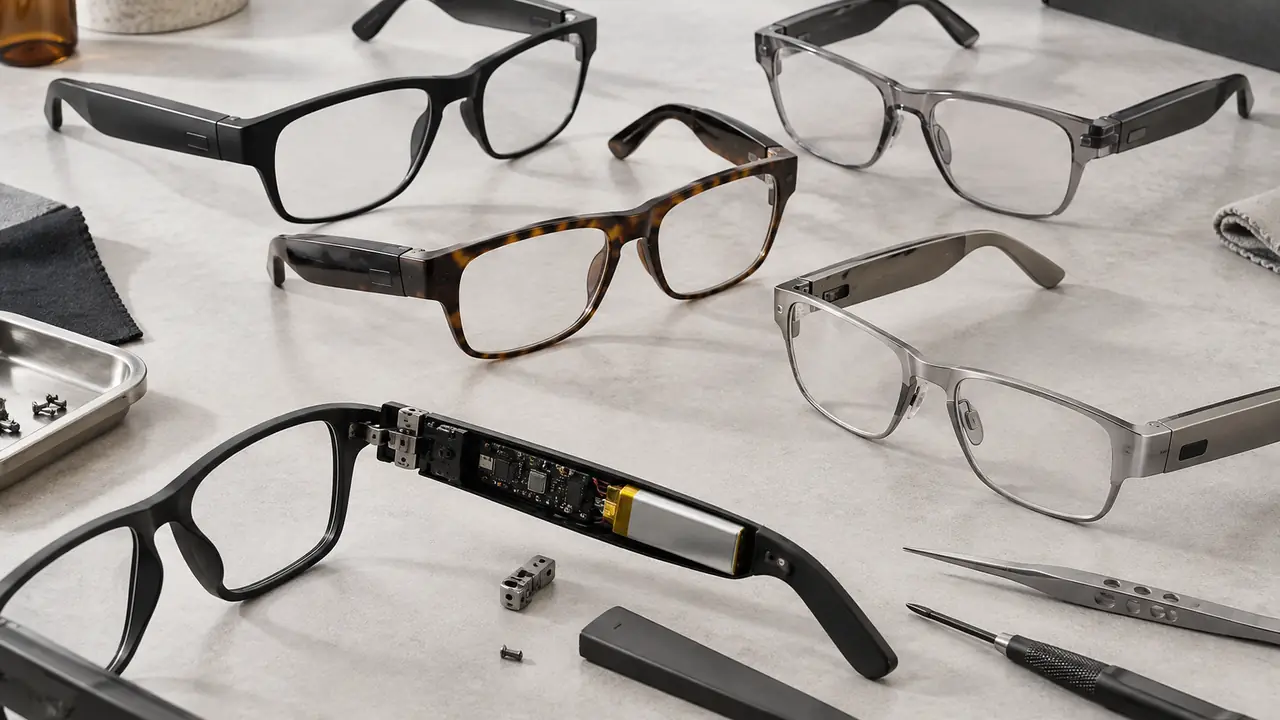
The geometry explains why glasses face these problems more than a handset. The microphones sit on the temples, several centimetres from the mouth, pointing forward or down. Across the category, call glasses use two or four microphones with environmental noise cancellation (ENC), and business models add a multi-microphone array with ENC or AI noise reduction per firmware. The speaker that plays the caller's voice sits a few centimetres from those same microphones, with no seal between them.
Root causes by layer
| Complaint | Design and materials | Firmware | Use |
|---|---|---|---|
| Wind | Mic port exposed to airflow, no wind mesh or foam, port on the front edge of the temple | Wind detection and suppression weak or disabled | Cycling, running, open-top vehicles |
| Echo | Speaker and mic acoustically coupled through the temple shell; loose assembly that vibrates | Acoustic echo cancellation (AEC) poorly tuned for open-ear output | Volume at maximum; call routed through a second device |
| Background noise | Mic spacing too small for beamforming; ports blocked by glue or residue | ENC too weak, or too aggressive so the voice sounds thin | Very loud venues, glasses worn pushed up on the head |
Two points sit underneath the table. First, the microphones must be matched: an array relies on the mics having similar sensitivity, so a mismatched pair in one temple degrades noise reduction even though each mic works on its own. Second, the codec and profile used for calls matter: Bluetooth call audio usually runs at a narrower bandwidth than music, and some phone operating system and app combinations select a different path. The background is on Bluetooth codecs for audio glasses.
Field triage routine
- Reproduce with a test call. Call a second phone or a voicemail box and listen to the recording. The wearer can then hear what the caller hears.
- Change one condition at a time. Repeat the call indoors in a quiet room, outdoors in still air and outdoors in wind. Wind-only problems point to ports and wind suppression.
- Lower the volume for echo. If echo disappears at lower volume, AEC tuning or speaker-to-mic coupling is the cause.
- Check the active device. With multipoint models, confirm which device holds the call. Calls handed over between devices mid-call can switch audio paths.
- Inspect the mic ports. Look for make-up, sweat residue, dust or a tear in the mesh. Clean dry per the manual.
- Record versions. Note firmware, app and phone operating system versions, plus the calling app used.
A unit that performs worse than a known-good reference unit in the same conditions is a product fault. A problem that every unit shares under one firmware version is a tuning issue for the plant's firmware team. A problem that appears only in one calling app is a compatibility case, worth logging but not a reason to replace hardware.
What to write into the spec
- Microphone count and layout. State the number of microphones per temple, port positions and the use of wind mesh or acoustic foam, confirmed on the engineering sample.
- Microphone matching. Require sensitivity matching within a tolerance agreed with the plant for each array.
- Noise reduction and AEC settings. Fix the ENC and AEC tuning on the golden sample, per firmware, and require written notice before changes.
- Test scenarios. Define the scenarios the tuning must pass: quiet room, street noise, office chatter and wind at a stated airflow, with recordings stored in the program file.
- Calling app and conference compatibility. List the calling and meeting apps to verify; for business models, compatibility is checked per project, as noted on business call glasses.
- Multipoint behaviour. Describe how a call on one device interacts with media on another.
Inspection items
Typical call-related checks during inspection, confirmed per order, are listed below; the general routine is on quality control.
- Microphone sensitivity check on each sampled unit, both temples, against the golden sample.
- Recorded test call in a quiet booth and with a played-back noise track, compared with the golden sample recording.
- Echo check at maximum volume.
- Visual check of mic ports, mesh and foam placement.
- Firmware version read-out against the locked version.
Engineering-stage tests go further: wind tunnel or fan tests at stated airflow, multi-language voice samples and long calls to check thermal behaviour. These are run on engineering and golden samples and repeated after any firmware change that touches the audio path.
It also helps to keep the reference material. A short set of golden sample recordings - quiet room, street, wind and echo at maximum volume - lets the plant, the desk and the buyer compare later lots by ear as well as by numbers. When a firmware update is proposed, the same recordings made on the new build show quickly whether the voice got clearer or thinner. That is cheaper than a field trial and harder to argue with.
Matching the product to the use case
Many call complaints come from a mismatch rather than a defect: a fashion audio model sold for cycling commutes, or a sports model sold for daily conference calls. Sorting the range by use case reduces that. The office calls and sports and outdoor pages show which modules matter for each. For a catalog model, call tuning is what the firmware already supports; changing microphone layout or AEC tuning is a logo or custom program, with typical MOQ and lead time on MOQ and lead time. When you send a brief through the quote form, describing where and how the glasses will be used for calls - desk, street, bike, site - lets the desk shortlist models whose microphone layout already fits, instead of tuning around a mismatch later.