
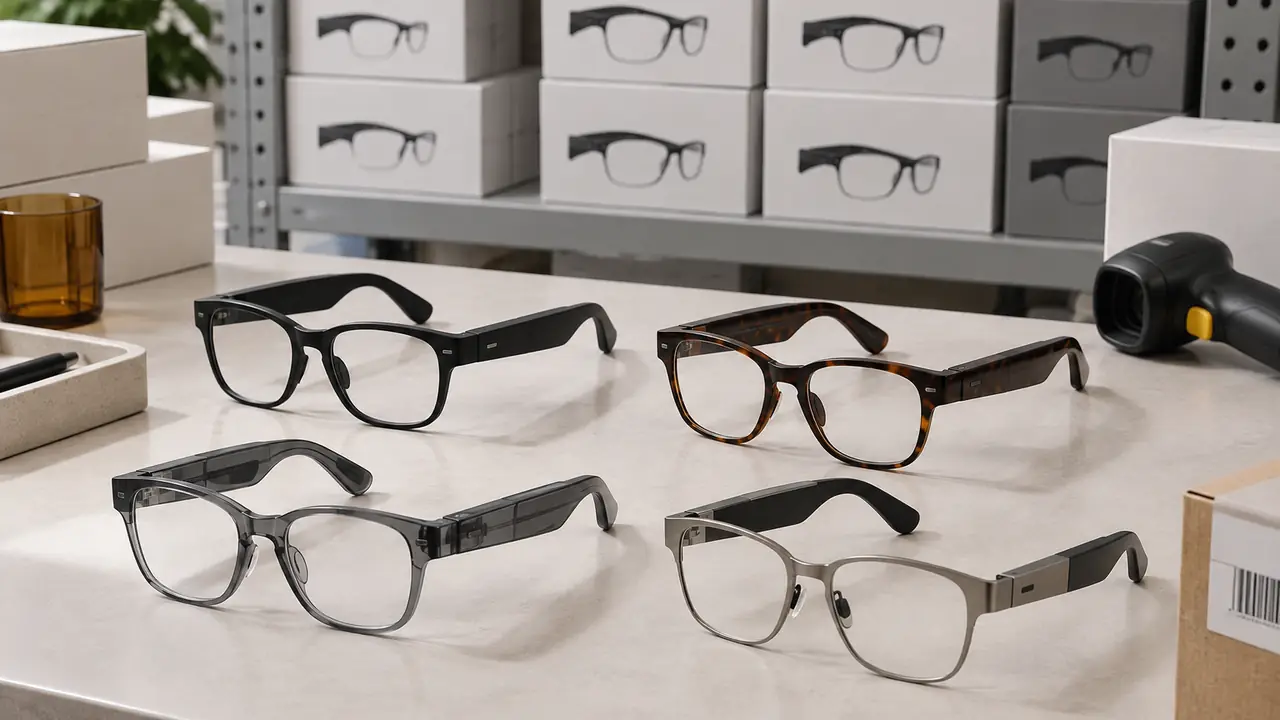
What the box has to do
Packaging for smart glasses does four jobs at once. It protects a frame that folds at a hinge carrying a flex cable, with lenses that scratch and temples that hold batteries and speakers. It carries the regulatory information for each market - radio approval marks, battery markings, recycling symbols and the address of the responsible party. It survives the trip, often by air, through couriers and marketplace warehouses. And it gives the customer a first impression that matches the price of the product.
These jobs pull in different directions. A large rigid box feels premium but adds volumetric weight to air freight; a slim mailer is efficient but may not protect the hinge. The right answer depends on channel: retail shelves, marketplace warehouses and direct shipping each favour a different structure.
Structures and inserts
Three structures cover most smart glasses programs. Each can be produced with a logo, custom print and inserts sized to the frame.
| Structure | Typical use | Protection notes |
|---|---|---|
| Rigid two-piece or drawer box | DTC, gifting, best tier | Strong walls; insert must hold the frame folded, with a cable recess |
| Folding carton with molded or card insert | Retail shelves, marketplace sales | Lighter and flatter; insert does most of the protection |
| Hard case inside a printed sleeve | Sports and travel lines, charging case models | The case protects the frame in use and in transit; sleeve carries print and marks |
The insert matters more than the outer box. It should hold the frame folded, with the temples resting so that no load sits on the hinge, keep the lenses clear of any surface and hold the charging cable in its own recess so that the magnetic connector cannot rub against the lenses. Molded pulp and card inserts are common alternatives to plastic trays where buyers want to reduce plastic content. A soft pouch or hard case adds protection and is usually expected in the better and best tiers; a charging case brings its own battery rules.
Battery marks and shipping rules
Smart glasses contain lithium-ion cells, so the packaging has to support battery shipping rules. When cells are installed in the glasses, the shipment is typically declared as UN3481, lithium ion batteries contained in equipment. Under IATA Packing Instruction 967 Section II, cells must be no more than 20 Wh and batteries no more than 100 Wh, which smart glasses cells are well within; packages on passenger aircraft are limited to 5 kg net lithium battery weight, and the package carries the lithium battery mark with the shipment declaration on the waybill. IATA guidance recommends a state of charge of 30 percent or less; under PI 967 that is a recommendation, not a requirement.
- Retail box: battery information as required by the destination market, plus recycling and battery symbols under rules such as the EU Battery Regulation 2023/1542 and WEEE.
- Master carton: lithium battery mark where required, carton count, gross weight and batch number.
- Documents: UN 38.3 test summary for the cells, available to the forwarder and marketplace.
A charging case with its own battery may need to be assessed separately per Wh, under UN3480 or UN3481 depending on how it ships. Rules change and forwarders apply their own conditions, so confirm the route with your forwarder; the details are in shipping wearables with batteries and on logistics and shipping.
Transit testing
A box that looks right can still fail in transit. Most programs agree a set of transit checks on packed samples before the first batch: drops onto faces, edges and corners of the retail box and master carton, compression for stacked cartons and a check that the frame, hinge and lenses are undamaged and the pair still charges and pairs afterwards. Drop heights, sequences and pass criteria are stated working defaults, confirmed per order, and the results go into the inspection record.
Two failure patterns are common enough to check every time. The first is hinge stress, where an insert holds the frame half open and a drop pushes the temple against its stop. The second is lens contact, where the cable or a loose accessory rubs the lens through transit vibration. Both are cheap to fix at the insert stage and expensive to discover in reviews.
Marketplace warehouses add their own conditions. Many expect cartons to survive their handling without extra overboxing, require barcode labels in fixed positions and apply separate rules to products containing lithium batteries. Check the warehouse requirements for each marketplace before the master carton is designed, because changing carton size or labelling after production starts usually means relabelling stock at the destination. Where the same product goes to retail, marketplace and direct channels, a shared retail box with channel-specific master cartons is often the simplest solution: the box stays consistent for customers, while each channel gets the carton count and labels it needs. The same applies to climate: cartons that travel by sea for 30 to 45 days to Europe benefit from desiccant and moisture-resistant inner bags around the retail boxes.
Designing the unboxing
A good unboxing follows the order in which a customer needs things. The sequence below suits most smart glasses programs.
- First view: the glasses, folded and centred, with nothing covering the lenses.
- Next: the charging cable in its recess, ideally with a short card showing how the magnetic contacts align.
- Then: the pouch or case, and spare nose pads or temple tips if included.
- Last: the quick start guide with pairing steps, the app download route, care advice and the compliance information.
The quick start guide is part of the packaging and part of after-sales. Pairing and charging steps on that card prevent many support contacts. If the pair ships partly charged, a note telling the customer to charge before first use avoids a common early complaint.
Quantities, timing and approval
Custom printed boxes usually belong to a logo and packaging program, typically 500 to 1,000 pairs per model, with logo samples in 10 to 15 working days - reference ranges confirmed in writing for each program on MOQ and lead time. Print proofs, a white sample of the structure and a packed transit sample are approved in that order. The private label route as a whole is explained in the private label guide. Send your channels and markets through the quote form and the desk will match the structure and marks to each.