
What a camera glasses unit contains
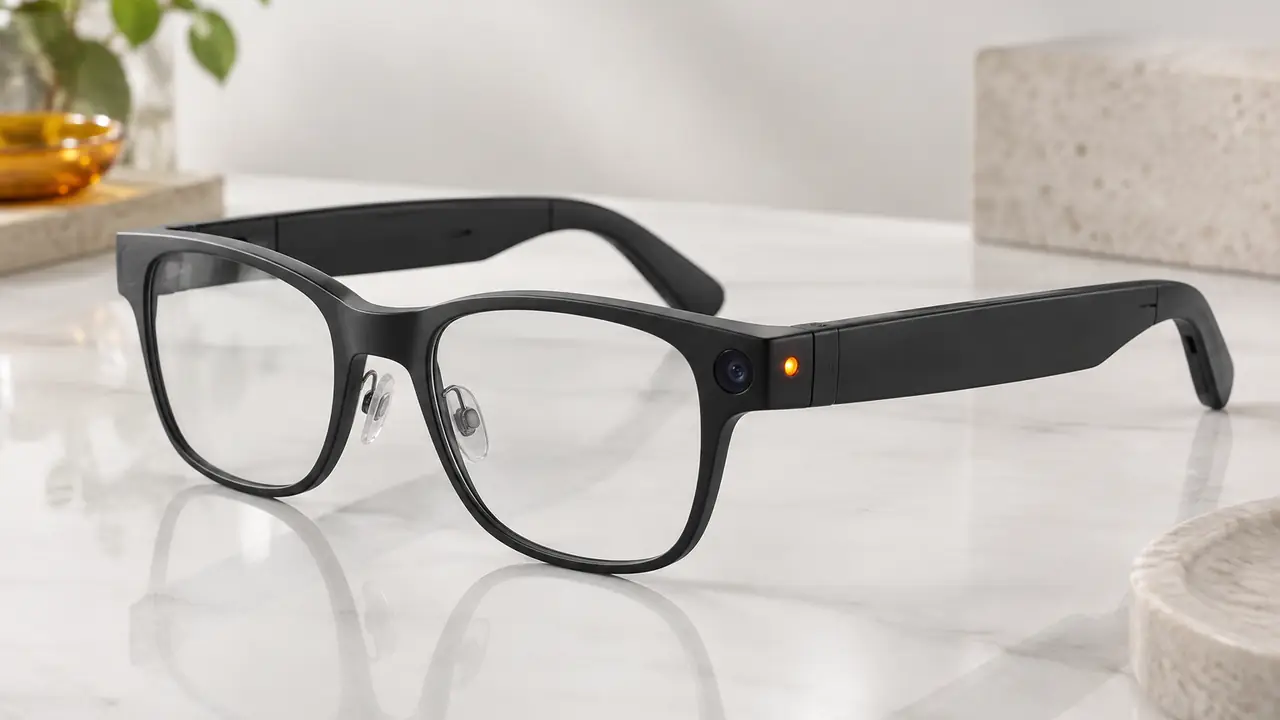
Camera glasses add an imaging chain to the standard smart glasses skeleton. A small camera module sits at the front corner of the frame, next to a recording indicator LED. Behind it, an image processor, onboard storage and a Wi-Fi radio share the temple with the Bluetooth chip, the cells, open-ear speakers and microphones. The hinge carries more signals than on audio glasses, so its flex cable and reinforcement deserve particular attention. Photos and clips are stored on the glasses and transferred to a phone app over Wi-Fi, with Bluetooth used for control.
Across the category, actual sensors are usually 5 to 12 megapixels. Some low-cost listings quote higher numbers that come from interpolation rather than the sensor itself, so the spec sheet should name the actual sensor resolution. Video is mostly 1080p, with 4K at the high end. Storage runs from 16 to 128 GB onboard, sometimes with a microSD slot. The camera module page covers the engineering, and camera glasses specs explains how to read each line of a spec sheet.
The recording indicator is part of the product
A camera worn on the face records people who may not know it. Responsible brands treat the indicator as a core component, not a decoration, and the desk will not source a camera model without one. On 13 October 2026 the European Data Protection Board adopted a statement on smart glasses. It is guidance, not new law, but it sets out clear expectations for manufacturers:
- the duty to inform people nearby sits with the manufacturer rather than only with the wearer;
- the indicator should be visible under different lighting conditions, including daylight;
- recording video and taking a photo should use different light signals;
- the device should not be able to record when the indicator is covered;
- a white LED can be mistaken for a reflection on the frame, so colour and pattern matter.
In practice that means writing into the spec the LED position, colour, brightness, blink patterns for photo and video, and a cover-detection check that blocks capture. These items are tested on the golden sample and again at pre-shipment inspection. The privacy indicator guide goes deeper.
Options buyers usually specify
| Module | Common options | What it changes |
|---|---|---|
| Sensor | 5 MP to 12 MP actual resolution | Photo detail, processor load, power draw |
| Video | 1080p mainstream; 4K on high-end platforms | File size, heat, storage and transfer time |
| Storage | 16, 32, 64 or 128 GB; optional microSD | Clip capacity and data handling on loss or return |
| Transfer | Wi-Fi to app, Bluetooth control | Radio test scope and EN 18031 documentation |
| Indicator | LED colour, position, photo and video patterns | Bystander visibility and alignment with EDPB guidance |
| Front | TR90 or acetate; clear, tinted or polarized lens | Camera window design and lens standard |
Data, cybersecurity and certification
Camera glasses carry personal data by design. The spec sheet should state whether images stay on the device until transfer, whether the app uploads anything to the cloud, where servers are located and how users delete files. For the EU, glasses fall under the RED cybersecurity requirements of Article 3(3)(d)(e)(f) since 1 August 2025, with the EN 18031 family as harmonised standards; the Cyber Resilience Act takes over from 11 December 2027. Wi-Fi widens the radio scope under FCC Part 15.247 and EN 300 328, alongside EN 301 489, EN 62368-1, RF exposure assessment, Bluetooth SIG qualification, UN 38.3 and IEC 62133-2 for the cells, and ISO 12312-1 or ANSI Z80.3 for lenses. Certificates are issued by test labs to the partner plant or your brand per project and verified by the desk.
Program route and quantities
Camera glasses suit content creators, field teams and travel brands; the use case is on content creation and first-person capture. Most programs start from a catalog platform with a logo and app skin at 500-1,000 pairs per model. A full custom front or imaging layout starts at 3,000 pairs, with ODM engineering samples in 30-60 days and batches in 45-75 days excluding certification queues. These are typical reference ranges, confirmed in writing for each program on MOQ and lead time. Start with the quote form.