
Why spec sheets need reading, not just comparing
Catalog spec sheets are written to sell. They are rarely wrong, but they usually report the best result under the most favourable conditions: playback time at moderate volume with AI features off, Bluetooth range in open space, camera resolution after interpolation. Comparing two sheets column by column therefore tells you little until you know how each figure was obtained. The skill is to read each line, place it in the typical range for the category and ask the one question that makes it testable.
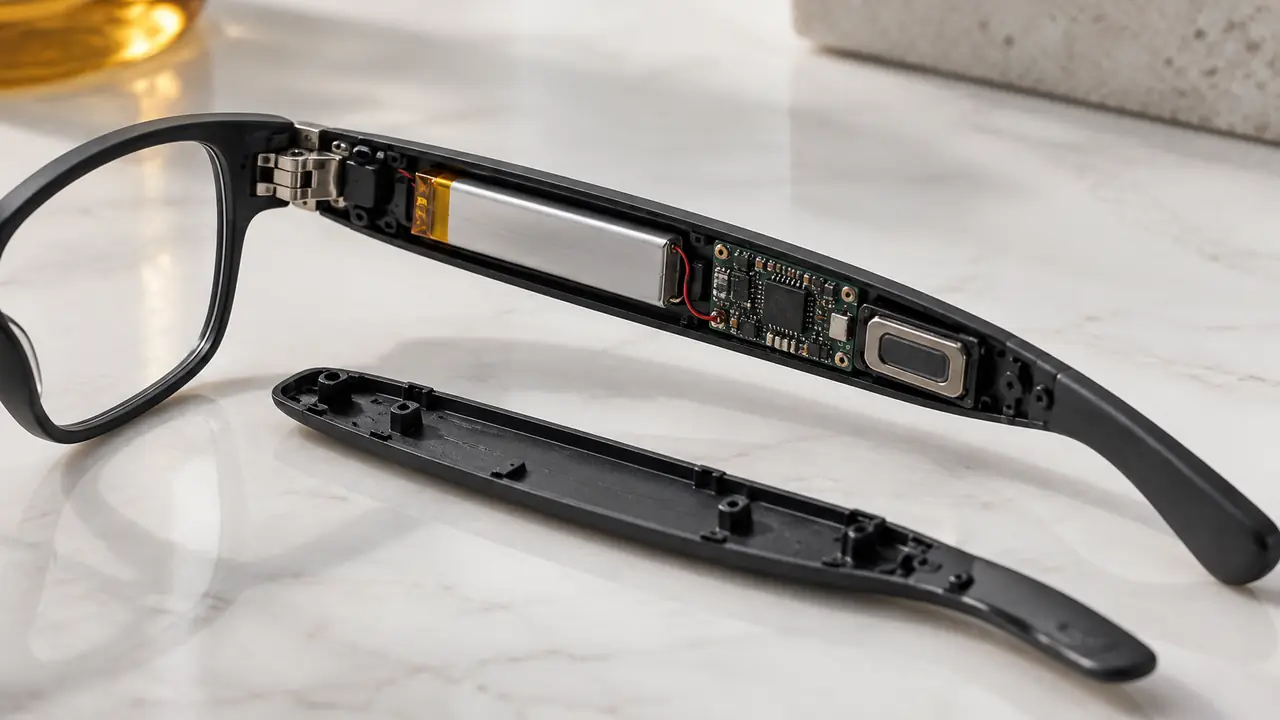
Templora spec sheets follow the same six-module order for every model - front and lenses, hinge and flex, board and chipset, battery and charging, audio or imaging module, mics, controls and app - so that any missing line is visible. If a supplier sheet does not follow that order, it is worth rewriting it into that order before comparing; the map is explained in inside a smart glasses temple.
The core lines with typical ranges
| Line | Typical across the category | Question that makes it testable |
|---|---|---|
| Bluetooth version | 5.2-5.4, 5.3 most common | Which features are enabled in firmware: multipoint, LE Audio, codecs? |
| Battery capacity | About 85-235 mAh total across both temples | Per cell or total? Which cell and which IEC 62133-2 report? |
| Music playback | 4-13 h | At what volume, codec and with which features on? |
| Talk time | 3-9 h | With noise reduction on, at what volume? |
| Charging | Magnetic pogo charging in 1-2 h | Cable type, connector spares, charge from flat to full? |
| Weight | 27-50 g per pair | With which lenses? Front and temple weight? |
| Water resistance | IPX4-IP54 per test | Tested per IEC 60529 by which lab, on which version? |
| Speaker output | Open-ear peak SPL about 75-90 dB per maker figures | Measured how, and with what leakage at the same level? |
| Microphones | Dual or quad mic ENC per firmware | Call test in wind and street noise? |
| Frame size | Lens 48-56 mm, bridge 16-20 mm, temple 140-150 mm | Printed size and total frame width? |
Reading the battery and runtime lines
Runtime is the line customers notice most and the one most often stated under ideal conditions. A useful sheet states capacity per cell and in total, playback and talk time with the test conditions, standby time separately, charge time and the charging method. Ask whether the playback figure was measured at a fixed volume level, which codec was used and whether voice assistant or translation features were active, because AI features can cut runtime sharply. The transport documents belong here too: the UN 38.3 test summary for the cells and the shipping classification, usually UN3481 for lithium-ion batteries contained in equipment. The battery and runtime guide covers the comparison in depth.
Reading the audio, camera and AI lines
Audio lines should be read as a pair. A high sound pressure figure means little without a statement about leakage at the same level, because open-ear speakers trade loudness against what people nearby hear. Frequency response charts are useful only when the measurement method is stated. Microphone lines should name the number of microphones and the noise reduction approach per firmware, and ideally refer to a call test in wind and street noise.
Camera lines need more care. Across the category, actual sensors of 5 to 12 megapixels are common and 1080p video is the norm; some low-cost listings state higher figures produced by interpolation. Ask for the sensor resolution, not the output resolution, plus storage (16 to 128 GB on board, or microSD), transfer method and the behaviour of the recording indicator LED. For AI and translation features, a sound sheet says per app and translation engine for supported languages and gives latency as a typical range, such as 0.5 to 3 seconds of cloud latency per network and language pair. Sheets that promise more should be treated with caution.
Reading the compliance and document lines
The last part of a sheet lists certificates and reports. These belong to partner plants or test labs and must be verified per project, not accepted from a list. For the US, look for the FCC ID under Part 15.247 and the Part 15 Subpart B report; for the EU, a declaration under the Radio Equipment Directive referring to EN 300 328, EN 301 489-1 and -17, EN 62368-1, an RF exposure standard and, since August 2025, EN 18031 for cybersecurity. Optical lines should name ISO 12312-1 or ANSI Z80.3 for the lenses and the 21 CFR 801.410 drop ball test for the US. Battery lines should name UN 38.3 and IEC 62133-2. Also check RoHS and REACH declarations. The full list by market is in the certification guide; confirm the scope for your product with your test lab.
- Check that the model number on each report matches the model on the sheet.
- Check the report date and whether the version you will buy was the version tested.
- Check who the applicant is; reports in another company's name may not transfer to your listing.
Turning the sheet into an order specification
Once each line has been questioned, the sheet becomes the base of the order specification. Lines that matter to your channel - runtime for commuters, call quality for office users, water resistance for sports - get a target and a test item; the rest are recorded as reference. Write each target in the same units and conditions as the test that will check it, for example playback time at a stated volume step and codec, so that the partner plant, the lab and the inspector all measure the same thing. Inspection before shipment then checks the batch against those lines; test counts and pass criteria are a stated working default confirmed per order.
Lead times and quantities are written into the same document: catalog models typically from 50-500 pairs per model, logo programs from 500-1,000 pairs, samples in 5-15 working days for catalog and logo work, all reference ranges confirmed in writing per program on MOQ and lead time. Send a supplier sheet you are evaluating, or the lines you need, through the quote form and the desk will return it in the six-module format with the questions marked.