
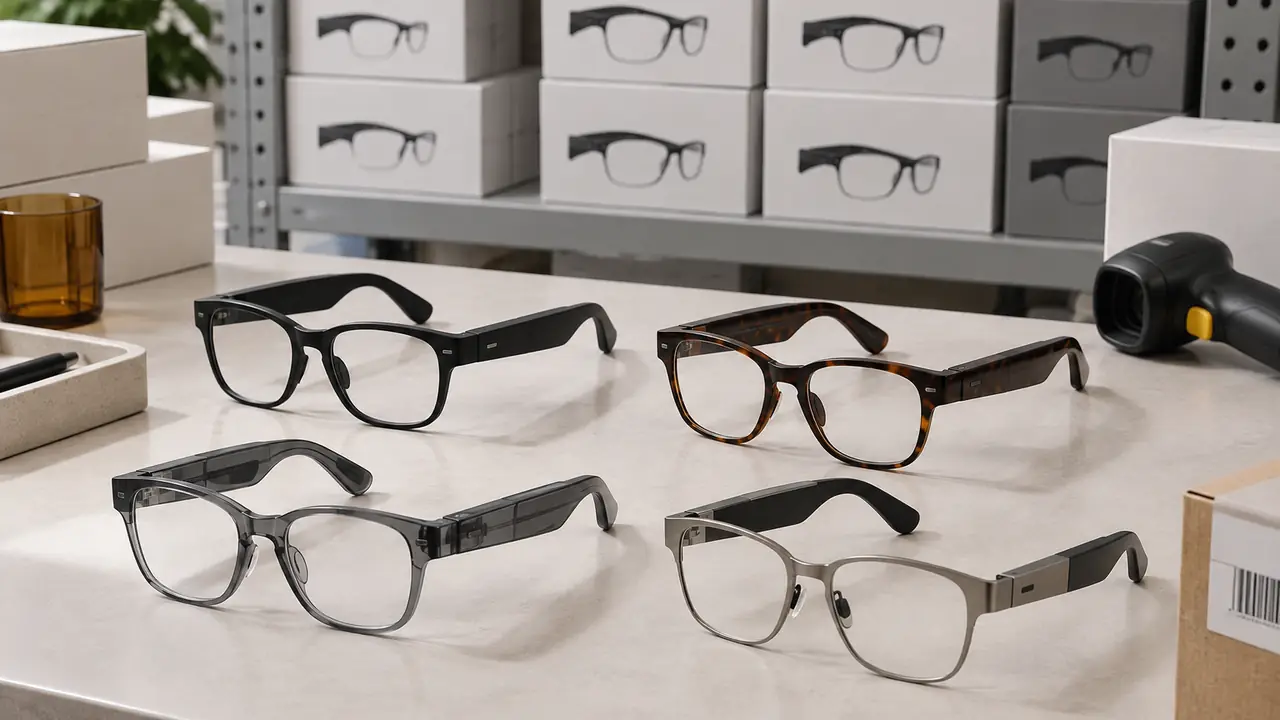
What shoppers read first
On major marketplaces, shoppers scan a smart glasses listing in a predictable order: the main image, the title, the first lines of the bullet points and then the specification table. Search behaviour points the same way. In a desk scan of 2,735 search suggestions around smart glasses, 721 phrases were about specifications and functions, 238 about materials and frames and 207 about comparisons. People want to know how long the pair runs, how it sounds, how heavy it is, whether it fits over their face and how it compares with earbuds.
That makes the agreed spec sheet the most valuable piece of listing content you own. Every figure on the listing should trace back to the golden sample, the test report or the firmware release notes for that program. When the listing and the spec sheet match, questions and returns drop; when they drift apart, reviews do the correcting for you.
The specification block
The table below lists the attributes most shoppers look for, how to state them and where the figure should come from. Ranges shown are typical across the category, not values for a specific model.
| Attribute | How to state it | Source document |
|---|---|---|
| Weight | Grams for the complete pair, for example within the 27-50 g category range | Golden sample weighing record |
| Runtime | Music and call hours with test conditions, such as volume level | Runtime test on production firmware |
| Charging | Charging time and connector type, such as magnetic pogo pin | Spec sheet and charging test |
| Bluetooth | Version, multipoint support per firmware | Bluetooth SIG listing and spec sheet |
| Water resistance | Water-resistant per IPX4 or IP54 rating, tested per IEC 60529 | IP test report |
| Frame size | Lens width, bridge and temple length in millimetres | Frame drawing |
| Lenses | Lens type, UV400, filter category under ISO 12312-1 where relevant | Lens test report |
| App and features | Functions per app version and firmware | App release notes |
Runtime deserves the most care. Volume, codec and AI features change runtime sharply, so a figure without conditions invites disappointment. The note on reading a spec sheet explains which conditions to record.
Compliance details that belong on the page
Marketplaces increasingly ask for compliance information at listing stage, and shoppers in some markets look for it. Typical items include:
- Radio approval. In the US, the FCC ID shown on the product and in the listing where the marketplace asks for it; the route is covered in FCC Part 15 for Bluetooth glasses. In the EU, the CE marking and declaration of conformity under RED 2014/53/EU.
- Battery information. Battery type and, where requested, the UN 38.3 test summary. Marketplace warehouses often apply their own rules for products with lithium batteries; check them before inbound shipping.
- Optical conformity. For sunglass lenses, the category under ISO 12312-1 or conformity with ANSI Z80.3, and the warning that category 4 lenses are not suitable for driving.
- Privacy features on camera models. A clear statement that the pair has a recording indicator LED, and how it behaves while recording and taking photos.
Certificates and test reports are held by partner plants or test labs for each program and are verified per project. Confirm marketplace-specific document requirements with the marketplace and, where needed, your counsel.
Wording that keeps a listing accurate
Several claims that appear across the category create risk because they cannot be supported or because they stray into regulated territory. The safer pattern is to state what was tested and under which conditions.
| Claim area | Risk | Accurate wording |
|---|---|---|
| Water exposure | Absolute water claims overstate what an IP test shows | Water-resistant per IPX4 or IP54 rating, tested per IEC 60529 |
| Health and vision | Medical or vision benefit claims are regulated | State lens facts: UV400, polarized, blue-light filtering lenses with no health claim |
| Translation | Claims of no delay or of every language cannot be met | Languages per app and translation engine; typical cloud latency 0.5-3 s |
| Camera | Wording that implies discreet recording raises privacy concerns | Camera with recording indicator LED; follow local recording rules |
| Runtime | Best-case figures without conditions | Hours with stated volume and feature settings |
Lens wording is the area most often misjudged; blue light filtering lenses: what can honestly be claimed covers it in detail.
Images, comparison content and FAQ
Smart glasses images work best when they explain the product rather than set a mood. A useful image set includes the pair from the front and side with a scale reference, an exploded or annotated view of the temple showing speaker, microphones and charging contacts, the charging cable in place, the frame measurements and the box contents. Many sellers avoid model photos with faces and use mannequin heads or product-only shots, which also keeps images consistent across colours.
Comparison content answers the questions shoppers bring from search. A short table against earbuds - awareness of surroundings, comfort, call pickup, runtime - helps buyers who are deciding between categories. Keep comparisons factual and about categories rather than named competitors.
The FAQ section should be built from real questions. Pairing, charging contacts, fit over larger faces, using the pair with prescription lenses and what happens to calls in wind are the usual themes. Pre-launch, the problem notes on this site are a fair starting set; after launch, customer questions and return reasons should feed the FAQ directly, as described in reducing returns on smart glasses.
Keeping listings in sync with the product
Smart glasses change after launch. Firmware updates add features, adjust touch controls or change runtime; a second production batch may use a revised component. Each change should trigger a listing review. A simple control is to give the listing a version that matches the firmware and spec sheet revision, and to update both together. When the desk inspects a batch before shipment, the inspection checks the product against the same spec sheet, so the listing, the product and the inspection record describe the same pair.
Packaging copy follows the same rule; the box is often photographed for the listing and has to match it, as covered on packaging and retail boxes. Typical quantities for logo and packaging programs are 500 to 1,000 pairs per model, confirmed in writing for each program. Send your target marketplaces and range through the quote form and the desk will map the documents each listing needs.