
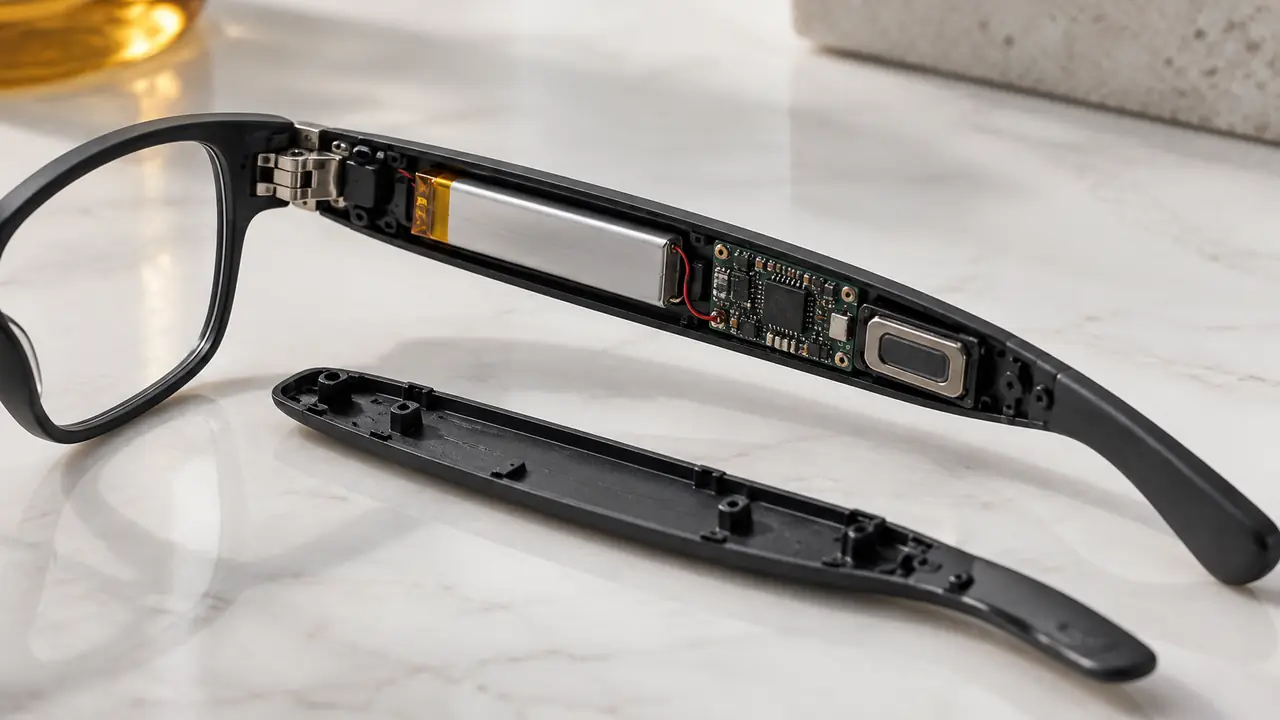
The signal path in one paragraph
A phone sends compressed audio over a 2.4 GHz Bluetooth link. An antenna in one temple picks it up and passes it to the Bluetooth audio system-on-chip, which decodes the stream, applies the equalizer and volume settings from firmware and drives a small amplifier. The amplifier feeds the speaker in that temple and, through the flex circuit in the hinge or a second radio link, the speaker on the other side. When the wearer speaks, the microphones capture the voice, the chip runs noise reduction per firmware, and the audio goes back to the phone. Everything else on the spec sheet - range, latency, battery life, call clarity - is a consequence of how well each step is designed into a narrow temple.
The chipset and what the version number means
Across the category, Bluetooth glasses use versions 5.2 to 5.4, with 5.3 the most common. The version number describes which features the chip can support, not how good a product sounds. A newer version can bring better power efficiency, LE Audio support and more stable connections, but only if the firmware and the phone support the same features. Templora spec sheets describe chipsets generically, for example a BT 5.3 audio SoC with multipoint per firmware, because the brand of the chip matters less to the end user than the tuning around it.
| Spec line | Typical across the category | What to ask |
|---|---|---|
| Bluetooth version | 5.2-5.4, 5.3 most common | Which features are enabled in firmware, not just in the chip |
| Profiles | A2DP for music, HFP for calls, AVRCP for controls | Whether BLE is used for the app and OTA updates |
| Codecs | SBC baseline, AAC common, LC3 on LE Audio capable designs | Which codec the target phones will actually negotiate |
| Multipoint | Two devices on many newer models, per firmware | How switching behaves during a call |
| Range | Stated in open space by the maker | Range with the pair worn and the phone in a pocket |
| Certification | FCC Part 15.247, CE RED with EN 300 328, Bluetooth SIG listing | Who holds the FCC ID and the Declaration ID, verified per project |
The antenna: the hard part in a frame
In earbuds, the antenna sits in a small shell away from the head. In glasses, it must fit in a temple a few millimetres thick, close to the skull, often next to a metal hinge or spring and sometimes inside a metal frame. Human tissue absorbs 2.4 GHz energy, and metal parts detune the antenna, so a design that works on a test bench can drop out when worn, especially when the phone is in a back pocket on the opposite side.
Good designs place the antenna at the end of the temple away from the hinge, keep metal decoration away from it and tune it on a head phantom rather than in free air. When a brand wants a metal or titanium front on a design that was tuned for TR90, the antenna often has to be retuned; that is one reason why material changes count as a custom program rather than a colour change. The frame materials page lists which materials affect radio behaviour.
Pairing, multipoint and the second speaker
Pairing works like any Bluetooth headset: the glasses advertise, the phone connects and stores a key. Two design details matter more on glasses. First, how the pair enters pairing mode: a long press on a touch strip is easy to trigger by accident when the wearer adjusts the frame, so the gesture and timing are tuned in firmware. Second, how the two temples share audio. Some designs run one radio and pass audio across the hinge flex; others use a radio in each temple and relay audio between them. The first is simpler but depends on the flex surviving thousands of folds; the second avoids the flex but adds power draw and timing work.
Multipoint lets the pair stay connected to two devices, for example a phone and a laptop, which business and office users value highly. It is a firmware feature, so behaviour differs between models: some pause music when a call arrives on the second device, others need a manual switch. Test the exact behaviour on the golden sample with the devices your customers use, and record it in the spec sheet. Connection complaints are covered in Bluetooth glasses not connecting.
Power, latency and what the user feels
The Bluetooth link is one of the largest power users in a pair of audio glasses, together with the amplifier. That is why playback time across the category varies from about 4 to 13 hours: a bigger cell, a more efficient chip, lower default volume and a simpler codec all extend it. Runtime figures should always state the conditions under which they were measured. The battery and runtime guide explains how to compare them.
Audio latency, the delay between the phone and the sound, matters for video and games more than for music. It depends on the codec, the buffer settings in firmware and the phone. Spec sheets that state a single latency number should say how it was measured. For translation glasses the larger delay is not the Bluetooth link but the app and cloud engine, typically 0.5 to 3 seconds per network and language pair.
Testing and certification of the radio
Because the glasses contain a 2.4 GHz transmitter, they need radio approval in each market. In the US that means FCC Part 15.247 for the Bluetooth transmitter with an FCC ID, Part 15 Subpart B for digital emissions, and an RF exposure assessment, since the device is worn on the head. In the EU, CE under the Radio Equipment Directive 2014/53/EU uses EN 300 328 for spectrum, EN 301 489-1 and -17 for EMC, EN 62368-1 for safety and EN 50566 or EN 62479 for RF exposure; since August 2025 the cybersecurity requirements under EN 18031 also apply to wearable radio equipment such as glasses. Bluetooth SIG qualification covers the use of the Bluetooth name and logo. Lab testing typically takes 3-6 weeks per lab and scope. Certificates are held by partner plants or test labs and verified per project; confirm the full scope with your test lab.
Production schedules depend on that path: catalog and logo batches typically run 20-35 days and full custom OEM 45-75 days excluding certification queues, as listed on MOQ and lead time. To start a Bluetooth glasses program, send your target devices, quantity and markets through the quote form.