
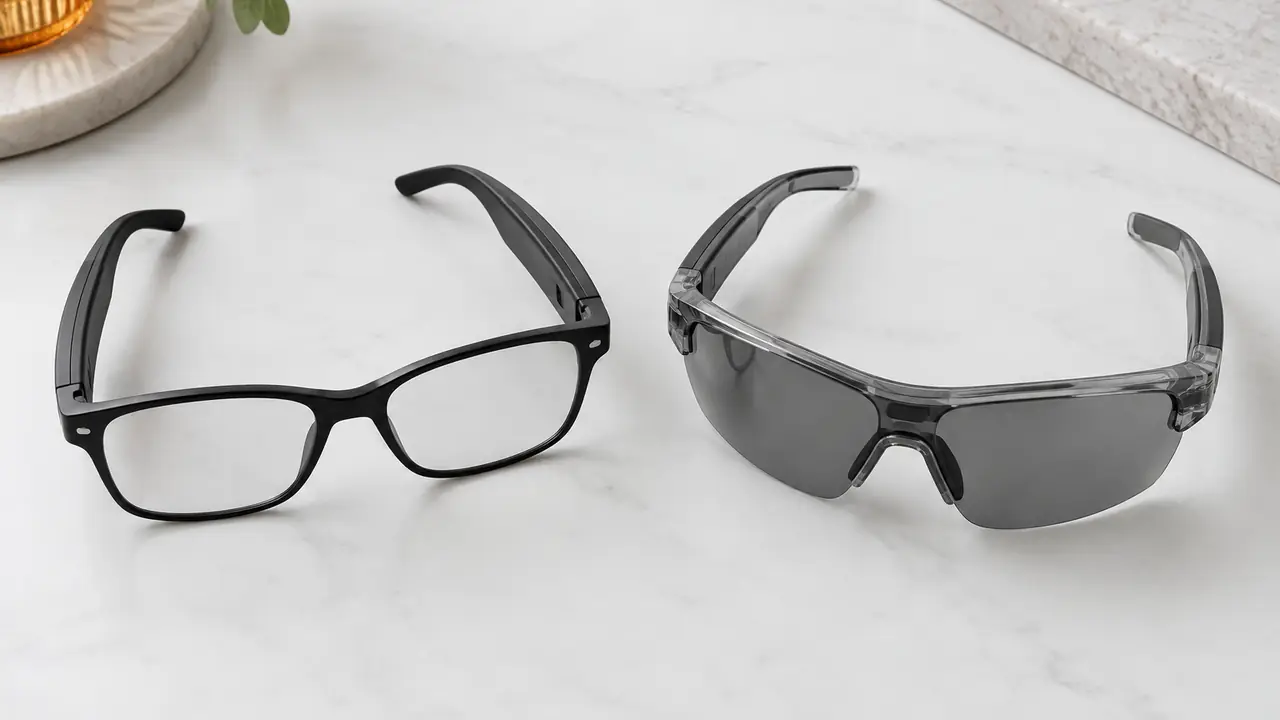
What a Bluetooth version number means
A Bluetooth version is a version of the core specification published by the Bluetooth SIG. Each version adds features to what came before and refines existing ones. What many buyers do not realise is that most features in a version are optional. A chipset or product that declares Bluetooth 5.4 is built to that version of the specification, but it does not have to implement every feature the version introduced, and a 5.3 product may already support the features that matter most for audio.
For that reason, the version number on a smart glasses spec sheet tells a buyer less than the list of supported features, profiles and codecs. Across the category, Bluetooth 5.2 to 5.4 is typical, with 5.3 the most common. The practical question is not which number is higher, but which capabilities the product actually uses and how well the firmware, antenna and frame implement them.
What changed between 5.3 and 5.4
Bluetooth 5.3 refined connection efficiency and reliability, including improvements to how devices manage connections and channel selection. Bluetooth 5.4 added features aimed mostly at low energy advertising and large networks of small devices: periodic advertising with responses, which lets one device talk to very many low-power devices efficiently; encrypted advertising data; a way for a device to state its GATT security requirements; and a choice of coding schemes for advertising. These are valuable for things like electronic shelf labels and sensor networks.
For audio glasses, which mostly stream audio to one user from one or two phones, those additions change little on their own. The features that shape the listening and call experience - classic Bluetooth audio profiles, LE Audio with the LC3 codec (introduced with Bluetooth 5.2), multipoint connection and noise cancellation - are available on 5.3 products and depend on the chipset and firmware rather than the version label.
Side-by-side comparison
| Dimension | Bluetooth 5.3 glasses | Bluetooth 5.4 glasses |
|---|---|---|
| How common | Most common across the category | Growing on newer chipsets |
| Audio streaming | Classic audio profiles; LE Audio per chipset and firmware | Same; no audio-specific change in 5.4 itself |
| Codecs | SBC and AAC common; LC3 where LE Audio is implemented | Same, per chipset and firmware |
| Multipoint | Per firmware | Per firmware |
| Advertising features | Earlier advertising feature set | Adds periodic advertising with responses, encrypted advertising data |
| Security information | Standard pairing and security modes | Adds a characteristic for stating GATT security levels |
| Real-world range and stability | Mostly decided by antenna, frame and firmware | Mostly decided by antenna, frame and firmware |
| Runtime | Decided by cells, chipset and use | Decided by cells, chipset and use |
| Qualification | Bluetooth SIG listing per product | Bluetooth SIG listing per product |
The pattern is clear: for audio glasses most rows are the same. Where 5.4 matters is on newer chipsets that bring other improvements with them, and on products that use low energy features beyond audio, such as developer glasses talking to sensors or enterprise fleets.
What decides connection quality in glasses
Connection complaints are among the most common reasons smart glasses are returned, and they are rarely about the Bluetooth version. They come from the antenna, which is small and sits in a temple close to the head, and from metal parts near it, such as a metal front, a hinge or a temple core, which can detune it. They come from firmware: how reconnection, multipoint switching and phone operating system updates are handled. And they come from the phone itself.
That is why programs specified through the desk test range and stability on the real frame, with the lens and the finish as shipped, on several phones, and test multipoint switching between a phone and a laptop for office lines. The checklist in Bluetooth glasses not connecting lists the usual causes, and multipoint Bluetooth in glasses covers two-device use.
Codecs, LE Audio and the app
The codec decides how audio is compressed between phone and glasses. SBC is universal; AAC is common and well supported on many phones; LC3, part of LE Audio, is designed for good quality at lower bit rates and supports newer features such as broadcast audio, depending on implementation. Which codec is used depends on what both the phone and the glasses support, so a listing should state supported codecs rather than imply one quality level. The note on Bluetooth codecs for audio glasses explains the differences.
The app and firmware also matter. Many glasses use a companion app for equalizer settings, touch control mapping and firmware updates. An update path that works reliably over the air is worth more to a buyer than a version upgrade, because it allows fixes after launch. See firmware and app for what to agree with the solution provider.
Qualification and compliance
Every product sold with Bluetooth branding needs a Bluetooth SIG listing, through a qualification process that results in a declaration ID for the product. Radio approval is separate: FCC Part 15.247 for the 2.4 GHz transmitter in the US, with Part 15 Subpart B for digital circuitry, and CE RED 2014/53/EU in the EU, with EN 300 328 for radio spectrum, EN 301 489 for EMC and EN 18031 for cybersecurity on wearable radio equipment since August 2025. The Bluetooth version does not change which of these apply. More detail is in Bluetooth SIG qualification.
What to specify
For audio, call and translation lines, a well-implemented Bluetooth 5.3 chipset is a sound choice; ask for the supported codecs, multipoint behaviour, LE Audio status and the OTA update path, and test connection stability on the real frame. Ask for 5.4 when the chipset generation brings other gains you need, or when the product uses low energy features beyond audio, such as developer smart glasses and enterprise fleets. In either case, put the version and the feature list on the spec sheet and check them on the golden sample. Catalog models typically start at 50-500 pairs per model, as a reference range confirmed in writing per program on MOQ and lead time. List the phones and features you need on the quote form.