
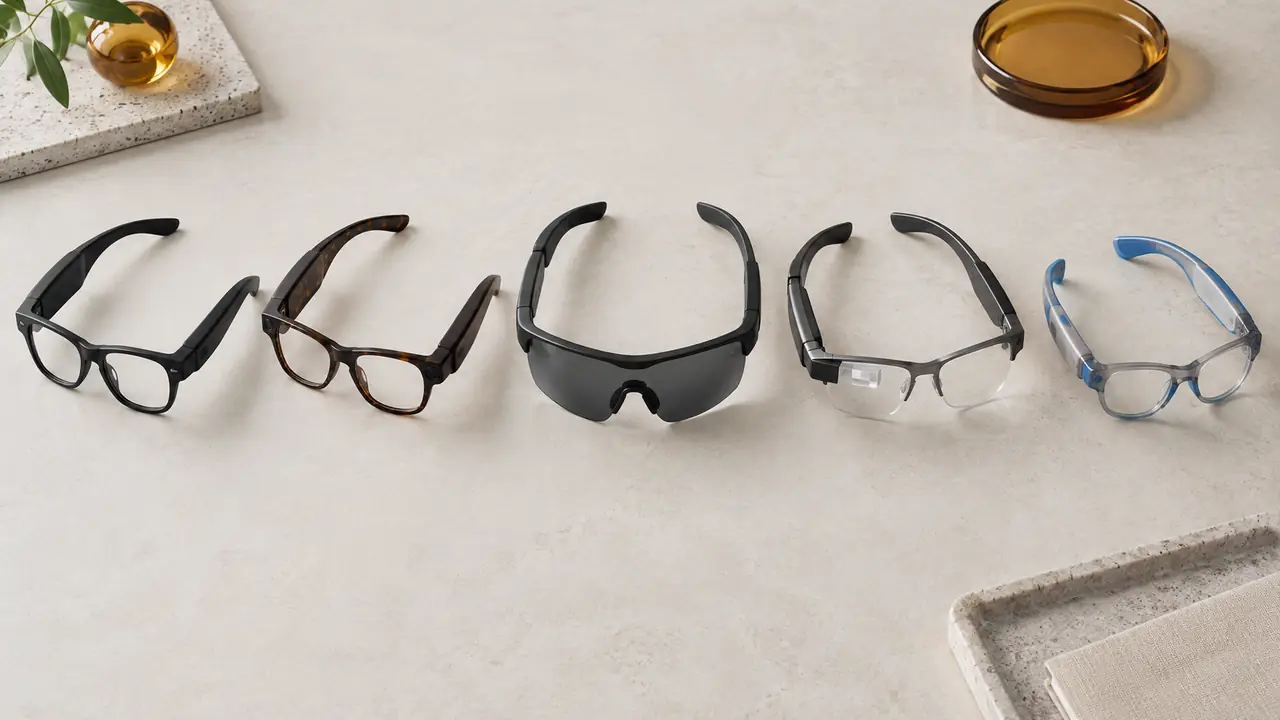
How to use this selector
Choosing a type is the first decision in a smart glasses program, and it fixes most of the others: which chipset, how many microphones, which certificates, how the pair ships and how many sizes the range needs. The twelve lines below sit in three families - audio, AI and imaging, and specialty - but buyers rarely stock a whole family. A typical range takes one volume line, one step-up line and one specialty line, built on as few boards as possible so that firmware, spare parts and after-sales stay manageable.
Read the table by row for what each line is, and by the last column for the buyer types that usually start with it. Spec figures are typical across the category, per spec sheet, and are confirmed on the golden sample of each program.
The twelve lines at a glance
| Line | Type | Typical spec signal | Best-fit buyers |
|---|---|---|---|
| Bluetooth audio | Audio | BT 5.2-5.4, 4-13 h music, 27-50 g | Marketplace sellers, wholesalers, DTC brands |
| Open-ear audio | Audio | Directional temple speakers, leak control per acoustic test | Brand owners, DTC brands |
| Bone conduction | Audio | Transducer at the temple bone, usually heavier than open-ear | Sports retailers, distributors |
| Business call | Audio | Multi-mic array with ENC per firmware, multipoint | Wholesalers, enterprise projects |
| AI translation | AI | Languages per app and engine, typical cloud latency 0.5-3 s | Brand owners, enterprise projects |
| Camera glasses | Imaging | 5-12 MP sensor, 1080p video, recording indicator LED | Brand owners |
| Photochromic and AR | AI and optics | Photochromic Cat. 0-3 per lens spec, or a HUD optic per project | DTC brands, retailers |
| Developer | AI | Open SDK or BLE GATT per solution provider, OTA | Enterprise projects, sourcing agents |
| Prescription-ready | Specialty | Rx-ready fronts, lens width 48-56 mm | Retailers, DTC brands |
| Sports | Specialty | Wrap front, PC or TR90, IPX4-IP55 per test | Marketplace sellers, sports retailers |
| Kids | Specialty | TR90 or silicone, typically under 30 g per model, UV400 | Retailers |
| Accessories | Specialty | Spare lenses, pogo cables, charging cases | Marketplace sellers, wholesalers, distributors |
Audio lines: the volume tier
Audio glasses are where most ranges begin. They need no camera and no display, so they avoid the privacy questions camera models raise, they are the simplest to certify and they ship as standard UN3481 consignments. The choice inside the family is mainly acoustic. Open-ear models aim a directional speaker at the ear canal and are judged on loudness against sound leakage; bone conduction models press a transducer against the side of the head and are judged on fit pressure and low-frequency feel; business call models add microphones and multipoint pairing for people who take calls all day. The family is compared in the audio glasses buying guide.
AI and imaging lines: features with extra scope
AI translation, camera, photochromic and AR, and developer models add a processor, more microphones, sometimes a camera or display, and always a heavier app. Each addition brings extra scope. Translation depends on the app and translation engine, so language counts and latency are stated per app, with typical cloud latency of 0.5-3 s. Camera glasses need a visible recording indicator LED; the EDPB statement adopted on 13 October 2026 is guidance rather than law, but it sets clear expectations on indicator visibility that brands selling in Europe should design for. Developer models are usually small engineering batches with an open SDK per solution provider. All of these draw more power, which the battery and runtime guide explains.
Specialty lines: fit, lenses and spares
Specialty lines solve fit and lens problems rather than adding electronics. Prescription-ready fronts let an optician or lens lab fit Rx lenses; sports models use wrap fronts, grippy nose pads and IPX4 to IP55 ratings per test; kids models are light, with UV400 lenses, optional blue-light filtering lenses with no health claim, volume limits per firmware and, in the US, a CPSIA children's product certificate. Accessories - spare lenses, pogo pin cables and charging cases - extend the life of every other line and are often the easiest add-on for marketplace sellers. Frame and lens details are in the lens and frame fit guide.
Building a range from the table
A practical three-tier range for a retailer might be Bluetooth audio as the entry model, open-ear or photochromic as the step-up, and prescription-ready fronts for optical counters, all on one board family. An enterprise buyer might combine business call and AI translation models with spare cases. Kids models typically start from 1,000 pairs per model and catalog models from 50-500 pairs, as typical reference ranges confirmed in writing for each program; see MOQ and lead time. When the shortlist is clear, send it through the quote form.