
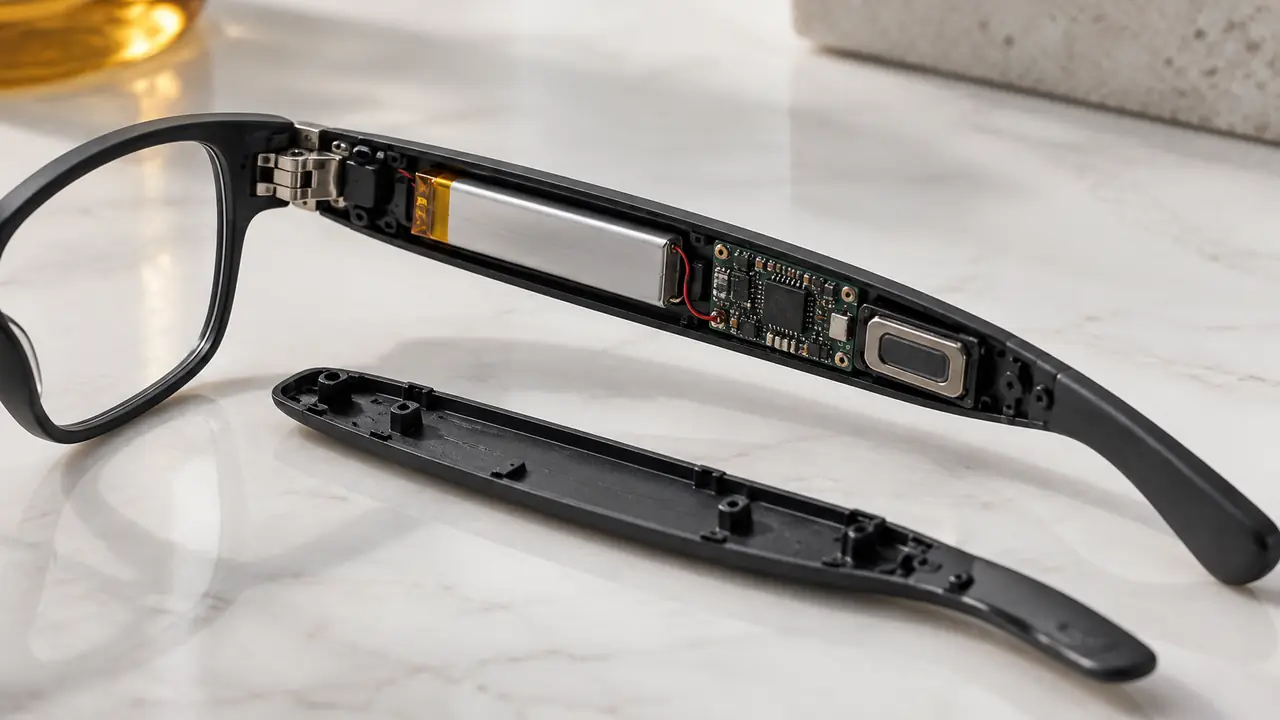
Why the type decides the program
Choosing a type is not only a marketing decision. Each type adds modules to the temple, and each module adds weight, power draw, test items and after-sales questions. An audio pair needs a Bluetooth audio system-on-chip, speakers, microphones and a battery. An AI pair adds a stronger processor or a phone-side app with a cloud assistant. A camera pair adds a sensor, storage, a Wi-Fi link and a recording indicator. A display pair adds optics and a projector. The further along that list a range goes, the heavier the pair, the shorter the runtime and the longer the certification and sample path.
Market data shows where volume sits today. IDC expected China's 2025 smart glasses shipments at about 2.9 million units, with audio and audio-plus-camera glasses making up roughly 2.2 million of them. Omdia estimated that models with a display rose from 3.3 to 8.4 percent of global AI glasses shipments in 2025. In short, most units sold are still audio-first, and display glasses remain a smaller, faster-moving niche.
The four electronic types side by side
| Type | Modules added | Typical ranges | Main test and compliance additions |
|---|---|---|---|
| Audio glasses | BT audio SoC, open-ear or bone conduction speakers, 2-4 mics, touch strip | 27-50 g; Bluetooth 5.2-5.4; 4-13 h music; 3-9 h calls | FCC Part 15.247 and Subpart B, CE RED, UN 38.3, frequency response and leak checks |
| AI and translation glasses | Mic array, assistant or translation via app and cloud engine | Languages per app and translation engine (mainstream 6-60+); typical cloud latency 0.5-3 s | Everything above plus EN 18031 cybersecurity scope in the EU, app data and permission review |
| Camera glasses | Image sensor, storage, Wi-Fi transfer, recording indicator LED | 5-12 MP sensors common; 1080p video typical, 4K on higher tiers; 16-128 GB storage | Radio approvals for Wi-Fi and Bluetooth, indicator visibility checks, market privacy review |
| AR and display glasses | Monocular or binocular HUD, birdbath or waveguide optics | Optics and weight per project | Optical and photosensitivity notes under ISO 12312-1:2022 for electrochromic lenses, display readability checks |
The table is a map, not a datasheet. Every figure on a Templora spec sheet is confirmed on the golden sample and in the test report for the specific program.
Audio glasses: the volume base
Audio glasses are the entry point for most brands because the bill of materials is short and the user benefit is easy to explain: music and calls without anything in the ear. Within the type there are three sub-lines. Bluetooth audio glasses use small directional speakers in the temple; open-ear designs tune ports and cavities to control sound leakage; bone conduction designs press a transducer against the side of the head and are usually heavier. Call-focused models add more microphones and noise reduction per firmware. The decisions buyers argue about are loudness against leakage, battery size against weight, and how many colourways a first order can carry.
Audio glasses are also the easiest type to compare across partner plants, because the core figures are well understood: playback and talk time, charge time of one to two hours on magnetic contacts, water resistance per IPX4 or IP54 rating tested per IEC 60529, and finished weight. That makes them a sensible first line for a marketplace seller or a wholesaler that needs predictable reorders. The trade-off is competition: many catalog models look alike, so differentiation tends to come from frame shape, lens options, packaging and the quality of the listing content rather than from the electronics alone.
AI, translation and camera glasses: more chip, more questions
AI glasses look similar on the outside but behave differently in use. Most of the intelligence runs in the companion app or in the cloud, so the experience depends on the phone, the network and the engine chosen by the app provider. That is why translation figures must always be written per app and translation engine, with typical cloud latency of half a second to three seconds depending on network and language pair. Offline packs exist for only a few languages. Buyers should expect more support tickets about app login, permissions and network than about hardware.
Camera glasses add the heaviest privacy load in the category. A visible recording indicator LED is not optional; the European Data Protection Board statement of October 2026, which is guidance and not a new law, expects the manufacturer to make recording visible in different lighting and to prevent recording when the indicator is covered. The camera also raises storage, Wi-Fi transfer and heat questions. Details are on camera glasses and AI translation glasses.
AR glasses and specialty frames
Display glasses put text or images into view through a small projector and optics. They are still the smallest segment by units, and they move the program into longer engineering: optical alignment, brightness outdoors, weight balance and battery size all fight each other. A photochromic or electrochromic lens is sometimes grouped with this line; ISO 12312-1:2022 includes a photosensitivity note for electrochromic lenses that belongs on the spec sheet.
Specialty frames are not a fifth electronics type but a way of packaging the types above. Rx-ready fronts let an optician fit prescription lenses; sports wraps use PC or TR90 with grip parts; kids frames are lighter, use UV400 lenses and carry volume limits per firmware. Each one changes the frame supply chain more than the electronics, which is why the desk aligns Shenzhen temple electronics with frames from Henggang or Ouhai and lenses from Danyang or Xiamen in one program.
How to choose a type for a first range
- Start from the use case. Commuters, cyclists and office users are served well by audio glasses; travellers and event teams by translation; creators by camera models.
- Match support capacity. AI and camera lines generate app and privacy questions; plan the help content before the launch.
- Check the compliance scope. More radios and more data mean more test items and longer lab queues, typically 3-6 weeks per lab and scope for FCC and CE testing.
- Size the first order. Catalog models typically start at 50-500 pairs per model, logo programs at 500-1,000 pairs, full custom builds from 3,000 pairs, confirmed in writing on MOQ and lead time.
Many brands begin with an audio catalog model under their own logo, learn which fits and colours sell, and add an AI or camera line in the second season. When you know which type and quantity you are considering, the quote form collects what a partner plant needs to shortlist models.