
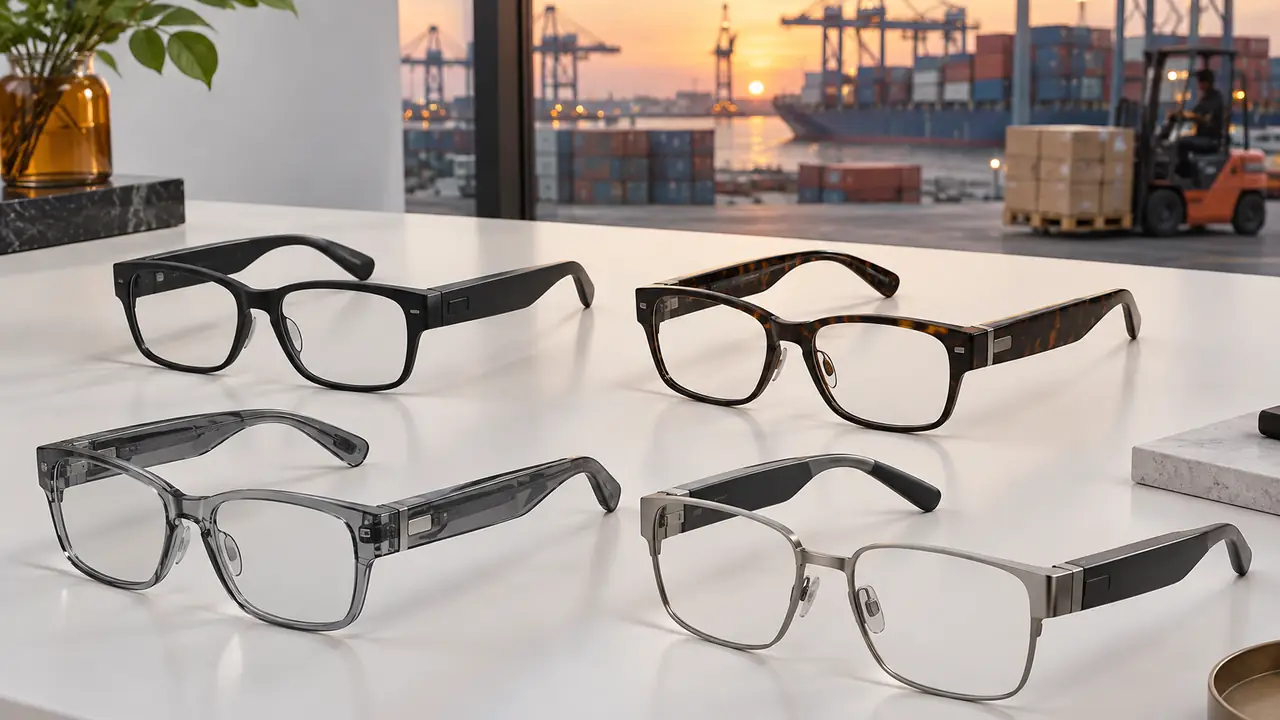
Why smart glasses sourcing is different
Most consumer electronics can be bought from one assembly plant that buys its own parts. Smart glasses are harder. The temples carry electronics - a Bluetooth audio system-on-chip, small lithium-ion cells, speakers or a camera, microphones and a touch strip - while the front and the lenses are eyewear, built by plants that think in hinges, acetate blocks, lens curves and optical standards. A plant that is strong in acoustics may buy frames it barely inspects; a frame plant that has added a Bluetooth board may not have a radio test bench. Either way, the buyer inherits the weak half.
The practical answer is to treat a program as three supply chains aligned in one specification. Templora works as a sourcing desk: it does not own production, it shortlists partner plants line by line, writes one spec sheet that covers frame, lens and electronics together, and follows the program from sample to shipment. The rest of this note explains how that works and what a buyer should expect at each step.
Where the parts come from
China's smart glasses supply base sits on top of long-established eyewear clusters and the Shenzhen electronics base. The figures below come from local and national reporting and describe the eyewear industry as a whole, not smart glasses alone.
| Cluster | Role in a program | Reported scale (source, year) |
|---|---|---|
| Shenzhen Longgang - Henggang and Yuanshan | Mid to high-end frames and complete eyewear; smart frames and structural parts | About 1,200 eyewear companies in Henggang and about 125 million mid to high-end pairs a year; Longgang eyewear output of 4.3 billion yuan in 2024 (Shenzhen Special Zone Daily, 2025) |
| Shenzhen Bao'an, Nanshan and Dongguan | Acoustics, displays, PCBA, AI and chipset solution houses, final assembly and injection molding | Described qualitatively (Science and Technology Daily, 2026; 21st Century Business Herald, 2025) |
| Wenzhou Ouhai, Zhejiang | Metal and acetate frames, hinges, export private label | 595 eyewear companies in 2020; industry output above 14.5 billion yuan in 2019 (China.com.cn Wenzhou, 2019-2020) |
| Danyang, Jiangsu | Lenses, including prescription, photochromic and polarized | More than 400 million lenses a year, about three quarters of national output and roughly 40-50 percent of global output by differing estimates (People's Daily, CCTV, Securities Times, 2023) |
| Xiamen, Fujian | Mid to high-end sunglasses, polarized lenses and sunglass frames | More than 300 eyewear companies (Xiamen investment promotion, 2025) |
In short, one pair of smart glasses is usually Shenzhen electronic temples, a frame from Henggang or Wenzhou, and lenses from Danyang or Xiamen. More context on each cluster is in China's eyewear clusters and on industry clusters. The desk's own office is in Wenzhou, also home to the Ouhai eyewear cluster; it is an operations office, not a production site.
The program, step by step
A typical program follows the same sequence whatever the line. The steps are short to describe and long to do well.
- Brief. Target market, line (audio, AI, camera, Rx-ready, sports, kids), quantity per model, colors, packaging level and the certifications the market needs.
- Route decision. Catalog model, logo program or full custom. This decides MOQ, samples, lead time and what tooling, if any, is opened. See OEM and MOQ explained.
- Shortlist. Two or three partner plants per supply chain, checked on capability, test equipment and document history.
- Samples. Catalog or logo samples first; engineering samples and EVT/DVT rounds for custom work; a signed golden sample at the end.
- Spec sheet and test plan. Six modules fixed in writing, with test items and acceptance criteria stated per order.
- Certification route. FCC Part 15, CE under RED 2014/53/EU with EN 18031, UN 38.3, optical standards - run by test labs and held by partner plants or labs per project.
- Batch production and inspection. In-line checks, then a pre-shipment inspection against the golden sample.
- Shipping. Lithium batteries declared under UN3481, PI 967 Section II for air; sea freight for larger orders.
Typical quantities and timelines
The ranges below are typical reference ranges seen across the category, confirmed in writing per program. They exclude certification queues, which depend on the lab and scope.
| Route | Typical MOQ per model | Samples | Batch production |
|---|---|---|---|
| Catalog model | 50-500 pairs | 5-10 working days | 20-35 days |
| Logo and packaging | 500-1,000 pairs | 10-15 working days | 20-35 days |
| Full custom OEM/ODM | From 3,000 pairs | 30-60 days for engineering samples, including 25-45 days of tooling | 45-75 days |
| Kids line | From 1,000 pairs | Per route | Per route |
Radio lab testing for FCC and CE commonly takes 3-6 weeks per lab and scope, which is an estimate rather than a fixed figure. Express or air delivery usually takes 5-10 days; sea freight to the US West Coast about 15-25 days and to Europe about 30-45 days. The live ranges are kept on MOQ and lead time.
Where programs lose time
Delays in smart glasses programs rarely come from the assembly line itself. They come from decisions that were not written down early enough.
- Splitting frame and electronics. When the frame is chosen first and the board is fitted later, the cell or speaker often does not fit the temple, and tooling has to be reopened.
- Lens questions left open. Polarized, photochromic, blue-light filtering (no health claim) or Rx-ready lenses change the lens supplier and the optical tests. Decide before samples.
- Certification started after the golden sample is changed. Any change to the board, antenna or battery after testing can trigger retesting.
- Unclear document ownership. FCC IDs, test reports and Bluetooth SIG listings are held by the partner plant or lab per project unless agreed otherwise. Agree it in writing at the start.
- Battery shipping assumptions. A charging case with its own cell is classed separately by watt-hour rating; check it with the forwarder before booking.
Getting started
The fastest programs start with a short, complete brief: line, market, quantity per model, colors, packaging level and target launch month. With that, the desk can propose a route, a shortlist and a sample plan in one reply. Factory checks are described on factory audit, and when you are ready the quote form asks exactly what the partner plants need to know.