
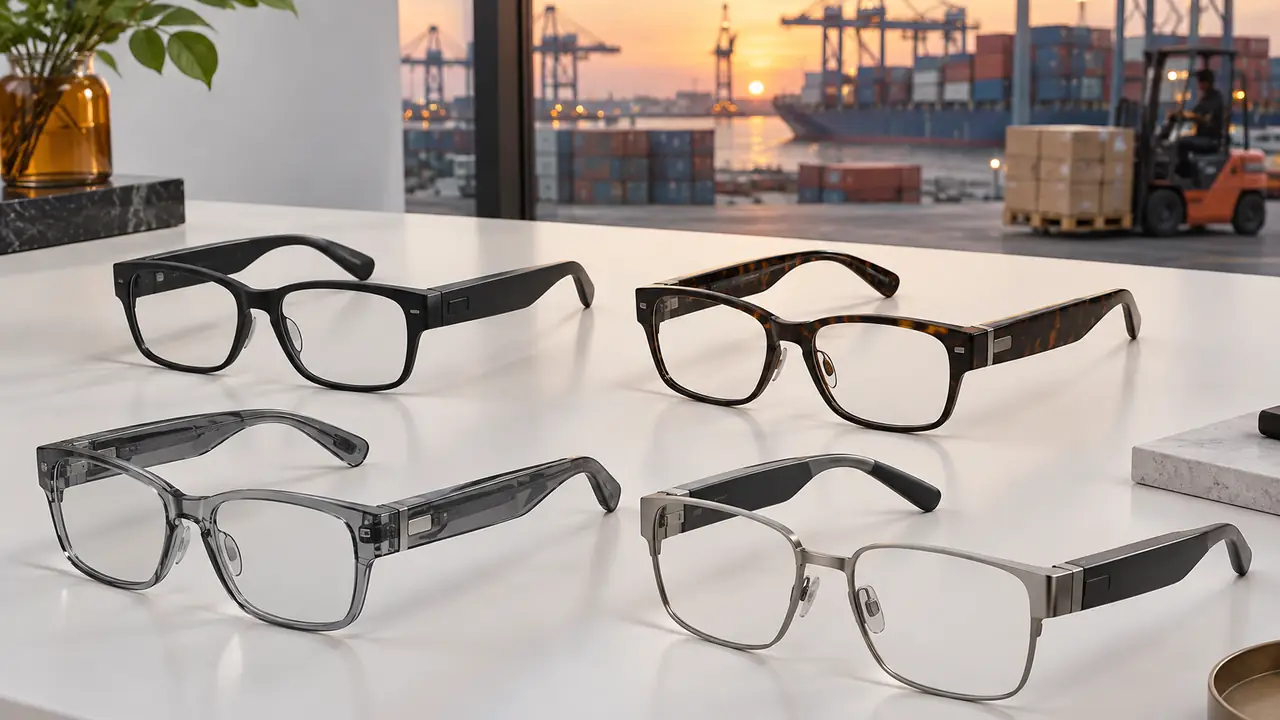
Why clusters matter for smart glasses
Eyewear in China is concentrated in a handful of towns and districts where frame plants, hinge makers, plating shops, lens plants, mold makers and packaging suppliers sit within a short drive of each other. For an ordinary frame, that density shortens lead times and keeps sampling cheap. For smart glasses it matters even more, because a program needs frame tooling, a temple shell that fits a battery and a speaker, lens cutting to the frame's shape and an assembly line that can handle both screws and solder. When those suppliers are close, a fit problem found on Monday can be tried in a revised part by the end of the week.
Reporting on the Shenzhen cluster describes this directly: local coverage notes that more than a hundred kinds of parts can be called up within 24 hours (Shenzhen Special Zone Daily, May 2025). That is the advantage a buyer is really paying for when sourcing from a cluster rather than from a stand-alone plant.
The five clusters at a glance
| Cluster | Typical contribution | Reported figures | Source and year |
|---|---|---|---|
| Shenzhen Longgang (Henggang, Yuanshan) | Mid to high-end frames, complete eyewear, smart frame shells and structural parts | About 1,200 eyewear companies in Henggang (another count gives more than 1,500 across Yuanshan and Henggang); about 125 million mid to high-end pairs a year; Longgang eyewear output 4.3 billion yuan in 2024 | Shenzhen Special Zone Daily, 2025 |
| Shenzhen Bao'an, Nanshan and nearby Dongguan | Acoustics, displays, PCBA and precision parts; AI and chipset solution houses; final assembly and injection molding | Qualitative | Science and Technology Daily, 2026; 21st Century Business Herald, 2025 |
| Wenzhou Ouhai, Zhejiang | Metal and acetate frames, hinges, export private label | 595 eyewear companies and more than 60,000 workers in 2020; output above 14.5 billion yuan in 2019; exports to more than 100 countries | China.com.cn Wenzhou, 2019-2020; Wenzhou culture and tourism bureau, 2023 |
| Danyang, Jiangsu | Lenses and lens processing, including prescription, photochromic and polarized | More than 400 million lenses a year, about three quarters of national output and about 40-50 percent of global output by differing estimates; more than 2,000 related companies | People's Daily, CCTV, Securities Times, 2023; 21st Century Business Herald, 2025 |
| Xiamen, Fujian | Mid to high-end sunglasses, polarized lenses, sunglass frames | More than 300 eyewear companies, over 20 with annual output above 100 million yuan | Xiamen investment promotion, 2025; Fujian commerce department, 2024 |
Wenzhou, Shenzhen, Xiamen and Danyang are also commonly listed, with Yingtan, as China's five main eyewear production bases. The figures use different definitions and years, so treat them as orders of magnitude rather than comparable statistics.
Shenzhen: the electronic temple and the frame
Shenzhen contributes two things. The first is the electronics: the Bluetooth audio system-on-chip, small cells, speakers, microphones, flexible circuits and, for richer lines, camera modules and AI processors. Bao'an is strong in acoustics, displays and PCBA; Nanshan hosts AI and chipset solution houses; Dongguan, next door, carries a great deal of final assembly and injection molding. A Shenzhen AI glasses industry alliance has also been working with a national telecom test lab on a series of AI glasses standards (2025-2026), a sign of how much activity is concentrated there.
The second is frames. Henggang and Yuanshan in Longgang have long made mid to high-end frames and finished eyewear, and plants there increasingly build smart frame shells with cavities for cells and speakers. For audio and AI lines, a program that keeps temple electronics and frame tooling in Shenzhen is usually the shortest path. See audio glasses and AI glasses for what those temples carry.
Wenzhou and Xiamen: frames, hinges and sunglasses
Wenzhou's Ouhai district is one of the oldest export eyewear bases in China, with deep experience in metal and acetate frames, hinges and private label work for overseas brands. For smart glasses that need a classic optical look, a metal bridge or a premium acetate front, Wenzhou frame plants are often shortlisted alongside Shenzhen ones. The desk's office is also in Wenzhou, in Yongjia county; it is an operations office, not a production site.
Xiamen is known for mid to high-end sunglasses and polarized lenses. Sports lines and sunglass-style audio glasses often source lenses or complete sunglass fronts there. More on materials is on frame materials.
Danyang: lenses at scale
Danyang, in Jiangsu, is the lens base. Its plants supply clear, tinted, polarized, photochromic and prescription lenses, and many offer lens cutting and edging to a frame's shape. For a smart glasses program, Danyang matters in three ways: lens tint and category per ISO 12312-1 for sunglasses, Rx-ready workflows where a lab fits prescription lenses to a smart front, and replacement lens kits sold as accessories. The lens choices are covered on lens options.
Two points are worth checking with any lens partner. First, ask which tests the plant runs in-house and which are sent to an outside lab: UV400 transmission, luminous transmittance category and, for the US market, the drop ball impact test under 21 CFR 801.410. Second, ask how the lens is shaped to the frame. A smart front often has a slightly different groove or rim than an ordinary frame, and the lens partner needs the exact frame tracing before cutting a batch.
Questions to ask in any cluster
- Which smart glasses or electronic eyewear programs has the plant run before, and which modules did it handle itself?
- What test equipment is on site - hinge cycling, salt spray, artificial sweat soak, drop, IPX splash, radio pre-scan?
- Who holds existing test reports, and can they be used for a logo program on the same board?
- How is a change to a part recorded, and how is the golden sample kept?
How the desk uses the clusters
A program is rarely sourced from one cluster. A typical audio line might combine a Shenzhen electronics partner, a Henggang or Wenzhou frame partner and a Danyang lens partner, with packaging from a nearby printer. The work is in aligning them: the temple cavity must match the cell and speaker, the lens must match the frame curve and the optical category, and final assembly must be inspected against one golden sample. That is the job of a sourcing desk rather than any single plant.
- Pick the lead cluster from the line: Shenzhen for audio, AI and camera; Wenzhou or Henggang where frame style leads; Xiamen for sunglass-led sports lines.
- Add lens and packaging partners once lens type and packaging level are fixed.
- Write one spec sheet that every partner signs against, then inspect the assembled pair, not the parts alone.
Typical MOQ and lead ranges for each route are on MOQ and lead time, confirmed in writing per program. To start a shortlist, use the quote form.