
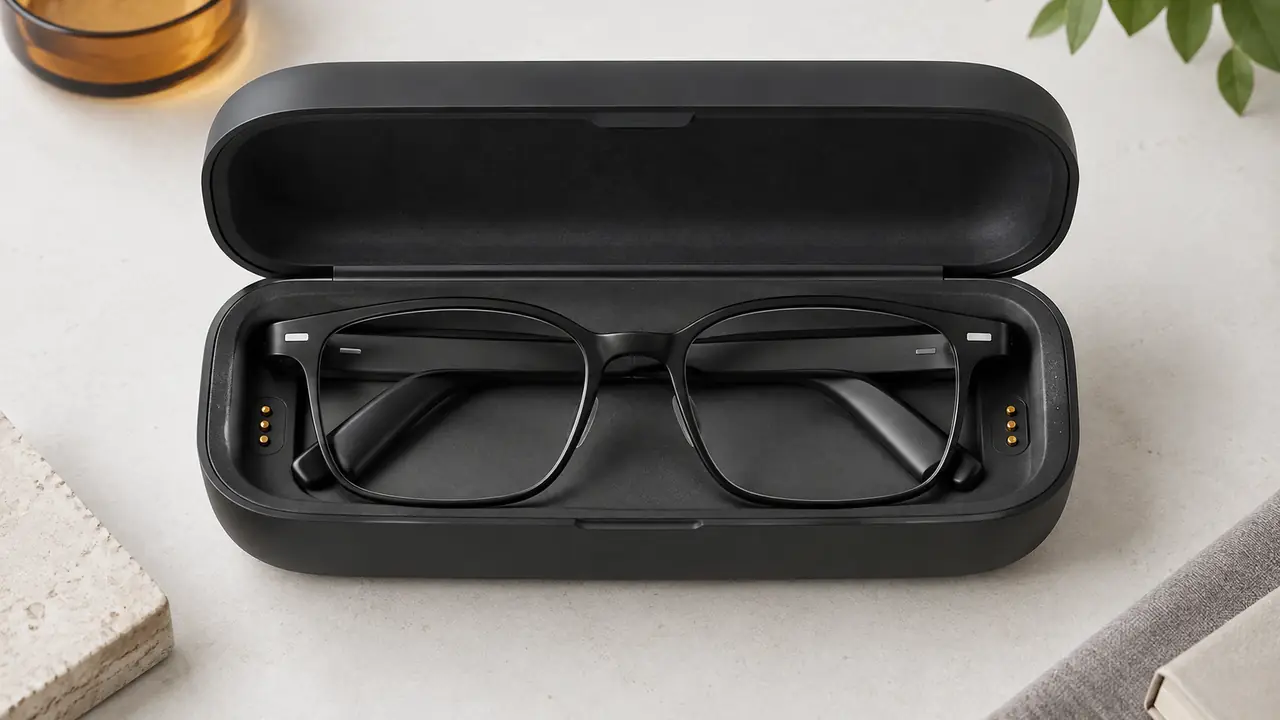
Three numbers, three different states
A pair of smart glasses spends its day in several power states. When music is playing, the radio streams audio, the decoder and speaker amplifier run and the microphones may be idle. During a call, the microphones, noise reduction and uplink all run at once. In standby, the glasses are on and connected but doing almost nothing, waking the radio briefly to stay paired. Switched off or in a case, they draw only a tiny leakage current. A spec sheet that lists playback, talk and standby time is describing three of these states, each measured on its own.
Because the average current in standby is a small fraction of the current during playback, standby time is always much longer than playback time - often by a large multiple. That is why a standby figure can look impressive and still say nothing about whether the pair will last through a working day of use.
What each figure measures
| Figure | State measured | Typical across the category | What to ask |
|---|---|---|---|
| Playback time | Continuous music streaming from full to cut-off | 4-13 h | Test volume, codec, source device, firmware |
| Talk time | Continuous call with microphones and noise reduction | 3-9 h | Call profile, noise reduction on or off, distance |
| Standby time | On and connected, no audio, no calls | Per spec sheet | Connected or unconnected, wake features on or off |
| Charge time | From cut-off to full through the charger | 1-2 h magnetic | Charger, cable and temperature used |
Combined cell capacity across both temples is typically about 85 to 235 mAh, so runtime differences of several hours between models are usually explained by chipset efficiency, speaker efficiency and test conditions as much as by capacity. The arithmetic is in smart glasses battery life explained.
Why standby claims mislead
Standby figures are sensitive to definitions. Some are measured with the glasses paired and connected to a phone; others with the radio advertising but not connected; others with the glasses effectively asleep. Wake features change the result as well. A pair with a wake word listening for a voice assistant, a wear sensor checking whether the glasses are on the head or a touch strip kept active draws more in standby than a pair that sleeps fully. Firmware updates can change standby drain without any change in hardware.
Customers rarely use glasses in pure standby for long. A realistic day mixes short bursts of music, a few calls, notifications and long idle periods. That mix is what a mixed-use test approximates, and it is a better guide than any single figure. Many buyers now ask for a stated mixed-use profile - for example, a set share of playback, calls and idle time - measured on the golden sample. The profile is agreed per program; there is no single industry profile.
- Connected standby: glasses paired and ready, closest to real idle time on the head.
- Unconnected standby: radio searching or advertising; can be higher or lower depending on firmware.
- Sleep or off: glasses folded or in a case; the figure that matters for a bag or drawer.
Test conditions that move the numbers
Volume is the single biggest lever for playback time. A figure measured at a moderate share of maximum volume can be far above what a cyclist at high volume in wind will get. The codec matters: richer codecs and weaker links raise radio activity. Temperature matters: cold cells deliver less. Distance and interference matter: a phone in a back pocket on a busy street makes the radio work harder than a phone on the desk in a lab. Firmware matters: noise reduction, equaliser settings and sensor polling all draw power.
For a buyer, the practical rule is that every runtime figure should come with its conditions in writing - test volume, codec, source, firmware version, temperature and the definition of standby used. Figures from different partner plants can only be compared when conditions match. The broader skill of reading a sheet is covered in how to read a smart glasses spec sheet, and AI-related drain in AI features and power draw.
Writing runtime claims customers trust
Listing copy that leads with standby time invites returns, because customers read it as daily runtime. A clearer structure is to lead with typical playback time, follow with talk time, and give standby as a separate, labelled line. Phrases such as typical and up to should be used consistently and matched to the test report. If the range includes AI or camera models, it helps to say plainly that those features shorten runtime.
- Lead with playback. State typical music playback first, with the test volume in a footnote.
- Add talk time. Calls matter most to office and field users, who often spend more of the day on calls than on music, so talk time deserves equal weight in the listing.
- Label standby. Give standby on its own line with its definition, connected or not.
- State charge time. Include the charge time and the cable or case used.
- Match the report. Every figure in the listing matches the test report the partner plant provides.
Marketplace sellers in particular benefit from this discipline, because runtime complaints are a common theme in reviews and because battery and runtime wording is often checked by platforms against documents. The listing angle is covered in smart glasses listing content.
Checking runtime at inspection
Runtime claims are only as good as the lot that ships. A pre-shipment inspection plan can include a runtime and standby check on a small number of pairs per lot, under the same conditions as the golden sample test, with a tolerance agreed in advance. Pairs that fall well short point to a cell lot problem, a firmware version mismatch or a setting left on at the line. Runtime and standby checks are standard test items on testing and inspection. Lead times for samples and batches are typical reference ranges on MOQ and lead time, and a runtime target can be sent with the rest of the brief through the quote form.