
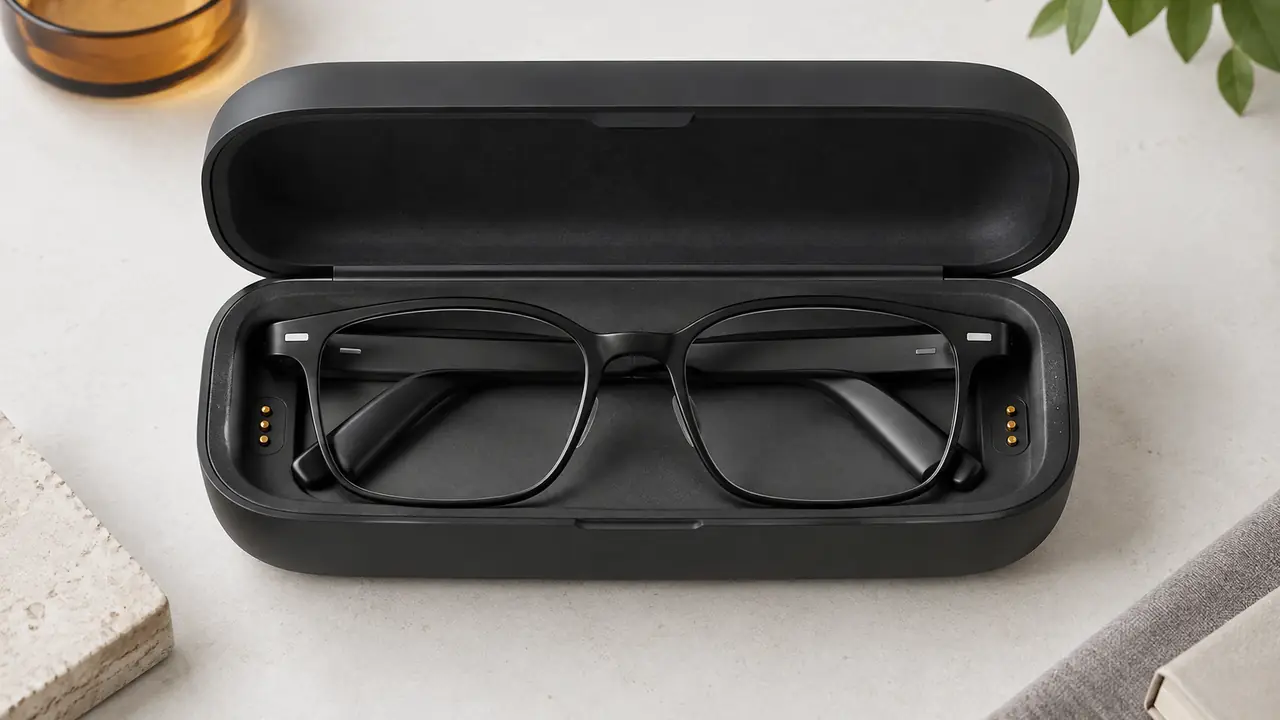
Why add a charging case
The cells inside smart glasses temples are small - typically about 85 to 235 mAh across both temples - because the temple has little room and the pair has to stay wearable. Typical runtimes of 4 to 13 hours of music and 3 to 9 hours of calls cover many days, but not a long travel day, a full shift of calls or a weekend away from a socket. A charging case addresses that gap. The glasses go into a protective case that holds its own battery and charges the temples through the same magnetic contacts used by the cable.
For buyers the case is also a packaging and retail decision. A glasses case is something customers expect anyway, so a charging case can replace a plain hard case and add perceived value. It also protects the hinge and the lenses in transit. On the other side, it adds weight and bulk, a second battery to certify and ship, and a part that can fail on its own.
Capacity: from mAh and Wh to recharges
Case capacity is stated in mAh at the cell's nominal voltage, and for shipping and labelling in watt-hours. The conversion is simple: Wh equals nominal voltage multiplied by capacity in amp-hours. Both figures come from the cell spec sheet and should match the test report.
The number of full recharges a case delivers is always less than case capacity divided by glasses capacity, because energy is lost in voltage conversion and in the charge circuits on both sides. Heat, the age of both batteries and how full the glasses are when they go in all change the result. A spec sheet should therefore state the number of recharges as measured on the golden sample, under stated conditions, rather than as a calculation.
| Item | Where it comes from | Why it matters |
|---|---|---|
| Case cell capacity (mAh) | Cell spec sheet | Basis for runtime extension and listing copy |
| Case energy (Wh) | Nominal voltage x Ah, per cell spec sheet | Shipping classification, labels, transport documents |
| Full recharges of the glasses | Measured on the golden sample | The figure customers actually experience |
| Case recharge time | Measured per test report | Daily routine and charger requirements |
| Standby loss in the case | Measured over a stated period | Whether glasses are full after a week in a bag |
Design points that cause most complaints
Case problems tend to cluster. The first is alignment: if the glasses can sit in the case without the temple contacts landing on the case pins, the pair looks charged but is not. Magnetic guides, a shaped cradle and a clear indicator help. The second is fold position. A case designed around one frame size may not fit a larger front or longer temples, so the case and the frame size range have to be designed together - common frame sizes run about 48 to 56 mm lens width and 140 to 150 mm temple length. The third is wake behaviour: glasses that do not switch off when placed in the case drain both batteries.
- Contacts: case pins meet the same sweat residue as the cable, so plating and cleaning matter. See magnetic pogo pin charging.
- Lid and hinge: lid magnets or detents should hold the glasses closed without pressing on the lenses.
- Indicators: separate signals for case battery level and glasses charging status reduce support questions.
- Input port: a standard port on the case, with input protection, so customers can use common chargers.
Safety and test files for the case
A charging case is, in effect, a small portable battery with a cradle. The cell needs a UN 38.3 test summary, and buyers commonly request an IEC 62133-2 report for the cell or battery. The case as a product falls under the safety and EMC scope of the target market - in the EU, for example, alongside the glasses under the Radio Equipment Directive or as a separate electrical product, depending on how it is sold; EU Battery Regulation 2023/1542 also applies to the battery inside. The test lab confirms which standards apply to the case and to the combination.
The protection circuit in the case deserves attention, because it charges another device. It should handle overcharge and over-discharge of its own cell, short circuit at the case pins and abnormal current drawn by the glasses. Thermal behaviour while charging inside a closed case is worth checking on samples. The battery safety tests are covered in IEC 62133-2 for wearable batteries.
Shipping a case with and without the glasses
The shipping class of a charging case depends on how it travels. A case packed with glasses, or glasses inside a case, ships with lithium batteries packed with or contained in equipment; a case sold as a spare on its own may be classed as a lithium battery in its own right. The classification between UN3480 and UN3481, the packing instruction and the labels are decided per Wh and per packaging - confirm with your forwarder before booking. The basics are in shipping wearables with batteries.
Fulfilment centres and marketplaces may also apply their own battery rules, often asking for the UN 38.3 test summary and a safety data sheet or equivalent before listing. Having the case Wh, the cell spec sheet and the test summary ready in one file saves weeks at launch. The retail box also has to carry the right battery marks where they apply, which is easier to design in than to sticker on later; packaging options are on packaging and retail boxes.
What to specify
- Fit: the frame sizes and fronts the case must hold, checked with golden samples.
- Capacity: cell model, mAh and Wh from the cell spec sheet, and the target number of recharges measured on the golden sample.
- Charging behaviour: auto-off of the glasses in the case, indicators, input port and charge time.
- Files: UN 38.3 summary, IEC 62133-2 report and market safety and EMC scope, verified per project.
- Branding and packaging: logo, colour, pouch or sleeve and retail box.
Charging cases are typically ordered from 500 to 1,000 pieces per item, with sample and batch timing as on MOQ and lead time, confirmed in writing per program. Send the case brief with the glasses brief through the quote form.