
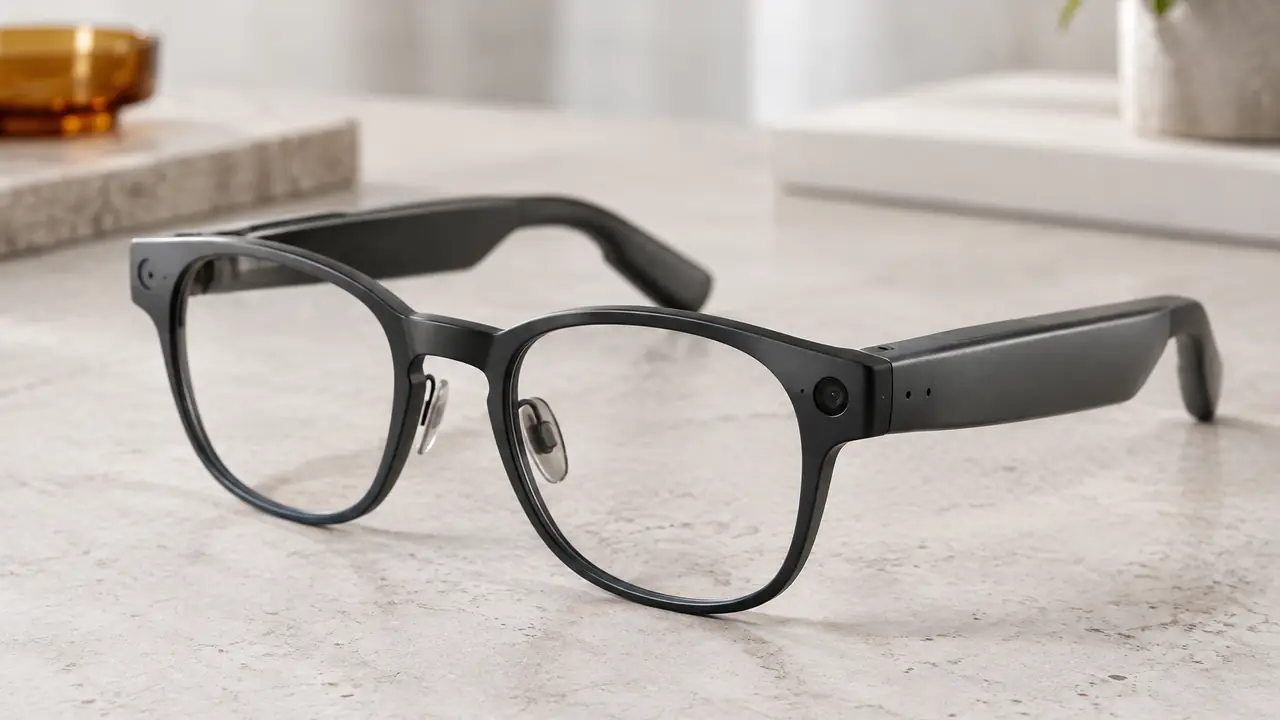
The hardware is mostly an audio pair
Open the temple of a typical pair of translation glasses and you find the same stack as a well specified pair of audio glasses: a Bluetooth audio system-on-chip, small lithium-ion cells, open-ear speakers near the ear, a touch strip and, most importantly, a microphone array. What makes the product a translation product is rarely a dedicated translation chip in the frame. In most of the category the translation itself happens in a companion app on the phone and, for most language pairs, on a cloud translation engine that the app calls over the network.
That split matters for buyers because it decides who owns which part of the experience. The partner plant that builds the frame owns pickup quality, Bluetooth stability, battery life and the speaker tuning. The app provider and the translation engine behind it own the language list, the translation quality and much of the delay. A sourcing program has to write requirements for both halves, and test both halves on the same golden sample, or customer complaints end up landing on the wrong supplier.
The signal chain, stage by stage
Every translated sentence follows roughly the same path. The table below lists each stage, where it usually runs and what a buyer should check during sampling.
| Stage | Where it usually runs | What to check on samples |
|---|---|---|
| Voice pickup | Temple microphone array, beamforming and noise reduction per firmware | Pickup of the wearer versus the other speaker, behaviour in wind and crowd noise |
| Audio transport | Bluetooth link from glasses to phone | Dropouts, reconnection time, behaviour when the phone is in a pocket |
| Speech recognition | App and cloud engine, on-device for a few languages | Accuracy with accents and trade vocabulary, handling of numbers |
| Machine translation | Cloud translation engine per app | Language pairs offered, consistency of terminology, punctuation of long sentences |
| Speech synthesis or text | App, played back through the temple speakers or shown on the phone screen | Voice clarity at street volume, option to read text instead |
| Return path | Phone speaker or second device for the other person | Whether the other speaker hears the output clearly in a real room |
Because the chain has several hops, the total delay is the sum of many small delays. The note on translation glasses latency breaks down where the seconds go; across the category, typical cloud latency is about 0.5 to 3 seconds per network and language pair.
Microphones decide most of the quality
Translation engines can only translate what they hear. In field tests of sample pairs, the most common reason a translation goes wrong is not the engine but the pickup: the microphone caught the wearer's own voice clearly but caught the other person faintly, or wind across the temple drowned the start of a sentence. Plants address this with arrays of two or four microphones and with beamforming that steers pickup toward the mouth or, in a conversation mode, toward the person in front. Settings are per firmware, and the same hardware can behave very differently after a firmware change.
For a buyer, three questions cover most of the risk. How many microphones are fitted and where are the ports on the temple? Is there a mode that listens outward to the other speaker, and how is it switched? How does pickup hold up at a busy trade fair stand or a train station? These are tested on the golden sample in the noise conditions your customers will meet, and the acoustic side of the design is covered on acoustic design.
The app and the translation engine
The companion app does far more than settings. It manages the Bluetooth session, passes audio to the speech recognition service, calls the translation engine, returns the result as speech or text and stores a transcript if the user enables it. It also carries firmware updates for the glasses. When you buy a catalog model, you usually inherit the app of the solution provider behind it; in a white-label program the app can be rebranded, and the scope of that work is set per program with the solution provider.
Language counts follow the app, not the frame. Mainstream products support from about six to sixty or more languages per app, and some cloud services advertise more. Offline packs, where they exist, usually cover only a handful of languages. When a spec sheet lists a language count, read it as a statement about the app and translation engine on the date of the sheet, and ask which pairs work offline. The trade-offs are covered in offline vs cloud translation glasses.
Data and privacy in the chain
A translation pair sends speech to a remote service for most languages. That makes data handling part of the product: where audio is processed, whether transcripts are stored, how long and under whose account. In the EU, glasses are listed as wearable radio equipment under Delegated Regulation (EU) 2022/30, so the cybersecurity requirements of RED Article 3(3)(d)(e)(f), with the harmonised EN 18031 series, apply to connected models placed on the market since 1 August 2025. A buyer should collect the app's privacy documentation and the plant's cybersecurity file during sampling, and have counsel review them for each market. The checklist in smart glasses data and app permissions lists the questions.
What a buyer specifies in a translation program
A workable brief for translation glasses fixes the following points before samples are ordered:
- Target markets and language pairs. The pairs your customers actually need, and which of them must work offline.
- Use scene. Travel, trade fairs, guided tours or field teams, each with its own noise profile; see travel and translation use.
- Microphone and mode requirements. Array size, outward listening mode, wind handling, tested per firmware.
- App route. The solution provider's app as-is, or a white-label app with your branding, and who maintains it after launch.
- Runtime under translation. Translation keeps the radio and microphones busy, so runtime is measured in that mode, not only for music.
- Compliance file. Radio approval, battery tests and EN 18031 documentation for EU sales, verified per project.
Templora, as a sourcing desk, matches the brief to partner plants and solution providers in Shenzhen, runs side-by-side sample tests and puts the agreed results on the spec sheet. Typical starting quantities are 50 to 500 pairs per catalog model and 500 to 1,000 pairs for a logo program, confirmed in writing per program on MOQ and lead time. To start, send your language pairs and markets through the quote form.