
Where the line between the two sits
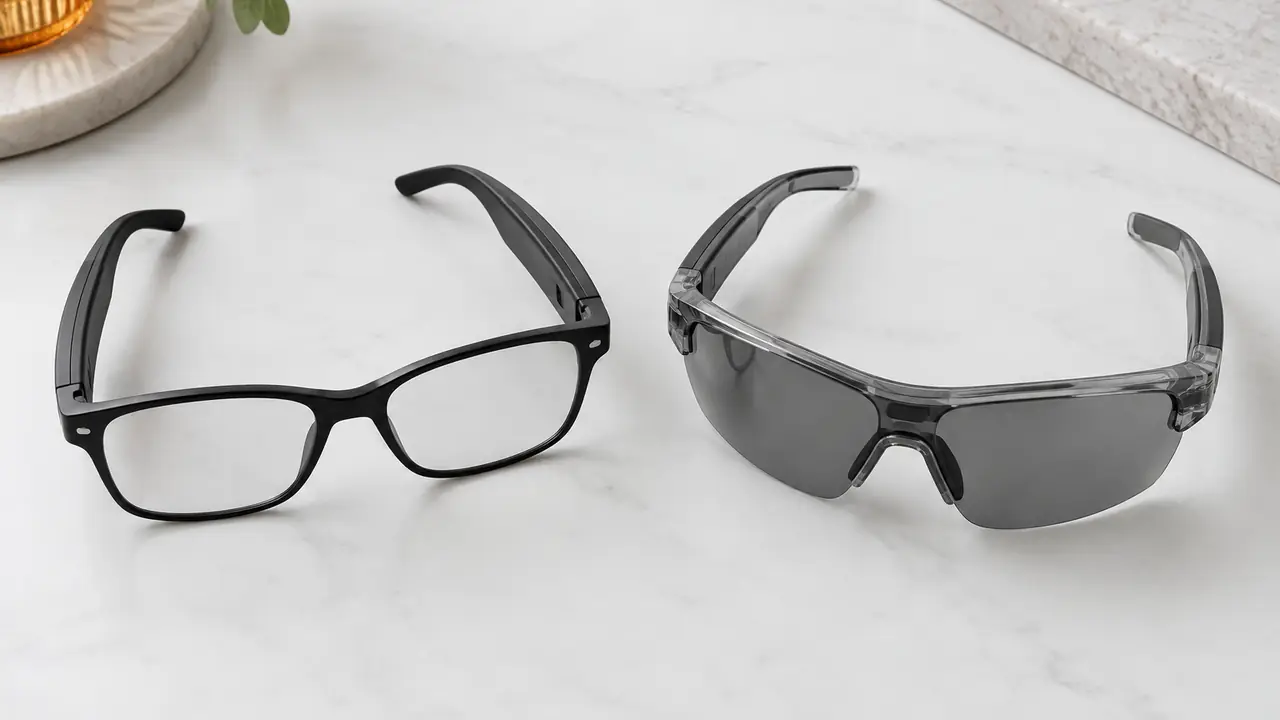
Audio glasses are the base of the category: a frame with a Bluetooth audio system-on-chip, directional speakers in the temples, microphones for calls, a battery and touch controls. The phone does the thinking; the glasses play what the phone sends and pass the wearer's voice back. Many audio models already offer the phone's own voice assistant through a long-press, but the glasses themselves do little processing beyond audio and noise cancellation.
AI glasses add a layer of their own. Depending on the program, that can be a more capable processor or a second chip, more microphones for pickup in noisy places, sometimes a camera, and a companion app that connects to an AI assistant or translation engine in the cloud. The glasses can then answer questions, summarise, translate conversation per app and engine, or describe what the camera sees, with the phone acting as the connection to the network.
Market trackers show that the AI layer is now where most of the category is heading. Counterpoint reported that AI smart glasses made up 88 percent of smart glasses shipments in the second half of 2025, and Omdia counted about 8.7 million AI glasses shipped worldwide in 2025. For a buyer, the question is not whether AI glasses exist, but whether a given channel needs the extra layer and is ready to support it.
Side-by-side comparison
| Dimension | Audio glasses | AI glasses |
|---|---|---|
| Core electronics | BT 5.2-5.4 audio SoC, speakers, mics, battery | Audio SoC plus extra processing, more mics, optional camera |
| What the user gets | Music, calls, phone voice assistant | Assistant, translation per app and engine, capture and description features |
| Dependence on app and cloud | Low; works as a Bluetooth headset | High; key features need the app and a network |
| Microphones | Dual or quad mic ENC per firmware | Mic array tuned for voice pickup and wake words |
| Runtime | About 4-13 h music, 3-9 h calls per spec sheet | Shorter when AI features run; stated per feature on the spec sheet |
| Weight | 27-50 g per pair across the category | Toward the upper part of the range, more with a camera |
| Firmware and app | Occasional OTA updates | Continuous app, server and firmware maintenance |
| Data and privacy scope | Limited | Voice and possibly image data; permissions and retention to document |
| Certification scope | Radio, EMC, safety, battery, optical | Same plus EN 18031 cybersecurity attention, data documentation |
| Typical MOQ entry | Catalog models 50-500 pairs | Catalog models 50-500 pairs; app white-label pushes toward custom volumes |
The table shows the pattern: every extra capability brings an extra dependency. That is not a reason to avoid AI glasses, but it is a reason to plan for them differently.
What the extra chip costs
Power is the first cost. Temple batteries are small, commonly about 85-235 mAh in total across both sides. Audio playback is efficient; wake-word listening, cloud round trips over the phone and camera capture are not. An AI model that shares a spec sheet runtime figure with an audio model is almost certainly quoting music playback, so ask for runtime per feature and at stated settings. The note on AI features and power draw explains where the energy goes.
Weight and heat are the second. More processing and a camera need board space, and the extra components sit in the temples or at the hinge. Programs balance them against the battery so the pair does not slide down the nose, and check surface temperature during long sessions.
Software is the third and the most underestimated. AI glasses depend on an app, a cloud service and firmware that all have to keep working after launch. A brand needs to know who maintains the app, how updates are pushed, what happens when the phone operating system changes, and which features stop if the service is withdrawn. The firmware and app page sets out what to agree with the solution provider before an order.
Returns follow the same pattern. Audio glasses are mostly returned for fit, lens choice, connection or leakage expectations. AI glasses add a further set of reasons: the assistant did not understand a request, a feature needed a network the customer did not have, the app asked for permissions the customer did not want to grant, or runtime fell short in heavy use. Most of these are expectation problems, and the fix is listing copy that states which features need the app and network, what runtime looks like with AI features on, and what data the app uses. A short quick-start card in the box that walks through pairing and app setup removes a surprising share of early returns.
Data, permissions and compliance
An audio headset handles little personal data beyond pairing. AI glasses can process voice recordings, transcripts and, with a camera, images. Buyers should document which data leaves the device, where it is processed, how long it is kept and which app permissions are requested. In the EU, the RED cybersecurity requirements under Delegated Regulation (EU) 2022/30 have applied to wearable radio equipment, explicitly including glasses, since 1 August 2025, with EN 18031 as the harmonised standards; from December 2027 the Cyber Resilience Act takes over. Confirm the scope for your product with your test lab and counsel. The buyer checklist in smart glasses data and app permissions is a useful starting list.
Which to stock
Choose audio glasses when the channel sells on comfort, awareness, calls and value, when after-sales capacity is limited, or when the customer simply wants music and calls in a pair of sunglasses. A Bluetooth audio glasses catalog model is the lowest-risk entry. Choose AI glasses when the customer has a clear task for the extra layer - travel and translation, hands-free questions at work, capture and description - and when the brand can support an app over its life. AI translation glasses are the most common first AI line because the use case is easy to explain. Many ranges carry both, with audio as the volume model and AI as the step-up tier. Catalog models typically start at 50-500 pairs per model, logo programs at 500-1,000 pairs and full custom builds with app white-label from 3,000 pairs, as reference ranges confirmed in writing per program on MOQ and lead time. Describe the channel and the features you need on the quote form.