
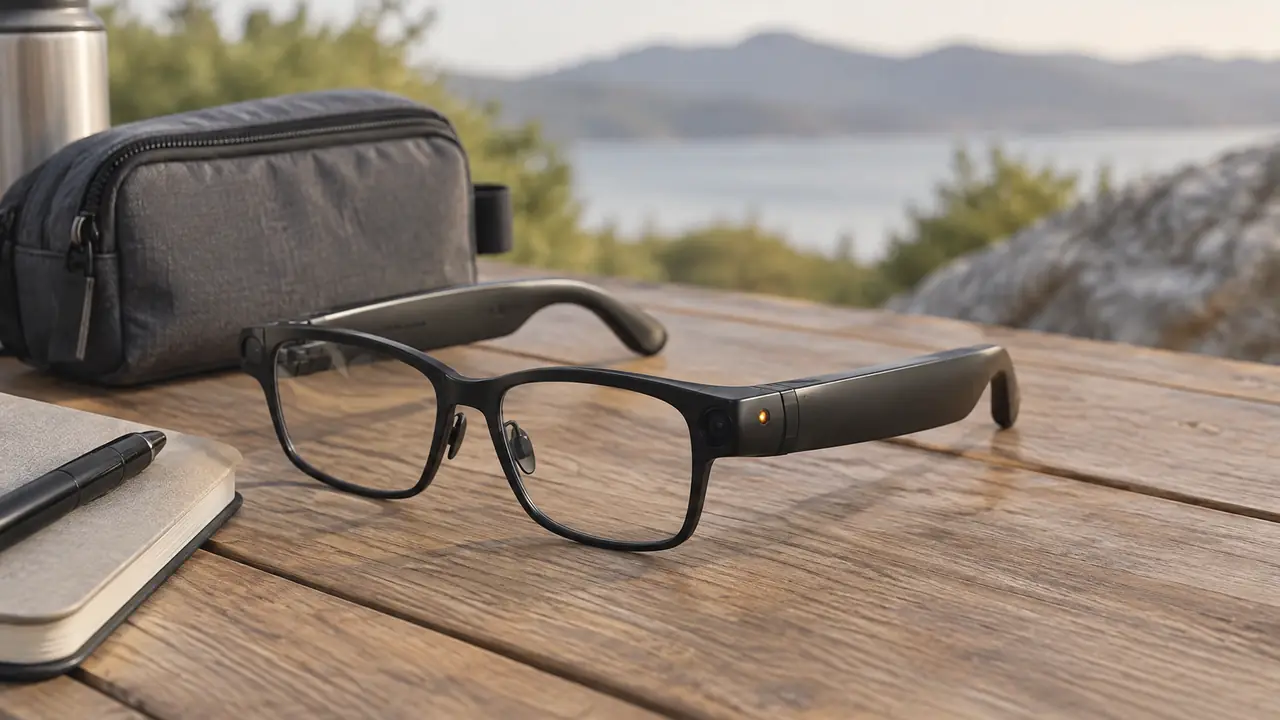
What creators want from camera glasses
Creators use camera glasses for footage a handheld camera cannot get: the view from the eye line while cooking, crafting, travelling, fishing or walking through a market, with both hands free. The product has to deliver usable footage, move it to a phone without friction and last long enough for a session. It also has to make clear to the people around the wearer that recording is happening. That last point is not an add-on. European data protection guidance now treats the indicator as part of the product, and buyers who plan it from the first sample avoid redesigns later.
Compared with audio glasses, a camera model changes the board, the power budget, the thermal design and the compliance file. It is planned as its own line, usually on the ODM route. The trade-offs against action cameras are in camera glasses vs action cameras.
Sensor, video, storage and transfer
The spec sheet should state the actual sensor resolution, not an interpolated figure. Across the category, 5 to 12 MP actual sensors are common; some low-cost models advertise higher numbers that are produced by interpolation. Video is mainly 1080p, with 4K on higher-end boards. Storage is 16 to 128 GB on board, sometimes with a microSD slot. Footage moves to the phone over Wi-Fi, with Bluetooth handling control and audio.
| Item | Typical across the category | What to check on samples |
|---|---|---|
| Sensor | 5-12 MP actual | Native resolution on the sensor data sheet, not the marketing figure |
| Video | 1080p mainstream, 4K on higher-end boards | Stabilisation, frame rate and clip length limits per firmware |
| Storage | 16-128 GB on board or plus microSD | Usable space after firmware, file format |
| Transfer | Wi-Fi to the app, Bluetooth for control | Transfer stability and time for a set clip length |
| Indicator | Recording indicator LED on the front | Visibility in bright and dim light, distinct capture modes |
| Power and heat | Recording draws far more than audio | Runtime and surface temperature during continuous recording |
Recording draws much more power than audio playback and warms the temple near the board. The test plan should include runtime and surface temperature during a continuous clip, plus the firmware behaviour when the pair gets warm. Module options are on camera module and in camera glasses specs.
The recording indicator LED
Every camera glasses program on this account includes a recording indicator LED on the front of the frame, visible to the people being filmed. On 13 October 2026 the European Data Protection Board adopted a statement on smart glasses. It is guidance, not a new regulation, but it shows how European data protection authorities read the existing rules. The statement places the duty to inform on the manufacturer rather than on the wearer, and sets out expectations for the indicator: it should be visible in a range of lighting conditions, recording and photo capture should use different light patterns, and the device should not record while the indicator is covered. A footnote notes that a white LED can be mistaken for a reflection.
Indicator design choices are covered in camera glasses privacy: recording indicators done right.
Privacy rules differ by market
Rules on filming people in public and private places differ between countries, and the EDPB statement applies to the European reading only. A brand selling in several markets should plan product copy, the in-box leaflet and the app onboarding to explain the indicator and remind users to respect local rules and venue policies. The product, its packaging and its listing should present first-person filming openly; wording that suggests unnoticed recording is not used on this account. On the hardware side, the radio file follows FCC Part 15 for the US and CE RED with EN 18031 cybersecurity for the EU, because camera glasses connect over Wi-Fi and Bluetooth and handle personal data. App permissions and data handling should be reviewed with the app provider; a checklist is in smart glasses data and app permissions.
Program route and timing
Camera programs usually run as ODM: a partner plant's board and camera module with a brand-specific front, tuning and app. Full custom typically starts at 3,000 pairs per model, with engineering samples in 30-60 days including tooling and batch production in 45-75 days, before certification queues. The HS reference for camera glasses is commonly 8525.89, confirmed with your customs broker. Figures are typical reference ranges, confirmed in writing for each program on MOQ and lead time. Brief a creator line on the quote form.