
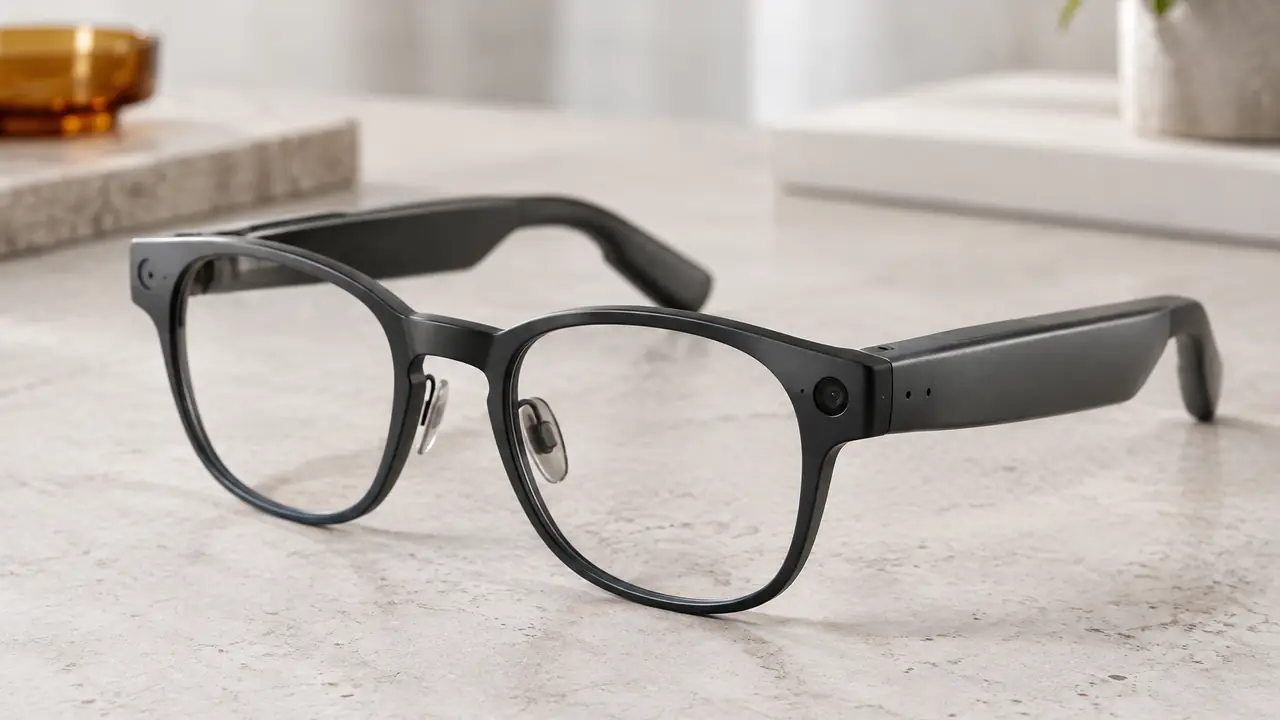
Where the camera sits and why it matters
A camera module in glasses has to fit in a space a few millimetres across, usually at the end piece near the hinge or in the bridge at the centre of the front. Position changes everything downstream. A hinge-mounted camera sees slightly off-centre, which affects framing for first-person footage; a bridge camera is centred but takes space that frame designers would otherwise use for strength and nose fit. The module also needs a flex connection back to the board in the temple, through the same hinge that carries the audio and charging circuits. That makes hinge durability a camera question as much as a frame question.
Weight and heat follow from the module too. A camera pair is generally heavier than an audio pair, and continuous video recording warms the temple. Plants manage this with recording time limits and thermal protection per firmware. Buyers should know those limits before writing listing copy about video length. The engineering side is covered on camera module.
The spec sheet, line by line
The table lists the figures that appear on most camera glasses spec sheets, the typical range across the category and what to verify on samples.
| Spec | Typical across the category | What to verify |
|---|---|---|
| Sensor resolution | 5-12 MP actual sensor is common | Native sensor resolution versus interpolated output size |
| Video | 1080p is the norm, 4K on higher-end models | Frame rate, stabilisation, clip length limits per firmware |
| Storage | 16-128 GB built in, or built in plus microSD | Usable capacity after system files, file format |
| Transfer | Wi-Fi for media transfer plus Bluetooth for control | Transfer time for a clip, pairing steps in the app |
| Recording indicator | Indicator LED near the lens, required on every model | Visibility in daylight, distinct patterns for photo and video |
| Water resistance | IPX4-IP54 per test on many models | Rating on the test report, tested per IEC 60529 |
Sensor resolution: native versus interpolated
Resolution is the most misused figure in this line. Small sensors of 5 to 12 megapixels are common across the category, and some lower-cost models advertise much higher numbers that come from interpolation - the image is enlarged in software after capture. Interpolation adds pixels but not detail. To verify, ask the plant for the sensor part's native resolution on its datasheet, then take test shots of a printed resolution chart or fine text at a fixed distance and compare. If the advertised resolution is interpolated, either remove it from the listing or label it clearly as output size. Professional buyers and marketplace reviewers increasingly check this point.
Beyond pixel count, lens quality and processing make the difference. Look at sharpness at the edges of the frame, colour in mixed indoor light, and behaviour when moving from a bright street into a dark shop. The image signal processor tuning is per firmware and can improve after updates, so test on the firmware version that will ship.
Video: resolution, stability and limits
Most camera glasses record 1080p video, with 4K on some higher-end models. For first-person content, stabilisation matters as much as resolution, because head movement is constant. Ask how stabilisation is done - electronic, in processing - and test while walking and turning the head. Check the clip length limit and what happens when the temple warms up: some models stop recording after a set time or reduce resolution. Audio recorded with video comes from the same microphones used for calls; wind noise outdoors is the usual weak point. Creators and content buyers should run all of this on the scenarios on content creation use.
Storage and transfer
Built-in storage of 16 to 128 GB is typical, sometimes with a microSD slot. Usable space is always somewhat lower than the headline figure because of system files. More important for user experience is transfer: most models use Wi-Fi to move media to the phone app, with Bluetooth handling control and pairing. Time a transfer of a one-minute clip on the sample, note how many steps the app requires and whether transfers resume after interruption. Long or fiddly transfers are a common review complaint. Also note the file formats produced, since some editing workflows need conversion.
Storage and transfer also affect runtime. Recording video and moving files over Wi-Fi are among the heaviest loads a temple battery carries, so camera models usually show shorter runtimes than audio models built on similar cells. Ask the plant for runtime figures measured in a realistic mix - a number of short clips, photos and transfers per hour, plus music or calls - rather than standby or audio-only figures. The background is in the battery runtime guide.
A sample checklist for camera programs
- Resolution chart shots at a fixed distance, compared with the sensor datasheet.
- Walking video outdoors and indoors, checking stabilisation, wind noise and colour.
- Long recording until the clip limit or thermal stop, noting temperature and behaviour.
- Transfer test of a one-minute clip, timed, with one deliberate interruption.
- Indicator test in bright sun and in a dim room, with photo and video patterns compared.
Run the checklist on the firmware that will ship, and repeat it after any update before mass production.
Indicator, privacy and compliance
Every camera pair in a Templora program carries a recording indicator LED. The EDPB statement adopted on 13 October 2026 - guidance, not law - expects manufacturers rather than wearers to carry the duty of making recording visible, with indicators visible in varied lighting, different signals for photo and video, and no recording when the indicator is covered. The design detail is in camera glasses privacy. On the compliance side, camera glasses need the same radio, battery and, in the EU, EN 18031 cybersecurity documentation as other connected glasses; a common customs reference is HS 8525.89, to be confirmed with your broker.
Camera programs typically start at 50 to 500 pairs per catalog model and 500 to 1,000 pairs for logo programs, with full custom builds from 3,000 pairs, confirmed in writing per program on MOQ and lead time. Send the target specs and markets through the quote form to start a sample comparison.