
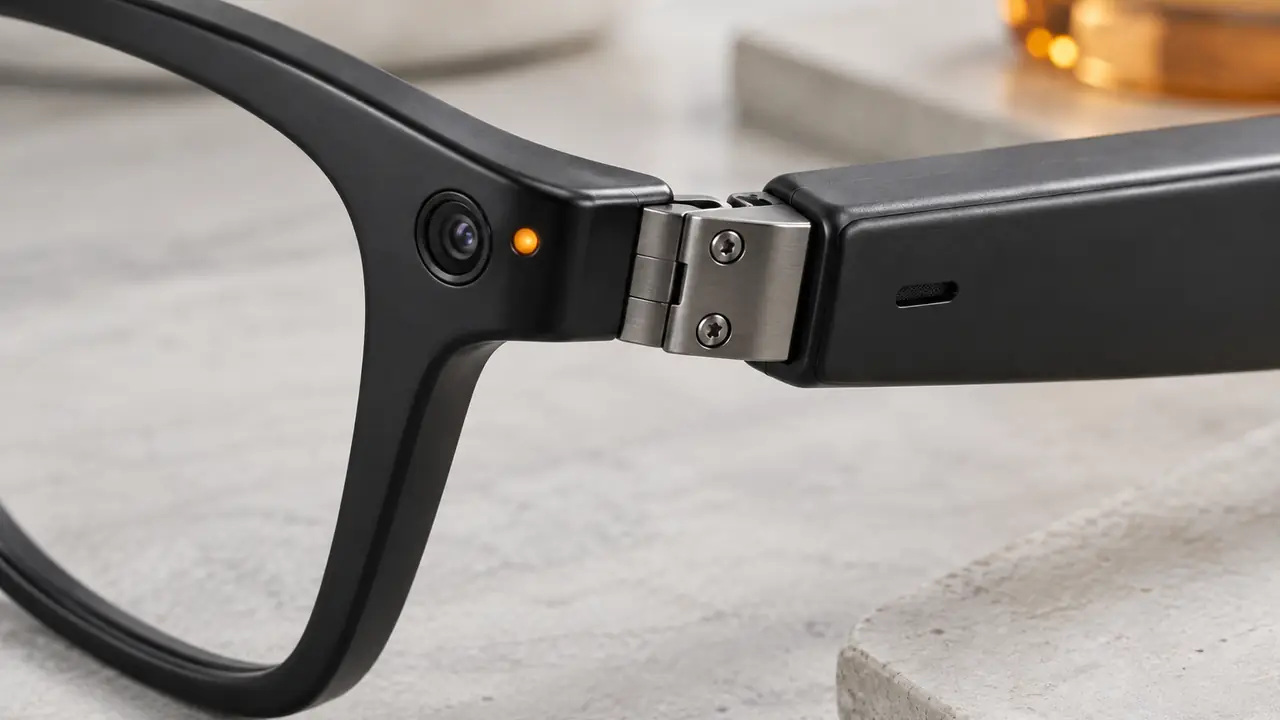
What sits in the front of a camera pair
The camera module in smart glasses is a compact sensor board with a fixed-focus lens, usually placed in the corner of the front next to a hinge, with an indicator LED close by. Behind it sits more electronics than in an audio pair: an image processor or a more capable SoC, storage, a Wi-Fi radio for moving files to the phone and a larger power budget. That is why camera models are heavier and shorter on runtime than audio models built on the same frame. The module also changes the front design: the lens window needs a clear, scratch-resistant cover, the front must stay rigid enough to keep the camera aligned, and the LED needs a light path visible from the front in daylight.
Sensor, field of view and video
Across the category, actual sensors of 5 to 12 MP are common. Some lower-priced models state higher resolutions that come from interpolation in the image processor rather than from the sensor, so the spec sheet should name the native sensor resolution. Video is mainly 1080p, with 4K on higher-end models; frame rate, stabilisation and bit rate are set per firmware and affect heat and battery drain. Field of view is fixed by the lens and stated per lens spec: a wider angle captures more of what the wearer sees but adds distortion at the edges, and the camera's mounting angle should match the natural head tilt so footage is not pointed at the ground. Low-light performance depends on pixel size and the lens aperture more than on the megapixel count.
| Item | Typical across the category | What to write in the spec sheet |
|---|---|---|
| Sensor | 5-12 MP actual | Native resolution, not interpolated output |
| Video | 1080p; 4K on higher-end models | Resolution, frame rate and maximum clip length per firmware |
| Field of view | Per lens spec | Stated angle and mounting tilt |
| Storage | 16-128 GB on board, or plus microSD | Usable capacity after system files |
| Transfer | Wi-Fi for media, Bluetooth for control | Transfer method and app flow |
| Indicator | Recording indicator LED | Colour, light pattern per mode, behaviour when covered |
A fuller spec walk-through is in camera glasses specs guide.
Storage and transfer
Photos and clips are written to on-board storage, typically 16 to 128 GB, or to a microSD slot on some models. Bluetooth is too slow for video, so files move to the phone over a direct Wi-Fi link opened by the companion app. That flow is where many complaints arise: slow transfers, failed imports and files stuck on the glasses. The app's media permissions and where files are processed fall under the data permission questions on firmware and app, and the EU cybersecurity requirements of EN 18031 apply to the radio and the data path.
Recording indicator design
Every camera pair sourced through the desk carries a recording indicator LED that shows people nearby when the camera is active. In October 2026 the European Data Protection Board adopted a statement on smart glasses. It is guidance, not new legislation, but it sets clear expectations for manufacturers rather than leaving the duty to inform only to the wearer:
- the indicator should be visible in a range of lighting conditions, including bright daylight;
- video recording and photo capture should use different light signals so bystanders can tell them apart;
- if the indicator is covered, the device should not be able to record;
- a white LED can be mistaken for a reflection, which the statement notes as a weakness.
In engineering terms this means choosing LED colour and brightness for daylight visibility, defining blink patterns per mode in firmware, and adding a sensor or optical check that blocks capture when the LED's light path is obstructed. These behaviours should be written into the spec sheet and tested at DVT. The design reasoning is in camera glasses privacy: recording indicators done right.
Tests, documents and timing
Camera models add items to the usual test plan: image and video quality against the golden sample, indicator visibility and blocked-indicator behaviour, heat during long recording, Wi-Fi radio testing alongside Bluetooth under FCC Part 15 and CE RED, and the EN 18031 assessment. Limits and durations are a stated working default, confirmed per order. A camera program with a new front or module position is full OEM or ODM work, typically from 3,000 pairs per model with engineering samples in 30-60 days; the reference table is on MOQ and lead time. For the content-creation use case see content creation, and send a brief through the quote form.