
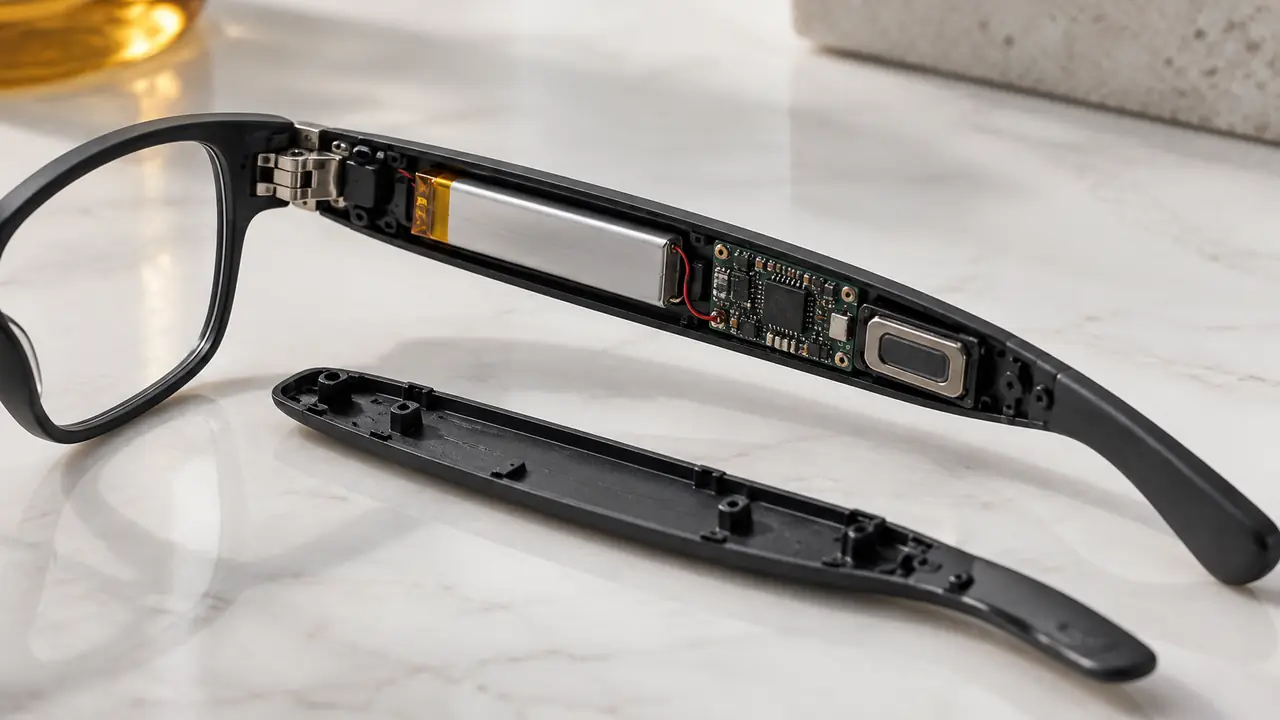
The problem: a heavier pair of glasses
Across the category, finished smart glasses weigh about 27 to 50 grams per pair, depending on battery size, frame material and whether a camera or display is fitted. Kids models are usually under 30 grams per model, and bone conduction designs tend to sit at the heavier end because the transducer needs contact pressure. That extra weight is the price of putting a battery, a board and speakers into a frame. The complaints it causes are predictable: the pair slides down the nose, presses behind the ears, leaves marks on the nose bridge or feels tiring after a few hours.
The good news is that most of these complaints are not about the total weight. Two pairs with the same weight can feel very different, because comfort depends on where the weight sits and how the frame spreads it across the nose and ears. Fixing comfort is therefore a design and specification task, not only a matter of picking the lightest model.
Comfort also shapes the commercial result. For DTC brands and marketplace sellers, fit and comfort problems sit next to connection issues among the main reasons for returns and poor reviews, and they are harder to fix after launch because they live in the frame rather than in the firmware. A catalog model cannot be re-weighted by an app update. That is why the desk asks about wearing time and use case - an hour of cycling, a full office day, a school day for a child - before shortlisting models, and why comfort is checked on samples with real wearers rather than judged from a product photo or a listed weight.
Where the grams go
| Part | Effect on weight | Effect on balance | Lever for the buyer |
|---|---|---|---|
| Battery cells | Largest single electronic item; total about 85-235 mAh | Sits in the temple, usually behind the ear if placed well | Choose the runtime you actually need |
| Board and speaker | Moderate | Sits near the ear; fixed by acoustic position | Usually fixed in catalog models |
| Camera module | Adds weight at the hinge corner | Pulls the pair forward onto the nose | Only add if the use case needs it |
| Frame material | TR90 and similar nylons are light; acetate and metal heavier | Heavy fronts tip the pair forward | Front material and thickness |
| Lenses | Glass and thick Rx lenses add weight at the front | Shifts weight to the nose | PC or lighter lens materials, per lens lab |
| Hinge hardware | Small | Spring hinges spread grip | Spring versus fixed hinge |
The pattern is simple. Weight at the front - lenses, a camera, a thick front - loads the nose. Weight behind the ear acts as a counterweight and can make a heavier pair feel lighter. A well-balanced design places the battery at the rear of the temple, keeps the front thin and uses lighter lens materials where the optical requirement allows.
Fixes by symptom
The pair slides down the nose
Usually caused by front-heavy balance, a bridge too wide for the wearer or smooth nose pads. Fixes include adjustable or silicone nose pads, a narrower bridge option within the typical 16-20 mm range, rubberized temple tips and moving cells further back in a custom build. For sports use, wrap frames with grip parts are covered on sports smart glasses.
Pressure behind the ears or on the temples
Usually caused by a temple too short for the head, a fixed hinge with a tight grip, or bone conduction transducers set with high contact force. Typical temple lengths run from 140 to 150 mm; offering two lengths or a spring hinge spreads the grip. On bone conduction models, contact pressure trades directly against bass and volume, so it is tuned rather than simply reduced.
Marks on the nose and fatigue after a few hours
Often a combination of total weight and small, hard nose pads. Larger pads in softer material spread the load. If a product is meant for all-day office or commuting use, set a comfort target on the spec sheet, such as a maximum front weight, and test it with a wear panel during the sample stage.
The pair feels loose during movement
A lighter frame can feel unstable when cycling or running. Temple grip sleeves, a slightly curved temple tip and a strap option help; ear hook shapes change the fit, so confirm them on samples with your target users.
Material choices and their trade-offs
Frame material affects both weight and feel. TR90 and similar nylons are light and flexible and are common on sports and kids frames. Acetate looks premium and takes colour well but is heavier and less flexible. Metal and titanium fronts can be thin and strong, but metal parts near the antenna may need radio retuning, so a material change is often treated as a custom program. The frame clusters in Shenzhen's Henggang and Wenzhou's Ouhai work in all of these materials, and the desk aligns the frame choice with the temple electronics from Shenzhen. More detail is on frame materials and in TR90 vs titanium smart frames.
What to test on samples
- Weigh the complete pair with the lenses you will ship, not the bare frame, and record front and temple weight separately if possible.
- Run a wear panel of several head sizes for a full working day, noting slipping, pressure points and marks.
- Check fit with the size range - lens width 48-56 mm, bridge 16-20 mm and temple 140-150 mm are typical; see smart glasses sizing.
- Repeat after hinge cycling, because a loosened hinge changes grip and balance.
- Confirm accessories such as spare nose pads and temple sleeves in the packaging list.
Comfort changes that stay within catalog parts - nose pads, temple sleeves, lens material - are usually possible on logo programs, which typically start at 500-1,000 pairs per model. Moving the battery or reshaping the temple needs a full custom build from 3,000 pairs per model, with engineering samples in 30-60 days. These are reference ranges confirmed in writing per program on MOQ and lead time. To brief a comfort target for a new range, use the quote form.