
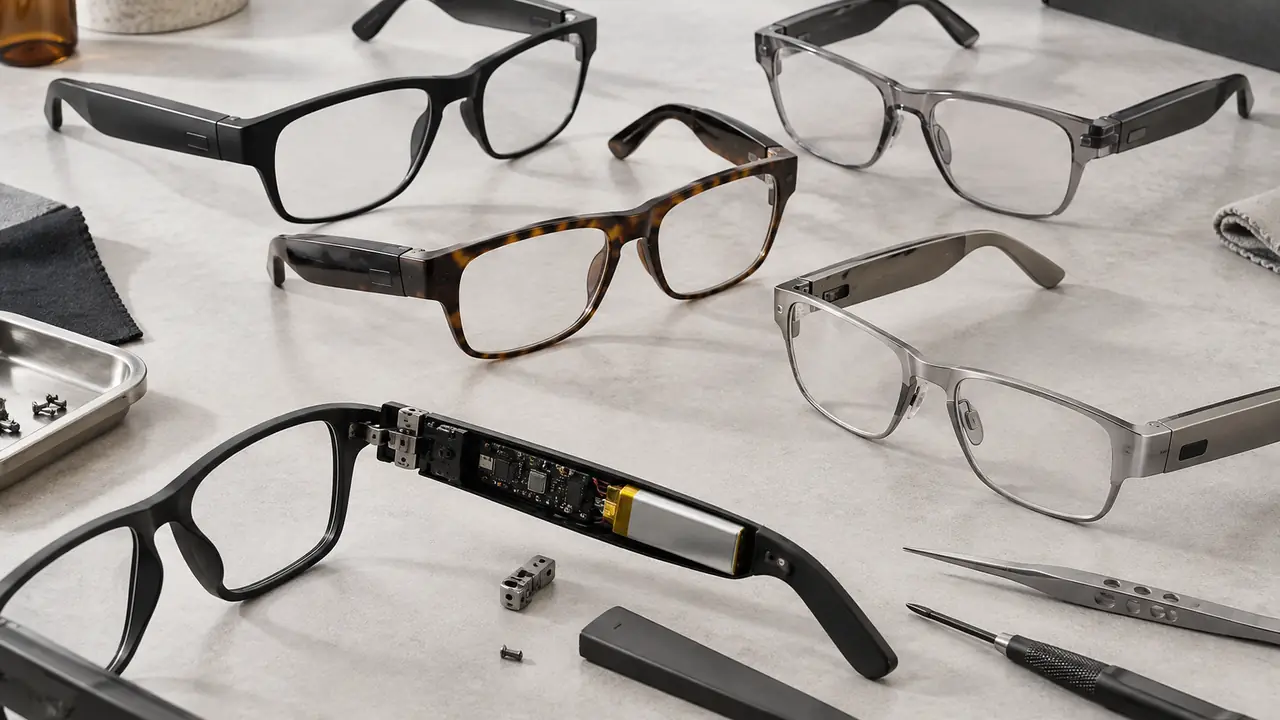
Why fit is harder on smart glasses
Ordinary frames are adjusted by an optician who warms the temples, bends the tips and tweaks the nose pads. Smart glasses resist that. The temples hold cells, boards and flex circuits, so they are thicker, stiffer and often cannot be heated or bent without risk to the electronics. The weight is higher - across the category, finished pairs weigh about 27 to 50 grams, against roughly 20 to 30 grams for many ordinary frames - and much of it sits in the temples behind the hinge. And on open-ear models, the speaker port has to sit near the ear, so the temple length is not only a comfort question but an acoustic one.
The result is a narrower window of heads that a single size fits well. Outside that window, customers report one of two problems. Too tight: pressure at the temples or behind the ears, headaches after an hour, red marks on the nose. Too loose: the frame slides down the nose, the glasses move when the wearer looks down or runs, the speaker ports drift away from the ears and sound becomes quieter.
Root causes
| Layer | Typical root cause | Complaint |
|---|---|---|
| Design | One frame size for a wide market; temple length fixed by electronics layout; heavy temples that tip the frame forward | Loose on narrow heads, tight on wide heads, sliding |
| Design | Bridge and nose pad geometry suited to one face shape only; no adjustable pads | Sits low or high, marks on the nose |
| Materials | Temple too stiff to flex; no spring hinge; hard temple tips without grip | Pressure, slipping during activity |
| Assembly | Temples set at uneven angles; hinge tension varies across a lot | Crooked fit, one side tighter |
| Use and sales | Size not shown on the listing; customer used to a different frame width; Rx lenses fitted without checking frame size | Mismatch between expectation and product |
Category frame sizes are a useful anchor. Rx-ready smart frames commonly use lens widths of 48 to 56 mm, bridge widths of 16 to 20 mm and temple lengths of 140 to 150 mm. A range built around a single 52-18-145 front will fit many adults but not all, and a kids line needs its own sizing, with pairs usually under 30 grams per model. Weight and balance are discussed in smart glasses weight and comfort.
Field triage for fit complaints
- Ask where it hurts or slips. Temples, behind the ears, bridge or nose pads each point to a different dimension.
- Compare with the customer's own glasses. The three numbers printed inside most frames - lens width, bridge, temple length - give a quick comparison with the smart frame.
- Check symmetry. Put the glasses on a flat table, legs open, and see whether both temple tips touch. An uneven pair is an assembly or hinge issue.
- Check the accessories. Offer the supplied alternative nose pads or temple sleeves if the model has them.
- Check the speaker position. On open-ear models, see where the port sits relative to the ear; a port behind the ear means the temple is too long or the frame sits too far forward.
- Exchange before refund. Where a second size or fit kit exists, an exchange keeps the sale.
Fit complaints are rarely defects, but when the same complaint dominates returns, it is a range-planning problem. Log the head-size feedback, the market and the frame size so the next order can correct it.
Market matters more than many brands expect. A front sized for one region can feel narrow in another, and nose bridge height varies across customer groups, so a frame that sits well in one market may rest on the cheeks in the next. Return reasons broken down by country or sales channel often show this clearly within the first weeks. That data is the strongest argument for a low-bridge pad option or a second front size, and it gives the plant a concrete target rather than a general request to 'fit better'.
Sizing remedies to specify
- Two front sizes where volume allows. A narrower and a wider front, sharing the same temple electronics, cover more heads. The tooling implications are in smart glasses tooling and molds.
- Adjustable or interchangeable nose pads. Include a second pad height, or adjustable metal pad arms, especially for markets with lower nose bridges.
- Temple tips and sleeves. Silicone sleeves or grip tips reduce slipping without changing tooling; see smart glasses accessories.
- Spring hinges. Where the design allows, they ease pressure on wide heads.
- Weight balance target. Ask the plant to state the weight per side and whether cells sit forward or behind the ear, measured on the engineering sample.
- Temple angle and hinge tension tolerance. Agree tolerances so units in a lot fit alike.
- Listing data. Publish the three frame dimensions and the weight, and a short guide to measuring an existing frame.
Inspection items
Typical fit-related checks during inspection, confirmed per order:
- Frame dimensions on sampled units: lens width, bridge, temple length, against the spec sheet and the golden sample.
- Weight of the finished pair against the agreed tolerance.
- Flat-table symmetry check and temple angle check.
- Hinge tension check: the temple holds position at mid-swing as the golden sample does.
- Accessory count: alternative nose pads, sleeves and fit guide in each pack.
- Wear check on a fit head form for slip and port position, where the program includes it.
Fit checks are quick and cheap, and they catch the assembly variation that turns a well-designed frame into a crooked one. They should sit next to the electrical checks in every lot, not be left to the end customer.
Planning a size range
For a first order, a single well-chosen size with fit accessories is often the right balance between MOQ and coverage. As volume grows, a second front size is usually the most effective remedy for fit returns. The trade-off is cost and inventory: two sizes double the stock lines and may need new tooling. Catalog models come with the sizes the plant already offers; a new front size belongs to a custom program with the typical ranges on MOQ and lead time. Through the quote form, tell the desk which markets and age groups you sell to, so frame sizes can be shortlisted against them.