
A working definition
For a buyer, the useful definition of smart glasses is practical rather than technical: a pair of glasses that a person can wear all day, that looks close enough to ordinary eyewear to be worn in public, and that adds at least one electronic function. In almost every product on the market today that function is audio - small directional speakers in the temples and microphones for calls - and many products add a voice assistant, translation, a camera or a small display on top. The frame still has to do everything a frame does: fit the face, hold lenses to an optical standard and survive being folded thousands of times.
That double identity explains most of the engineering trade-offs and most of the returns. An audio product that is uncomfortable is returned as an eyewear failure; a frame with a weak hinge fails as an electronics product, because the hinge carries the cable between the two temples. Programs that succeed treat both halves seriously from the first brief, and write the frame, the lens and the electronics onto one specification instead of three separate ones.
The five types buyers stock
Retail and wholesale ranges usually sort into five types. The boundaries are blurring as chipsets get more capable, but the split still decides price band, certification scope and the questions customers ask.
| Type | What it adds to a frame | Typical buyer question |
|---|---|---|
| Audio glasses | Open-ear speakers, microphones, touch or voice controls | How loud, how long, how much sound leaks |
| AI and translation glasses | Microphone arrays, an app or cloud assistant, translation per engine | Which languages, what latency, what data leaves the device |
| Camera glasses | A small camera, storage, a recording indicator light | Image quality, storage, privacy rules in each market |
| Display and AR glasses | A projector and optics that put text or images in view | Weight, battery, readability outdoors |
| Specialty frames | Rx-ready fronts, sports wraps, kids sizes, accessories | Fit range, lens workflow, safety for children |
Industry trackers describe the same shape. Omdia counted about 8.7 million AI glasses shipped worldwide in 2025, with models that include a display still a small share of the total, and Counterpoint reported that AI smart glasses made up 88 percent of smart glasses shipments in the second half of 2025. In practice, most of the volume is still audio-first. The full split by line is on the types guide.
What sits inside the temple
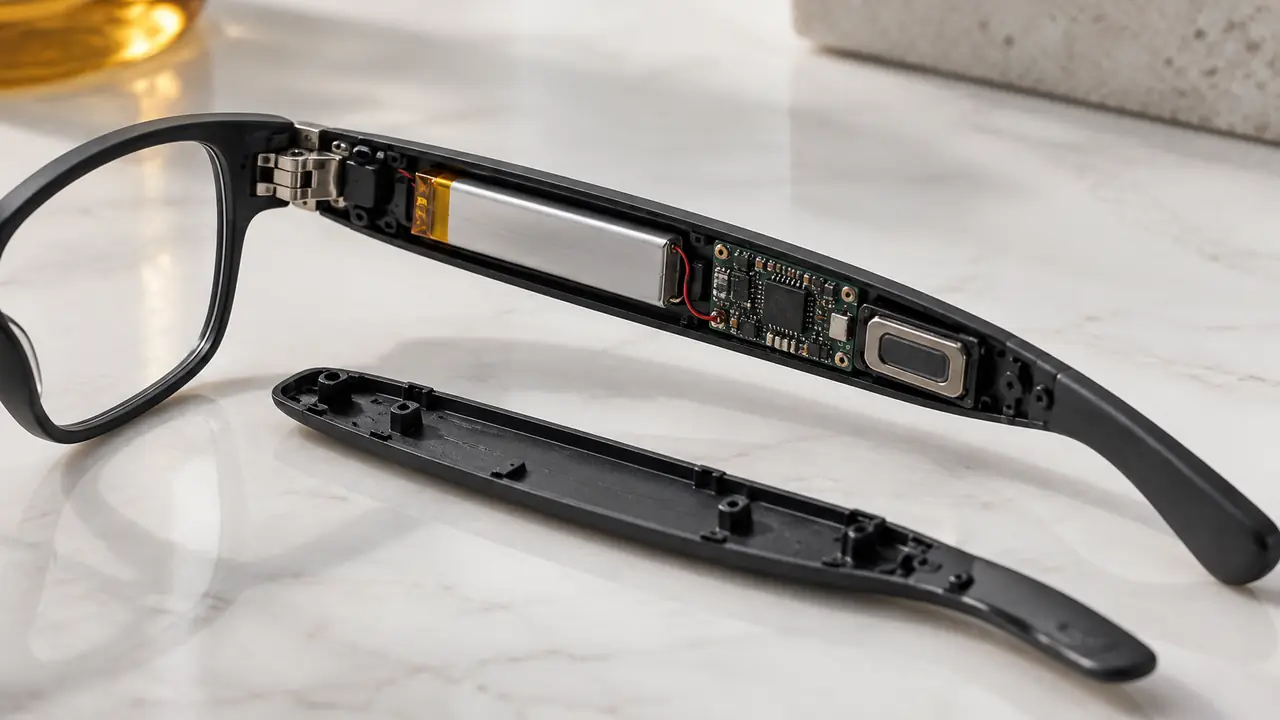
Open a temple and you find a compact stack that every program has to specify. The order below is the order a partner plant assembles it, and the order used on every Templora spec sheet.
- Front and lenses. The frame front and the lenses, which carry the optical standard: ISO 12312-1 for sunglasses in Europe, ANSI Z80.3 in North America.
- Hinge and flex. A metal hinge with a thin flexible circuit running through it, linking the two temples.
- Board and chipset. The Bluetooth audio system-on-chip, often version 5.2 to 5.4, plus an AI or camera processor on richer models.
- Battery and charging. Small lithium-ion cells, commonly 85 to 235 mAh in total across both temples, with magnetic pogo contacts.
- Audio or imaging module. A directional speaker or bone conduction transducer near the ear, or a camera module at the hinge.
- Mics, controls and app. One to four microphones per side, a touch strip, and the companion app that carries settings and firmware updates.
A walk through each part, with what tends to fail, is in inside a smart glasses temple.
Typical specifications and what they mean
Specification sheets across the category cluster in predictable ranges. Finished pairs weigh about 27 to 50 grams; music playback runs from 4 to 13 hours; most models are rated IPX4 to IP54 for splashes and sweat. Camera models usually use 5 to 12 megapixel sensors with 1080p video as the norm. Translation models depend on the app and translation engine: mainstream products support from six to sixty or more languages, and cloud processing usually adds between half a second and three seconds of delay depending on network and language pair.
Two habits help when reading these sheets. First, check under which conditions a runtime figure was measured, because volume and AI features change it sharply. Second, treat any water rating as a test result for the unit as built, not a promise for its whole life; the note on IP ratings for smart glasses explains why.
Use cases that drive the specification
The use case decides more of the specification than the type does. Cyclists and runners need wind-resistant microphones, sweat-resistant contacts and wrap frames; office users care about multipoint pairing and call clarity; travellers buying translation glasses care about microphone pickup in noisy places and what happens without a network; content creators buying camera glasses need storage, transfer speed and a clear recording indicator. Enterprise buyers - event organisers, tour operators, field teams - care about fleet charging, firmware control and repairability. The use case pages map each scenario to the modules and test items that matter.
How a sourcing program is built
Smart glasses sit across three supply chains in China: temple electronics from the Shenzhen electronics base, frames from eyewear clusters such as Shenzhen's Henggang and Wenzhou's Ouhai, and lenses from Danyang and Xiamen. A program aligns all three. Templora, as a sourcing desk, shortlists partner plants by line, gets catalog or logo samples, fixes the six modules and the test plan on a spec sheet, follows batch production and inspects each lot before it ships. Typical starting quantities are 50 to 500 pairs per catalog model, 500 to 1,000 pairs for a logo program and from 3,000 pairs for a full custom build - reference ranges confirmed in writing for each program on MOQ and lead time. When you are ready, the quote form asks exactly what a plant will need to know.