
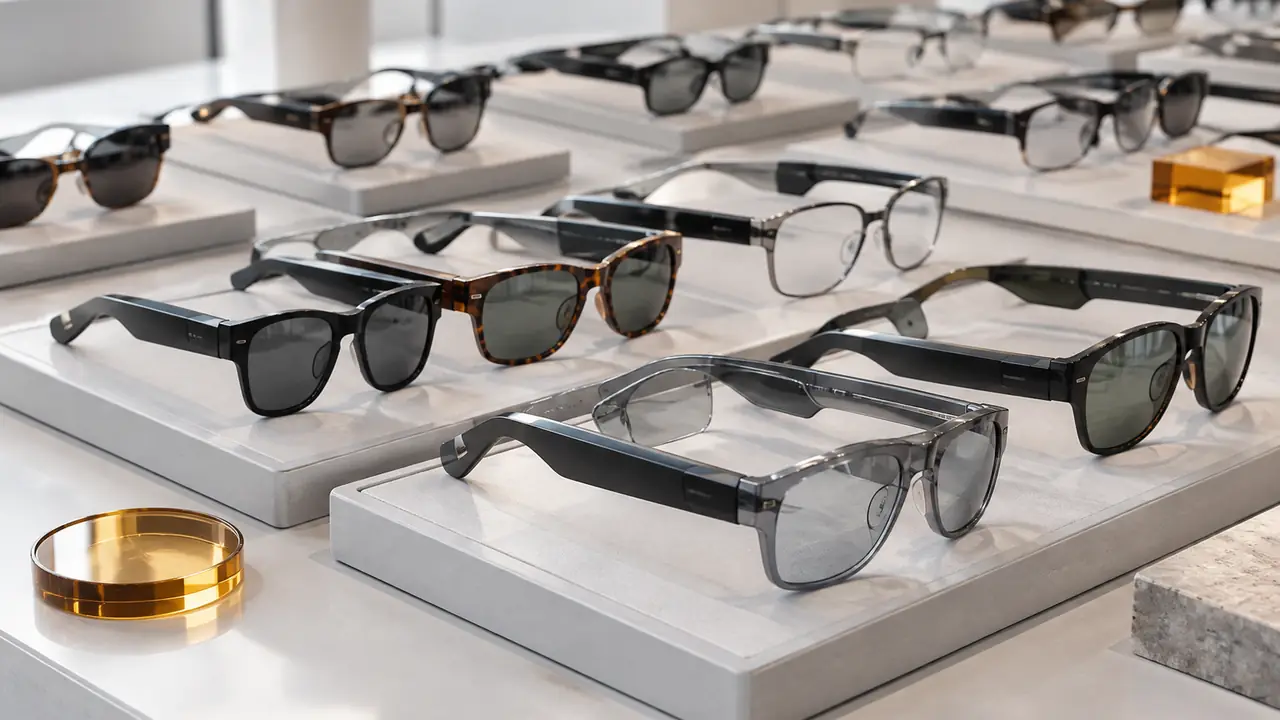
The wholesaler's problems in this category
Wholesalers sell to many small resellers who each want a little of everything. In smart glasses that creates three tensions. Depth across price tiers: resellers want an entry model, a mid model and a better model, but each tier is a different board, battery and frame, and the differences have to be real rather than a new box. Mixed cartons: a reseller ordering a few dozen pairs wants several models and colours in one shipment, while plants prefer full cartons of one SKU. Restocking: catalog models change quietly; a second batch with a different chipset, a new firmware or a slightly different label can break a reseller's listing or confuse their customers.
Recommended lines and why
- Bluetooth audio glasses: the volume line, available across tiers from simple single-speaker models to multipoint models with larger cells. Across the category, music playback runs 4-13 h per spec sheet.
- Business call glasses: a clear step-up for office buyers, with multi-mic arrays and noise reduction per firmware and multipoint connection.
- Accessories: replacement lenses, magnetic charging cables, cases and nose pads, which add margin per carton and help resellers keep customers.
Tier depth without guesswork
The desk builds tiers from what actually differs inside the temple, so a reseller can explain the step. The table shows typical differences across the category; exact values are per spec sheet for each model.
| Tier | Typical hardware | What the reseller can point to |
|---|---|---|
| Entry | BT 5.2-5.3 audio SoC, smaller cells, single mic per side | Music and calls, lighter weight |
| Mid | BT 5.3, larger cells, ported speaker chamber | Longer playback, less sound leakage per acoustic test |
| Upper | BT 5.3-5.4, multipoint, multi-mic noise reduction per firmware | Two devices at once, clearer calls |
| Add-on | Polarized or photochromic lens, Rx-ready front | Outdoor use, glasses wearers |
Cost drivers for each tier are described in the cost factors article; quotes are issued per program. Keeping two tiers on the same charging cable and case simplifies accessory stock for resellers, and keeping the same front across a clear and a sun version doubles the offer without a second board or a second radio file.
Mixed cartons, restocking and quantities
Catalog models typically start at 50-500 pairs per model and accessories at 500-1,000 pieces per item, with batch production of 20-35 days. Mixed loads are built at the consolidation stage: each model is packed in full inner cartons at its plant, and the desk combines them into mixed master cartons or a mixed pallet before export. For repeat orders the desk locks the spec sheet, firmware version and label artwork against the golden sample, and flags any change the plant proposes, such as a chipset revision, before it ships. Ranges are confirmed in writing per program; the current table is on MOQ and lead time.
Documents on every load
Wholesale loads cross borders often and in small lots, so the paperwork needs to be complete and repeatable:
- Commercial invoice and packing list per model, with HS reference: audio glasses are commonly classified under 8518.30 or 8517.62, sunglasses without electronics under 9004.10 and lenses under 9001.40 or 9001.50. Classification is confirmed with your customs broker.
- FCC Part 15 grant and FCC ID per model; CE under RED with EN 18031 for EU resellers.
- UN 38.3 summary and safety data sheet per model, and UN3481 under PI 967 Section II for air shipments; charging cases with their own cells are assessed per Wh.
- Lens reports to ISO 12312-1 or ANSI Z80.3 and the 21 CFR 801.410 drop-ball test.
Shipping options are on logistics and shipping, and HS questions in HS codes for smart glasses.
Inspection and illustrative case
Pre-shipment inspection for wholesale loads samples every model in the load, not only the largest SKU: pairing and reconnection per firmware, a runtime spot check, hinge function, label and FCC ID match, and carton marks. This is an illustrative, anonymous example: an electronics wholesaler restocked a popular catalog audio frame and found the plant had moved to a new chipset revision. Because the desk had locked the spec sheet, the change was flagged before loading, the plant confirmed the FCC grant still covered the model, and the wholesaler updated its reseller notes before the stock arrived. To set up a mixed program, use the quote form.