
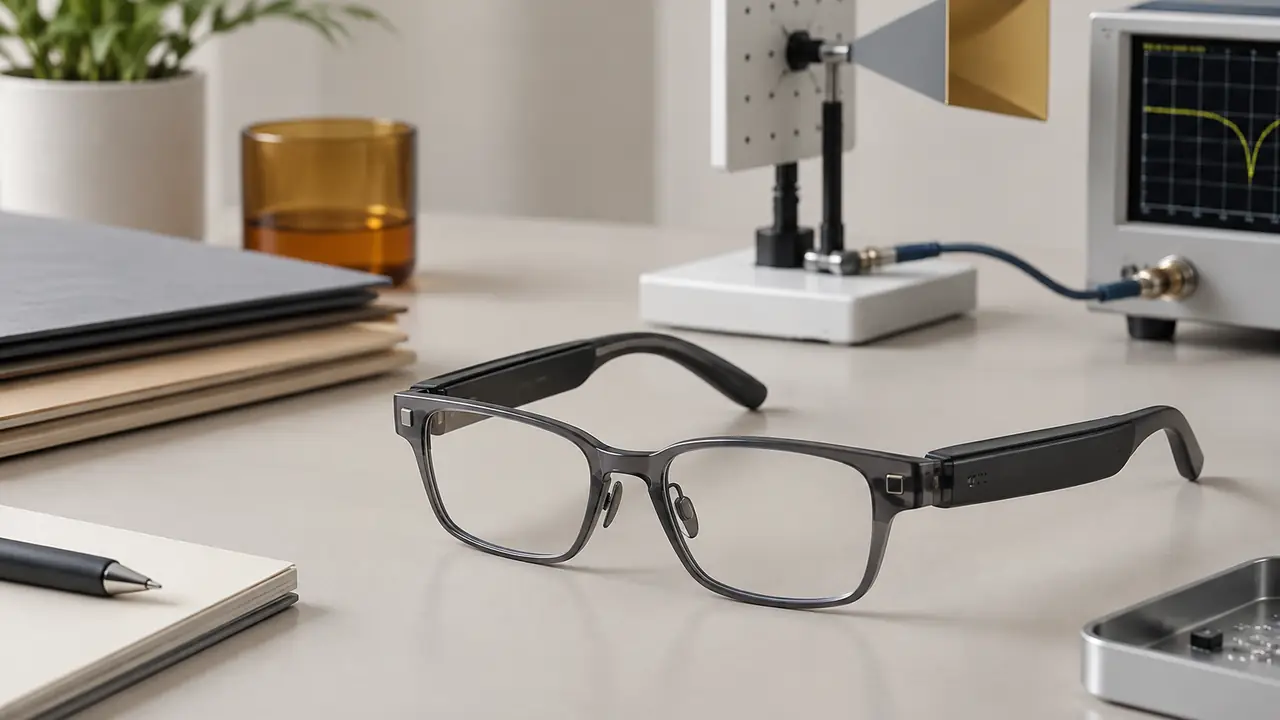
Why RED, and not only the EMC and low voltage rules
The Radio Equipment Directive, RED 2014/53/EU, covers products that intentionally send or receive radio waves. Because a pair of audio, AI or camera glasses contains a Bluetooth transmitter, it is radio equipment, and RED becomes the main directive for CE marking. RED itself pulls in the protection goals of electrical safety and electromagnetic compatibility, so a separate declaration under the general EMC and low voltage directives is not the usual route for this product type. What sits outside RED - chemicals, waste, batteries and general product safety - is handled under its own rules and is covered later in this note.
The directive is written as essential requirements rather than test methods. Manufacturers show conformity by applying harmonised standards, which give a presumption of conformity for the requirements they cover. Where a harmonised standard is not applied in full, or does not exist for a requirement, a notified body is usually involved. For a standard Bluetooth audio product built on established standards, the self-declaration route is common, but the choice is made per product with the lab.
The essential requirements and their standards
For a typical pair of Bluetooth glasses, the requirements map to a familiar set of standards. The table shows the usual mapping; the lab confirms the exact editions and parts that apply to the design.
| RED requirement | What it protects | Standards commonly used |
|---|---|---|
| Article 3(2) | Efficient use of radio spectrum | EN 300 328 for 2.4 GHz wideband transmission |
| Article 3(1)(b) | Electromagnetic compatibility | EN 301 489-1 with EN 301 489-17 for wideband data equipment |
| Article 3(1)(a) safety | Electrical and fire safety | EN 62368-1 |
| Article 3(1)(a) health | RF exposure of the user | EN 50566 or EN 62479, depending on output power and use position |
| Article 3(3)(d), (e), (f) | Network, personal data and fraud protection | EN 18031-1, -2 and -3, applicable since 1 August 2025 |
The cybersecurity row is new for many brands and is covered in its own note on RED cybersecurity and EN 18031. The other rows are well established and most partner plants with export experience have run them before on the same chipset.
Spectrum and EMC in practice
EN 300 328 looks at how the Bluetooth transmitter uses the 2.4 GHz band. As with FCC testing, the lab needs firmware that can hold the radio on fixed channels and power settings, and samples built on the production board and antenna. EN 301 489-1 and -17 look at whether the product emits too much noise and whether it keeps working under interference such as electrostatic discharge, radiated fields and, for the charging mode, conducted disturbances. Glasses have a specific weak point here: the hinge and the flexible circuit that crosses it, which can act as an antenna for noise and are exposed to touch. Plants with experience in the category usually route and shield the flex with this in mind.
Performance criteria matter in EMC tests. The lab checks whether the product keeps its function during and after a disturbance - for example whether a call drops or the pair resets after an electrostatic discharge on a temple. Brands should agree what counts as acceptable behaviour with the lab, using the criteria in the standard, rather than discovering it in the report.
Safety and RF exposure for a head-worn product
EN 62368-1 is the safety standard for audio, video and information technology equipment. For glasses, its practical focus is the battery and charging circuit, the temperatures of surfaces that touch the skin, and the materials around the cell. Labs usually ask for the cell's safety documentation, often IEC 62133-2, and for details of the protection circuit. Because the cell sits in a temple near the skin, temperature during charging and during long calls deserves attention; the battery side is explained in IEC 62133-2 for wearable batteries.
For RF exposure, EN 62479 is used to show that low-power devices are below the level where a detailed assessment is needed, while EN 50566 covers devices held or worn close to the body where a detailed assessment is required. Which one applies depends on output power and how close the antenna is to the head, and that is the lab's call. As with FCC, moving the antenna or raising output power later can change the answer.
The rules beside RED
A CE marked pair of glasses still has to meet several other EU rules. RoHS 2011/65/EU restricts certain substances in electrical and electronic equipment. REACH requires disclosure where substances of very high concern are present above the threshold in an article, which matters for frame plastics, coatings and nose pads. WEEE brings the crossed-out bin marking and producer registration in each member state where the product is sold. The General Product Safety Regulation, GPSR, adds traceability and responsible person requirements. The EU Battery Regulation 2023/1542 applies to the cells inside; see EU Battery Regulation and smart glasses. If the lenses are sunglass lenses, EN ISO 12312-1 applies to them as well.
Planning a CE file
A workable sequence is the same as for the US: freeze the antenna, board and battery; obtain test-mode firmware; quote the lab scope including EN 18031; prepare label, manual and box artwork; and only then release the golden sample. Lab testing for CE commonly takes 3 to 6 weeks depending on the lab and the scope. On catalog models the partner plant often already holds a test file that can be reviewed; on full custom builds the file is new. The desk checks that each report names the right model and version and that the declaration of conformity covers every standard used. The overview is on compliance and certifications; timing sits alongside the ranges on MOQ and lead time, and the quote form asks for your target markets at the start.